

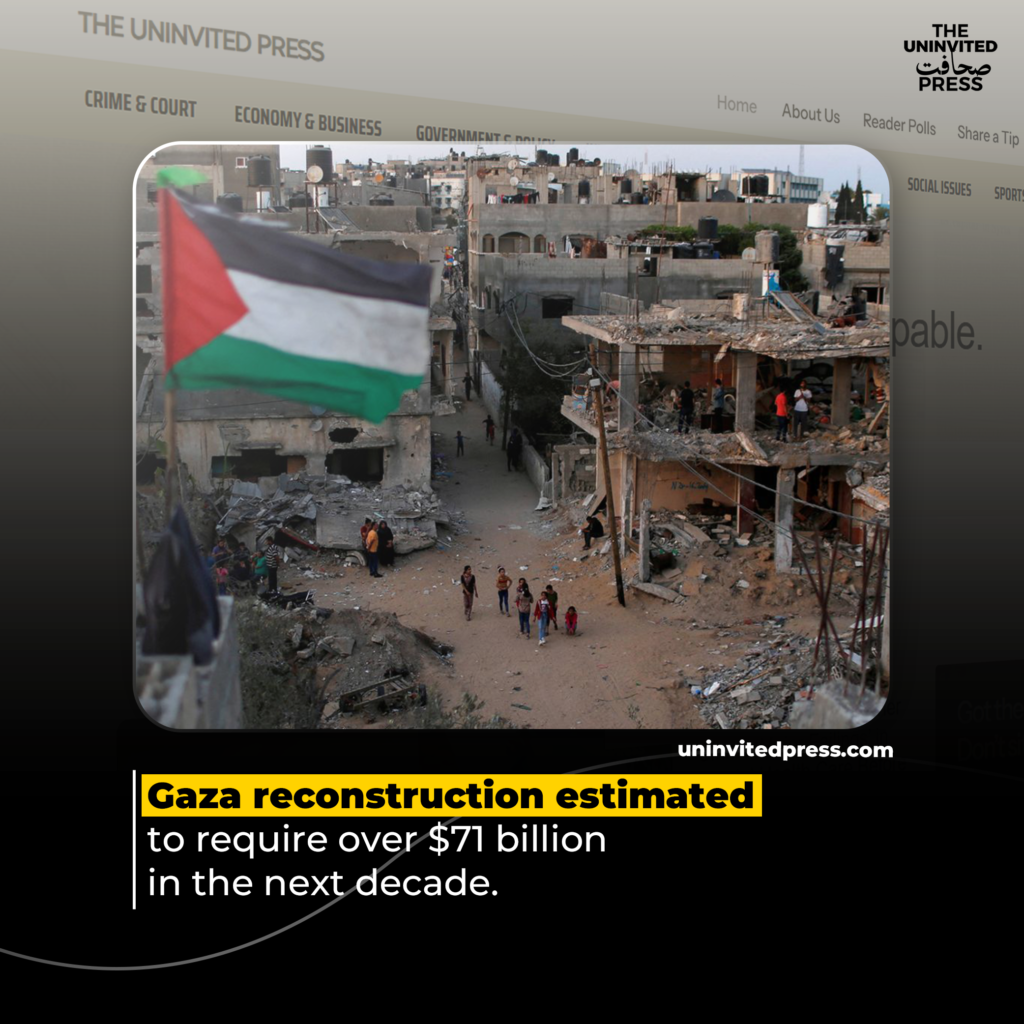
Massive rebuilding effort projected as war-damaged infrastructure and housing crisis deepen humanitarian concerns.
The reconstruction of Gaza is expected to require more than $71 billion over the next decade, highlighting the scale of devastation caused by years of conflict. The estimate underscores the enormous humanitarian and economic challenge facing the territory as international agencies and donors consider long-term recovery planning.
Infrastructure Collapse Deepens Humanitarian Crisis and Slows Recovery:
Gaza’s reconstruction challenge goes far beyond repairing damaged buildings, as the territory faces what experts describe as a near-total breakdown of essential infrastructure. Entire residential neighborhoods have been flattened, leaving thousands of families without permanent shelter and forcing many to rely on temporary or makeshift housing. Public facilities such as hospitals and schools have also been heavily affected, reducing access to basic healthcare and education at a time when demand is extremely high.
Humanitarian agencies emphasize that rebuilding will require restoring the core systems that sustain daily life, including electricity grids, water networks, and sanitation services.
In many areas, power outages and water shortages have become routine, further deepening the humanitarian crisis.
Aid organizations warn that without the rapid restoration of these services, public health risks could increase significantly, particularly due to limited medical capacity and overcrowded living conditions.
At the same time, the displacement crisis remains one of the most pressing challenges, with large portions of the population still unable to return to their homes. The destruction of transport routes and municipal infrastructure has also made access to aid and reconstruction materials difficult, slowing recovery efforts.
Experts say the scale of coordination required-between local authorities, international donors, and humanitarian groups-makes Gaza’s reconstruction one of the most complex post-conflict rebuilding efforts in recent decades.
Challenges in Funding, Governance, and Long-Term Recovery Efforts:
The estimated $71 billion reconstruction bill places a heavy burden on the international community, particularly donor countries and global financial institutions expected to fund large portions of Gaza’s recovery.
Such a vast financial requirement means that aid commitments, development loans, and multilateral support will likely be essential to rebuilding key sectors, including housing, healthcare, education, and public utilities. However, securing and coordinating this level of funding remains a major challenge, especially as donor priorities and geopolitical tensions continue to shift.
At the same time, political uncertainty on the ground is seen as one of the biggest obstacles to effective reconstruction. Analysts note that without a stable and unified governance framework, the planning and distribution of aid could face delays or fragmentation, reducing the efficiency of rebuilding efforts.
Security concerns and restricted access to construction materials and damaged zones further complicate implementation, slowing down projects that are urgently needed for civilian recovery.
Experts also warn that reconstruction on this scale requires long-term coordination rather than short-term emergency aid. Consistent funding streams, transparent oversight mechanisms, and cooperation between local authorities and international agencies are considered essential to prevent gaps in implementation.
Without these conditions, recovery risks becoming uneven, with some areas rebuilt while others remain in ruins, prolonging displacement and deepening the humanitarian crisis across the territory.