

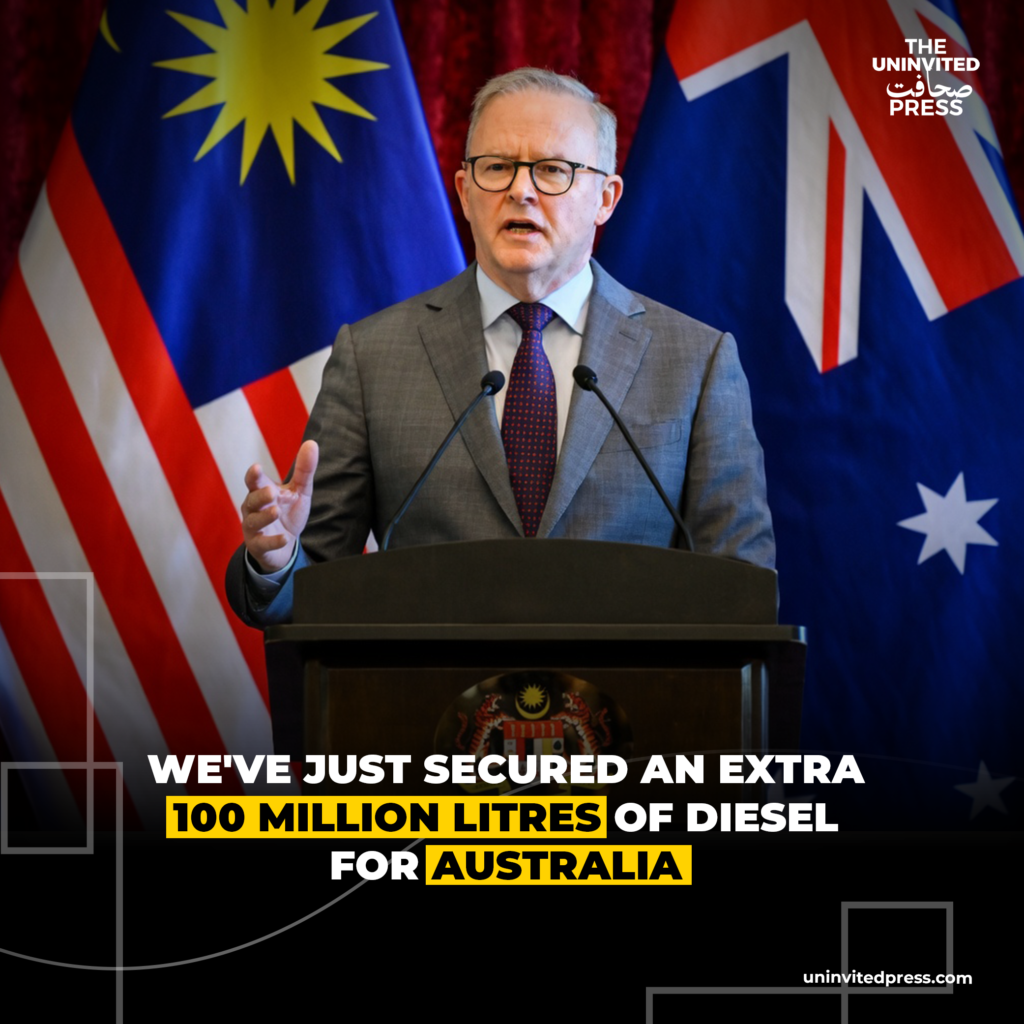
Australian PM announces 100 million litres from Brunei and South Korea as Canberra scrambles to shield economy from Middle East turmoil.
Australian Prime Minister Anthony Albanese has announced the securing of an additional 100 million litres of diesel for his country, describing it as a direct response to supply disruptions caused by the ongoing war in Iran and the near-blockade of the Strait of Hormuz.
Speaking during a visit to Malaysia, Albanese said the two shipments-one from Brunei and another from South Korea-represent the first deliveries activated under new “Strategic Reserve” powers that allow the government to underwrite fuel purchases in a volatile global market.
“This is the first of many expected shipments,” Albanese told reporters, adding that the deals were facilitated through Export Finance Australia in partnership with local fuel companies including Viva Energy. The 100 million litres equate to roughly 570,000 barrels of diesel, expected to arrive in May.
Regional Engagement Enters High Momentum Phase:
The announcement came as Albanese wrapped up talks with Malaysian Prime Minister Anwar Ibrahim in Putrajaya. Malaysia’s state energy giant Petronas has reportedly agreed to prioritise any excess fuel supplies for Australia, reflecting deepening energy ties between the two nations amid the crisis.
Australia, which relies heavily on refined fuel imports from Asia, has been hit hard by the fallout from the Iran conflict. Traditional supply routes through the Strait of Hormuz-a chokepoint for much of the world’s oil-have faced severe disruptions, driving up global prices and threatening shortages of diesel, petrol and aviation fuel.
Albanese’s government has been on a diplomatic offensive across the region, holding talks in Brunei, Malaysia, Singapore and beyond to lock in supplies. Officials have also explored alternative sources, including the United States and Mexico, as Asian refiners face their own constraints.
Skepticism Grows Over Scale of Relief Efforts:
While the government hailed the deal as a win for energy security, analysts and some observers noted that 100 million litres represents only about one day’s national diesel consumption in Australia, which burns through roughly 90-100 million litres daily for transport, agriculture and industry.
Opposition voices and commentators have pointed to longer-term vulnerabilities, including Australia’s limited domestic refining capacity after years of closures. Russian state media reportedly mocked the announcement, suggesting it underscored Australia’s dependence on imports while major oil producers in the Middle East and Russia continue to benefit from elevated prices.
The Albanese administration insists the new powers, combined with existing stockpiles and around 50 tankers reportedly already en route, will prevent major disruptions. Energy Minister Chris Bowen has emphasised that the government is also securing fertiliser and urea supplies to protect farmers during the planting season.
Wider Impact on Asia-Pacific Energy Security:
Australia is shifting its energy strategy as the U.S. focuses on the Iran conflict, strengthening ties with Southeast and East Asian partners like Malaysia to secure fuel supplies. Both countries agreed on a “no surprises” policy to prevent sudden export restrictions.
The move aims to stabilize diesel supply and limit rising fuel costs affecting transport, farming, and logistics. Prime Minister Anthony Albanese has described the approach as pragmatic diplomacy, leveraging Australia’s resource exports to ensure energy security during global uncertainty.