

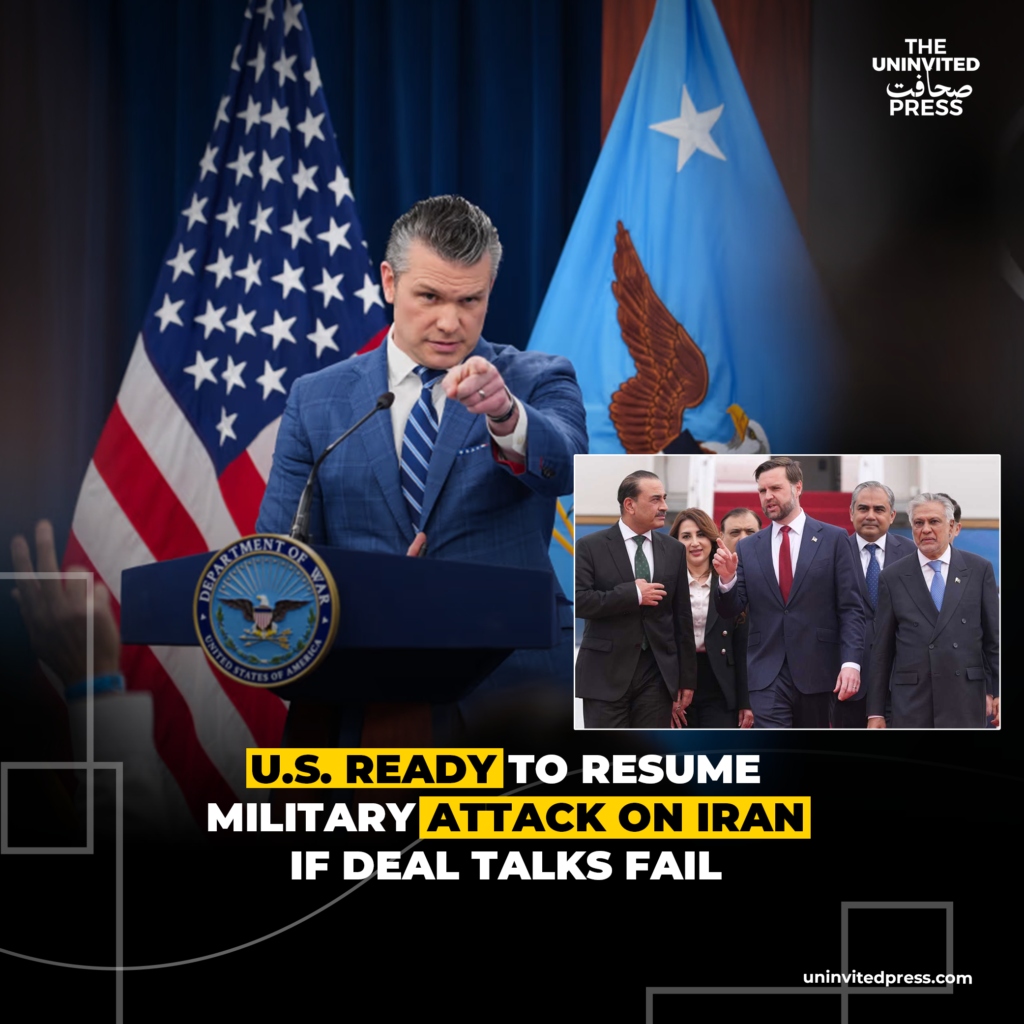
Defence Secretary Pete Hegseth says American forces are ‘locked and loaded’ to resume combat if Tehran rejects demands for permanent curbs on its nuclear programme.
The United States has issued a stark warning that it is prepared to restart major military operations against Iran if ongoing diplomatic efforts to secure a permanent ceasefire and nuclear agreement collapse.
Speaking at a Pentagon briefing, US Defence Secretary Pete Hegseth declared that American troops remain “maximally postured” and “ready to resume combat operations at literally a moment’s notice” should Iran fail to meet Washington’s terms.
Hegseth, standing before the US flag and the Department of Defense seal, pointed directly forward while emphasising that US forces could transition from the current naval blockade of Iranian ports back to large-scale airstrikes “with more power than ever before”.
Deadlock in US-Iran Negotiations:
The latest US-Iran talks held in Islamabad failed to reach a breakthrough, with Vice President JD Vance stating that Iran rejected US demands, including limits on uranium enrichment.
Iran called the US conditions “excessive,” arguing they undermine its right to a peaceful nuclear program and accusing Washington and Israel of aggression.
A major dispute remains over the duration of enrichment restrictions, with the US seeking a 20-year suspension and control over enriched uranium, while Iran offers only short-term pauses.
US officials warned that if no deal is reached, strikes could target Iranian energy and nuclear-related infrastructure. Military leaders said US forces are ready to resume operations if ordered.
Blockade Intensifies Pressure on Tehran:
The US has already imposed a naval blockade on Iranian ports and effectively controls access through the Strait of Hormuz, a critical chokepoint for global oil supplies. Washington describes the measure as a response to Iranian “piracy and terrorism” in the waterway, while critics argue it risks further escalating regional tensions and driving up energy prices worldwide.
Iranian officials have condemned the blockade as economic warfare and called on the international community to pressure Washington to lift it. The Islamic Republic has also signalled willingness for further talks, but not under military threat.
The current ceasefire is due to expire soon, raising fears of a return to open conflict. Analysts note that while Iran’s conventional military capabilities have been degraded, its asymmetric tools-including proxy militias, remaining missile stocks and potential disruption of Gulf shipping-could still impose costs on US and allied forces.
Diplomacy and Threats Shape US-Iran Crisis:
The heightened US rhetoric comes as diplomatic efforts continue behind the scenes, with some reports suggesting a possible second round of negotiations. However, deep mistrust persists, rooted in the US withdrawal from the 2015 nuclear deal during Donald Trump’s first term and the recent direct military confrontation.
For millions across the Middle East, the prospect of renewed fighting raises alarms over further civilian casualties, displacement and economic fallout. The conflict has already disrupted oil markets and strained relations between Washington and several Gulf states wary of broader instability.
As the clock ticks on the ceasefire, the Trump administration continues to frame its position as one of strength, insisting that only a “real agreement” that permanently neutralises Iran’s nuclear ambitions will prevent further US military action.