

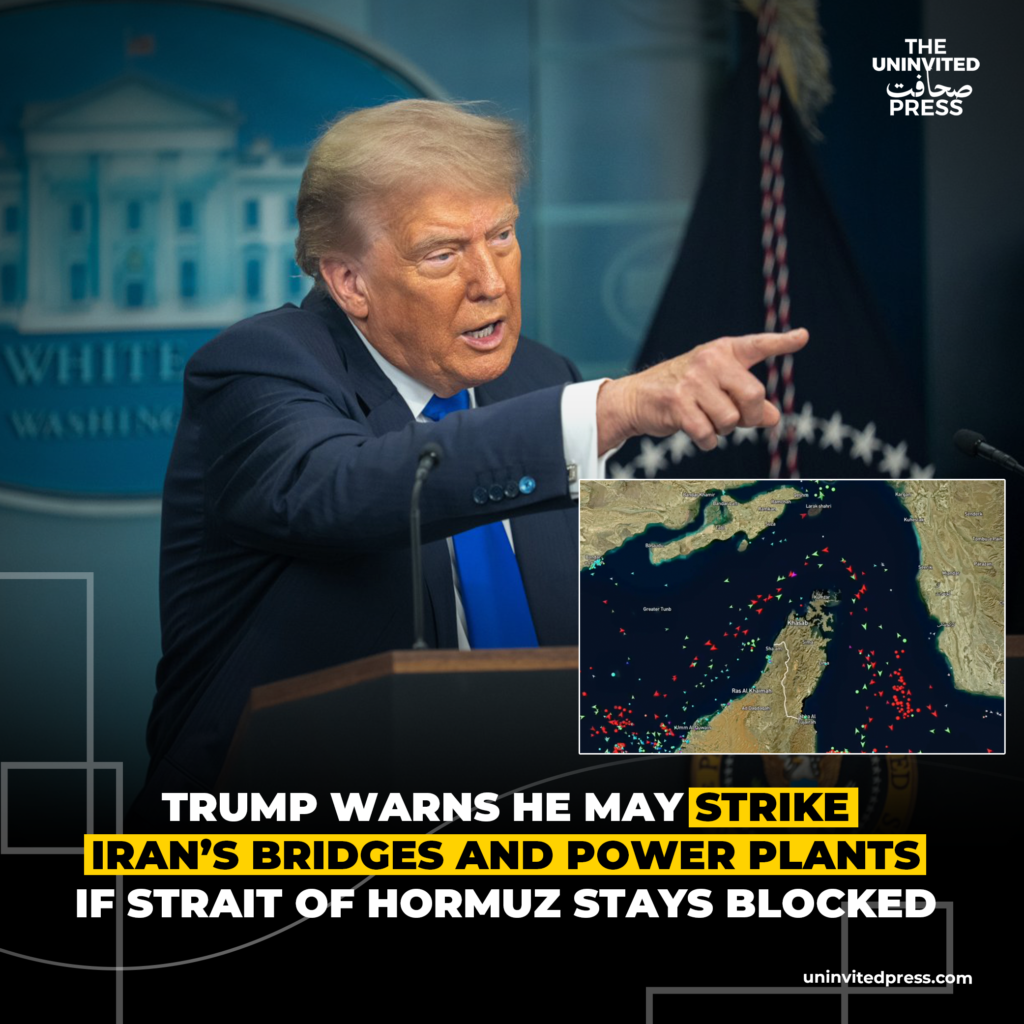
US president warns of strikes on bridges and power plants if Tehran fails to lift blockade by Tuesday evening, amid ongoing war and rejected ceasefire proposals.
US President Donald Trump has issued a fresh ultimatum to Iran, threatening to destroy the country’s bridges and power plants if the Strait of Hormuz remains closed beyond his self-imposed deadline of Tuesday evening.
In an expletive-laden social media post on Easter Sunday and again during a White House news conference on Monday, Trump warned that failure to reopen the vital waterway would trigger what he described as “Power Plant Day, and Bridge Day”-a sweeping assault on Iranian civilian infrastructure.
“Tuesday will be focused on actions targeting power plants and bridges in Iran. Open the Strait, or there will be serious consequences. Watch closely,” Trump wrote on Truth Social.”
He later specified the deadline as 8pm Eastern Time (midnight GMT Wednesday), claiming the US military has a detailed plan to “decimate” every bridge and leave every power plant “burning, exploding and never to be used again” within hours.
Key Waterway Remains Severely Restricted:
The Strait of Hormuz, through which roughly one-fifth of the world’s oil and liquefied natural gas normally passes, has been effectively blocked by Iran since the escalation of hostilities with the US and Israel in late February 2026. The closure has caused oil prices to surge and disrupted global energy supplies.
Iran has used control of the narrow chokepoint as leverage in the ongoing conflict, which entered its fifth week on Monday. Tehran has rejected multiple US-backed ceasefire proposals, including a 45-day temporary truce, insisting instead on a permanent end to the war with security guarantees and sanctions relief.
Iranian officials have dismissed Trump’s threats as bluster while warning that any attack on civilian infrastructure would trigger retaliation across the region and beyond.
Rising Concerns About Possible War Crimes:
Trump’s repeated threats to target civilian power plants and bridges have drawn sharp criticism from legal experts, who say such actions could amount to war crimes under international law by deliberately harming essential services for the civilian population.
During Monday’s press conference, the US president appeared unconcerned, stating he was “not at all” worried about such accusations and framing the potential strikes as necessary to force Iran to reopen the strait and accept a deal.
Defence Secretary Pete Hegseth indicated that US strikes on Iranian targets have already intensified, with Monday seeing the largest volume of operations since the war began.
The White House has linked the demand to reopen the Strait of Hormuz to broader ceasefire talks. However, Iran has countered with its own proposals, prioritising a definitive end to hostilities over temporary pauses.
Ripple Effects Grow Across Region and Beyond:
The blockade has stranded vessels, disrupted energy markets, and raised fears of a wider regional conflict, with shipping through the Strait of Hormuz dropping as tankers avoid the area. Analysts warn further escalation could trigger a humanitarian crisis in Iran by damaging power plants, bridges, and essential infrastructure, affecting electricity, water, and transport for millions.
Iran has carried out retaliatory strikes on Gulf refineries and other targets, while the US and Israel continue airstrikes on Iranian military and economic sites. As the deadline nears, mediators including Pakistan, Egypt, and Turkey are making backchannel efforts, but deep mistrust remains.
The Strait of Hormuz continues to be a critical flashpoint, with global energy security and the risk of broader conflict at stake.