

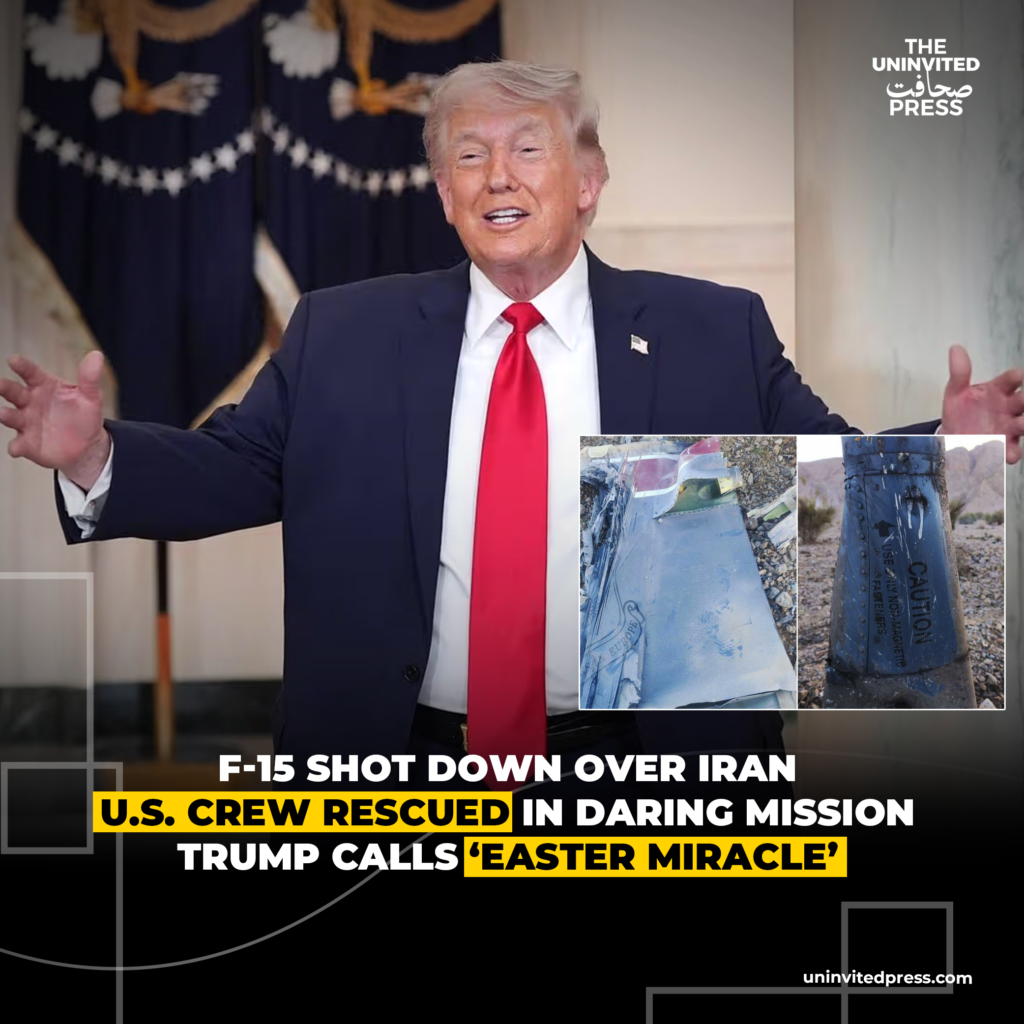
Daring rescue of second crew member hailed by Trump as ‘Easter miracle’ amid fears of wider war.
Iranian forces shot down a United States F-15E Strike Eagle fighter jet over southwestern Iran on Friday, marking a significant escalation in the month-long conflict between the US, Israel and Iran.
Both crew members ejected safely from the aircraft, but one-the weapons systems officer-went missing for more than a day in rugged mountainous terrain, prompting an intense US search-and-rescue operation deep inside Iranian territory. The pilot was recovered shortly after the incident, while the second airman was successfully extracted early on Sunday in what US officials described as a high-risk mission involving special operations forces.
President Donald Trump announced the rescue on social media, declaring “WE GOT HIM!” and later describing the operation as an “Easter miracle” in a message to media outlets. “The enemy was large and violent. The rescuers were brilliant, strong, decisive, and as cool as anyone can be,” Trump said, adding that such a rescue in hostile territory was considered nearly impossible.
The downed jet belonged to the US Air Force’s 48th Fighter Wing, based at RAF Lakenheath in the UK. Iranian state media and military sources claimed the aircraft was brought down by air defence systems, with some reports suggesting the use of advanced missiles. Debris images circulated online showing wreckage consistent with an F-15, including a large blue component marked with US military warnings.
High-risk extraction amid a bounty hunt:
US officials said the second crew member, a colonel and weapons systems officer, sustained injuries but managed to evade capture while hiding in remote mountains. Iran reportedly offered a bounty for information leading to the airman’s location, and local forces conducted searches in the area.
The rescue involved dozens of aircraft and ground teams operating under difficult conditions, with US forces monitoring the airman’s position. Trump later revealed concerns that initial communications from the stranded officer might have been a trap set by Iranian forces. Despite the risks, the operation succeeded without further reported US losses.
The incident comes as the US continues airstrikes on Iranian targets and maintains pressure on Tehran to keep the Strait of Hormuz open for oil shipments. Trump has issued strong warnings to Iran, including threats of further military action if the waterway is blocked.
Wider context of the ongoing conflict:
Iranian officials have portrayed the shootdown as a demonstration of the country’s defensive capabilities against US aggression. State media highlighted the downing as part of resistance to what they call an illegal US-Israeli war launched in late February.
The event has raised fears of further escalation in a conflict that has already seen strikes across the region, including on Iranian infrastructure. Analysts warn that the loss of a US combat aircraft-the first confirmed manned jet downed by Iran in this war-could intensify military operations on both sides.
The rescued airman was reportedly taken for medical treatment, with officials stating he is expected to recover. The US military has not released the names of the crew members.
Broader context of the ongoing conflict:
The downing of the F-15E occurs against a backdrop of heightened aerial confrontations. Iran has made multiple claims of shooting down US aircraft, including unverified assertions regarding F-35 stealth jets, which Washington has denied.
US and Israeli strikes have targeted Iranian military sites, while Tehran has vowed to defend its airspace and retaliate against perceived aggression. The rescue mission, conducted on Easter Sunday, has been framed by Trump and supporters as a symbol of American resolve and military prowess.
As the conflict enters its second month, diplomatic efforts remain stalled, with both sides exchanging threats over key strategic assets like the Strait of Hormuz, through which a significant portion of global oil passes.