

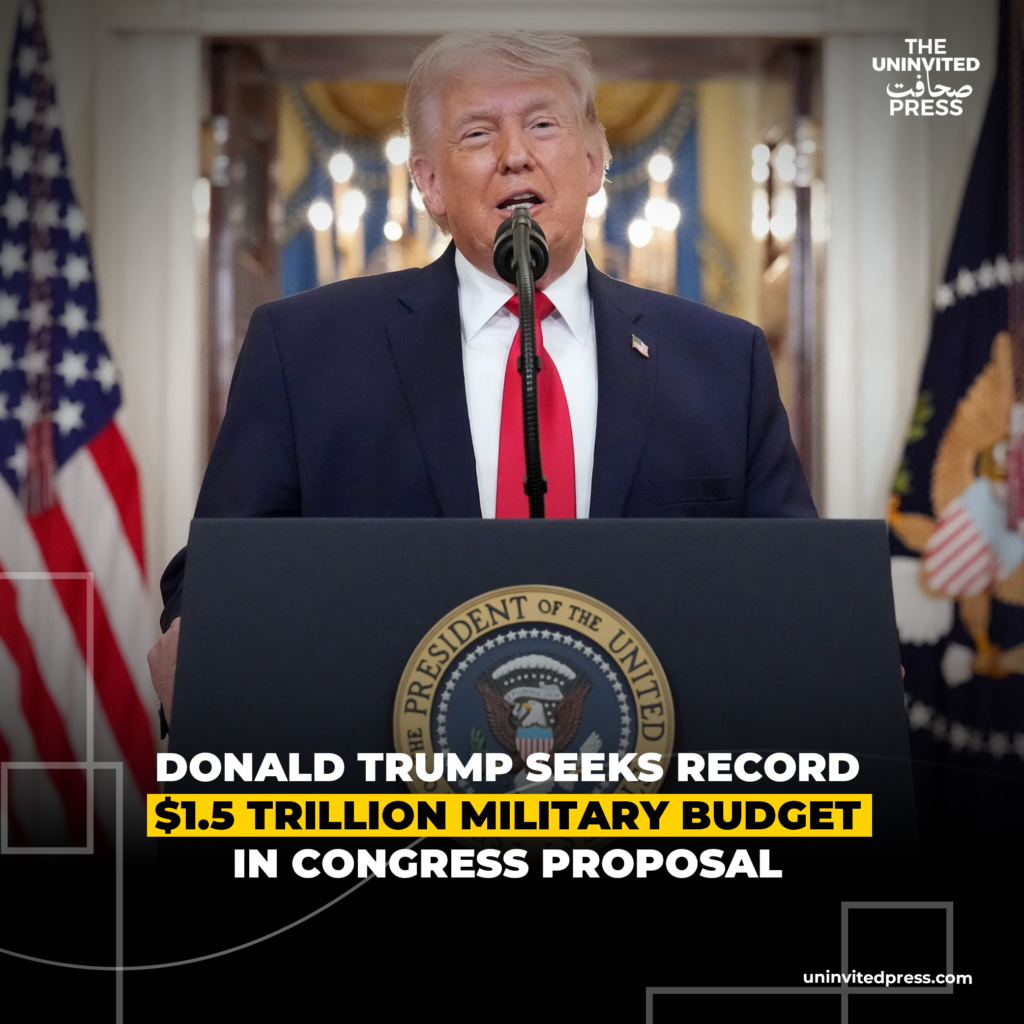
Proposal marks largest defence spending request in modern history, paired with deep cuts to domestic programmes amid global tensions.
President Donald Trump has submitted a sweeping budget proposal to Congress requesting a record $1.5 trillion in defence spending for fiscal year 2027, a nearly 40-44 percent increase over current levels that would represent the highest military budget in US history.
The request, released on Friday, comes as the United States remains engaged in direct military conflict with Iran, which began in late February, alongside other international commitments. The White House described the massive outlay as essential to “rebuild” the US military, expand the defence industrial base, fund new shipbuilding, and advance initiatives like the proposed “Golden Dome” missile defence system.
Significant increase during ongoing conflict:
The $1.5 trillion figure includes approximately $1.1 trillion through regular appropriations and an additional $350 billion via budget reconciliation, a partisan process that could bypass Democratic opposition in the Senate. This marks a roughly $445-500 billion jump from fiscal 2026 levels, which already exceeded $1 trillion when including supplemental funding.
Administration officials and Republican congressional leaders, including the chairmen of the House and Senate Armed Services Committees, have praised the proposal as necessary to restore American deterrence and maintain military superiority in an era of great power competition, particularly with China, and to address immediate costs tied to the Iran conflict.
Critics, however, have raised concerns over the scale of the increase at a time when the US national debt continues to climb. Budget analysts estimate that sustaining such elevated defence spending could add trillions more to the federal debt over the coming decade. Some Democrats have accused the administration of prioritising military expansion while sidelining domestic needs.
Backdrop of Trump’s “peace through strength” policy:
The defence surge is accompanied by proposed 10 percent reductions in non-defence discretionary spending, totalling around $73 billion in cuts to areas including environmental protection, education, health research, housing, and certain green energy initiatives. The White House has framed these as eliminations of “wasteful” programmes, shifting more responsibilities to states and local governments.
This trade-off has drawn sharp criticism from progressive voices and some fiscal hawks, who argue that the budget reflects a clear choice: massive investment in military power at the expense of social services and climate-related programmes. Opponents contend that the US is already spending more on defence than the next several countries combined, questioning the need for such an unprecedented hike.
Context of Trump’s “peace through strength” strategy:
Trump has long pushed for stronger military spending, calling it key to deterrence and peace. His proposed $1.5 trillion “Dream Military” budget includes troop pay raises and investments in advanced weapons and defence capacity.
The proposal comes amid rising costs from the US-Iran conflict and broader fiscal pressures. Congress is expected to review and possibly revise the plan, with debates likely over defence spending versus domestic priorities.