

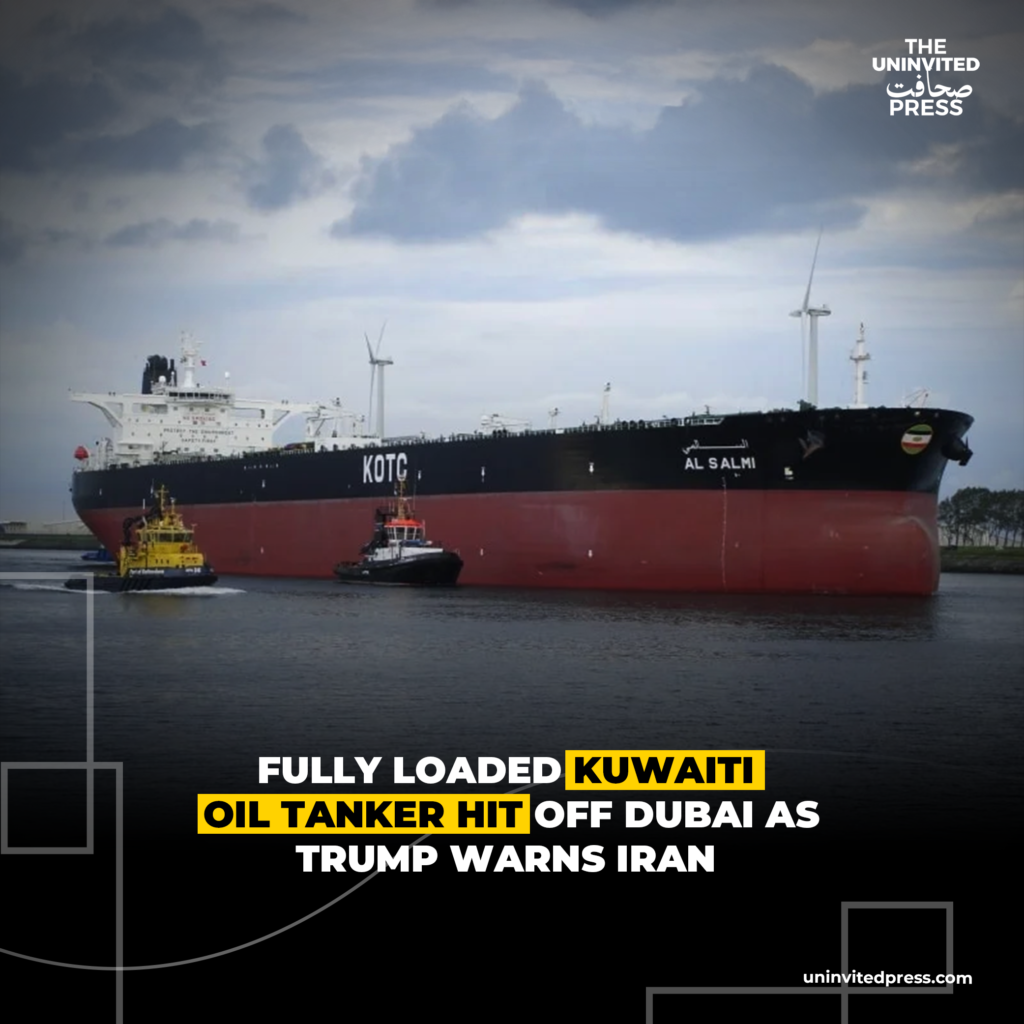
Kuwait Petroleum Corporation reports drone attack on fully loaded Al-Salmi vessel as fire is extinguished with no casualties; Trump renews threats against Iranian energy infrastructure.
A fully loaded Kuwaiti crude oil tanker was struck in what Kuwait described as an Iranian attack while anchored off Dubai port, triggering a fire and warnings of a potential environmental disaster in the Gulf waters.
The incident involving the very large crude carrier (VLCC) Al-Salmi, operated by Kuwait Oil Tanker Company (KOTC) under the Kuwait Petroleum Corporation (KPC), occurred around 00:10 local time on Tuesday. Kuwaiti state news agency KUNA quoted KPC as saying the vessel sustained hull damage and caught fire after being “directly targeted” by Iranian forces.
Emergency response teams from Dubai and Sharjah authorities quickly intervened, extinguishing the blaze. Officials confirmed that all 24 crew members aboard were safe, with no injuries reported. Damage assessment is ongoing, but KPC warned of a possible oil spill in the surrounding waters, as the tanker was fully laden with nearly two million barrels of crude.
The Al-Salmi, a 319,660 deadweight ton vessel built in 2011, was flying the Kuwaiti flag and carrying oil in the anchorage area of Dubai port when the strike-reportedly involving a drone-took place approximately 31 to 57 nautical miles northwest of the city.
Escalation intensifies in the US-Israel conflict with Iran:
The attack on the Kuwaiti tanker comes on day 32 of the ongoing US and Israeli military campaign against Iran, which began on February 28. It marks the latest in a series of assaults on merchant vessels in the Gulf and Strait of Hormuz, where Iran has been accused of using missiles and explosive drones against shipping.
Kuwait, a close US ally and major oil exporter, has not directly engaged in the conflict but relies heavily on Gulf shipping routes. The incident has heightened concerns over the safety of neutral-flagged vessels in one of the world’s most critical energy chokepoints.
Dubai authorities confirmed they responded to a drone-related incident in their waters, mobilising maritime firefighting teams. UAE officials have activated air defences in the region amid the broader tensions.
Trump warns of ‘total destruction’ as oil prices climb:
The tanker strike unfolded hours after US President Donald Trump issued fresh warnings to Iran over its partial closure of the Strait of Hormuz, a vital waterway for global oil shipments.
In a social media post, Trump stated that if a deal to end the conflict is not reached “shortly” and the strait is not fully reopened, the US would “blow up and completely obliterate” Iran’s electric generating plants, oil wells, Kharg Island-the country’s main oil export terminal-and possibly desalination facilities.
“Great progress has been made,” Trump wrote, while emphasising potential “extensive destruction” if Iran does not comply. US Secretary of State Marco Rubio has reiterated that Washington prefers diplomacy but warned of “real consequences.“
Oil prices spiked on the news, with West Texas Intermediate crude rising above $100-105 per barrel and Brent approaching $112-115 in volatile trading, reflecting fears of wider disruptions to energy supplies.
Regional and environmental issues:
The Gulf region, already strained by weeks of conflict, now faces added environmental risks from a possible oil spill near busy shipping lanes and coastal areas of the UAE. Kuwaiti officials said coordination with local authorities is underway to contain any leakage.
Iran has not immediately commented on the specific incident, but it has previously described its actions in the Gulf as responses to the US-Israeli strikes that began in late February.
Analysts warn that continued attacks on commercial shipping could further destabilise global energy markets and draw in more regional actors. Saudi Arabia, Qatar, and Jordan have reportedly condemned recent Iranian actions at a summit in Jeddah.
As investigations continue into the Al-Salmi incident, the episode underscores the fragile balance in the Gulf, where oil infrastructure and maritime traffic remain highly vulnerable amid the broader war.