

US president’s comments spark outrage in the region while Iran accuses Washington of plotting military escalation despite diplomatic overtures.
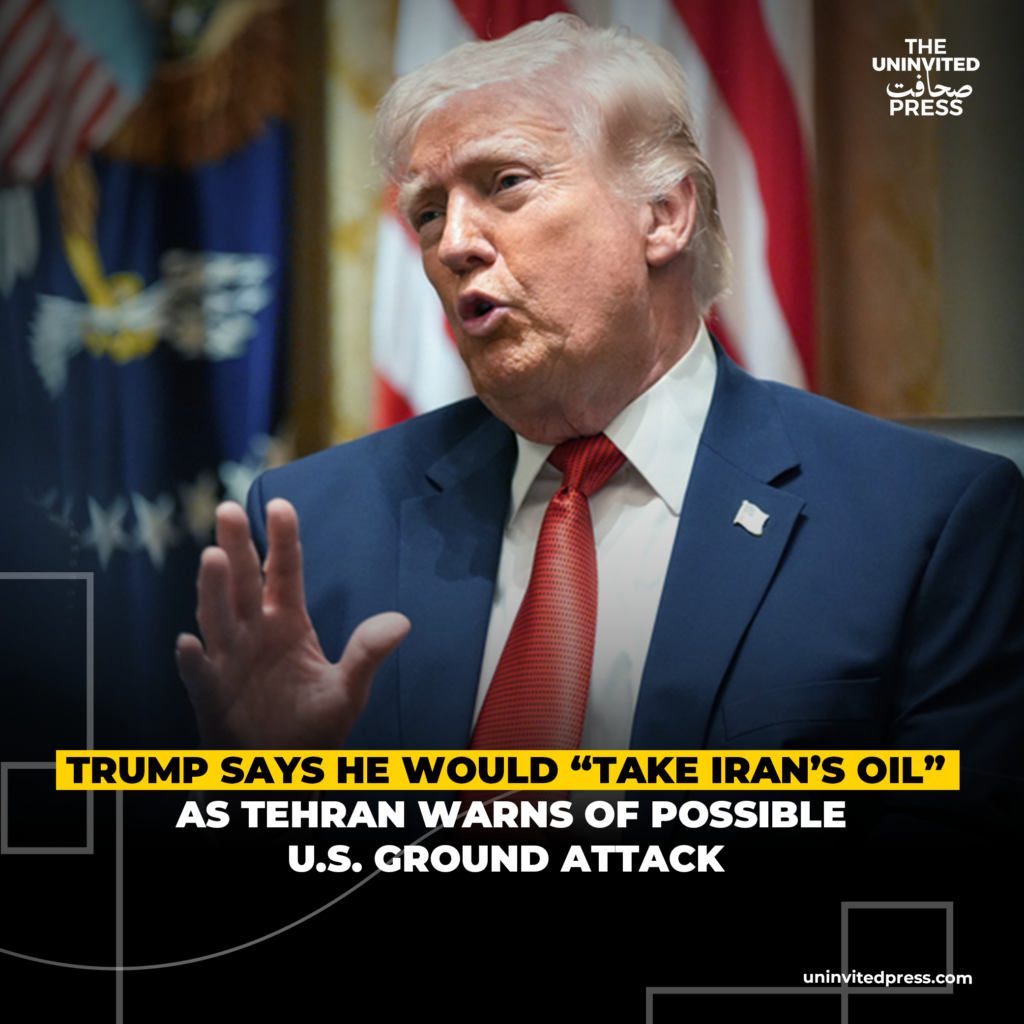
US President Donald Trump has openly stated that his “preference” and “favourite thing” would be to seize Iran’s oil resources, including potentially capturing the country’s main oil export hub at Kharg Island, as tensions in the ongoing US-Israeli war with Iran enter a critical phase.
In an interview, Trump said: “To be honest with you, my favourite thing is to take the oil in Iran but some stupid people back in the US say: ‘why are you doing that?’ But they’re stupid people.” He added that the US could “very easily” take control of Kharg Island, which handles more than 90 percent of Iran’s oil exports, while noting “maybe we take Kharg Island, maybe we don’t. We have a lot of options.”
The remarks come amid a month-long conflict that began with joint US-Israeli airstrikes on Iranian targets in late February 2026, which killed Supreme Leader Ali Khamenei and senior officials. Trump has also claimed that Iran has already undergone “regime change” and described current Iranian leaders as “very reasonable,” while asserting that Tehran has allowed oil tankers to pass through the Strait of Hormuz as a “sign of respect.”
Iran signals strong resistance to any ground attack:
Iranian officials have responded defiantly, accusing the US of preparing a ground invasion while publicly pushing for negotiations. Parliament Speaker Mohammad Bagher Ghalibaf warned that Iranian forces are “waiting for the arrival of American troops on the ground to set them on fire” and would punish US regional partners. Other Iranian statements have threatened to make the Persian Gulf “run with the blood of invaders” if US forces land.
Tehran has dismissed Trump’s claims of successful diplomacy, insisting that Washington is making unrealistic demands while simultaneously building up forces in the region. Reports indicate the deployment of thousands of additional US Marines and elements of the 82nd Airborne Division, raising fears of a potential limited ground operation
.Regional analysts note that any attempt to seize Iranian oil infrastructure would represent a major escalation, risking wider disruption to global energy supplies through the Strait of Hormuz, a chokepoint for much of the world’s oil trade.
Conflicting signals from Washington:
Trump’s comments contrast with his administration’s parallel claims that indirect talks with Iran are progressing and that a deal could be reached “fairly quickly.”
The US has reportedly sent a 15-point proposal through intermediaries, demanding Iran halt uranium enrichment, surrender its stockpiles, curb its missile programme and cut support for regional allies.
Critics in the Middle East and beyond view Trump’s oil remarks as revealing the true motives behind the conflict, echoing historical accusations of resource-driven interventions. They argue that talk of seizing oil fields revives memories of past Western interventions in the region and undermines any genuine diplomatic efforts.
Escalation, Diplomacy, and Uncertainty in the Iran Conflict:
The war has already caused significant casualties, displaced populations and damaged infrastructure across Iran, while triggering retaliatory strikes and raising fears of wider involvement from groups like the Houthis. Oil prices have surged, adding economic pressure globally.
As Pakistan prepares to host potential US-Iran talks and other regional powers seek de-escalation, Trump’s latest statements have injected fresh uncertainty. Iranian officials maintain they will defend their sovereignty by any means necessary, while the White House continues to project strength and openness to a negotiated end-provided its demands are met.
Whether Trump’s oil rhetoric is negotiating leverage, a genuine policy preference or both remains unclear. What is evident is that the conflict, now in its second month, continues to teeter between the possibility of a fragile diplomatic breakthrough and dangerous military escalation.