

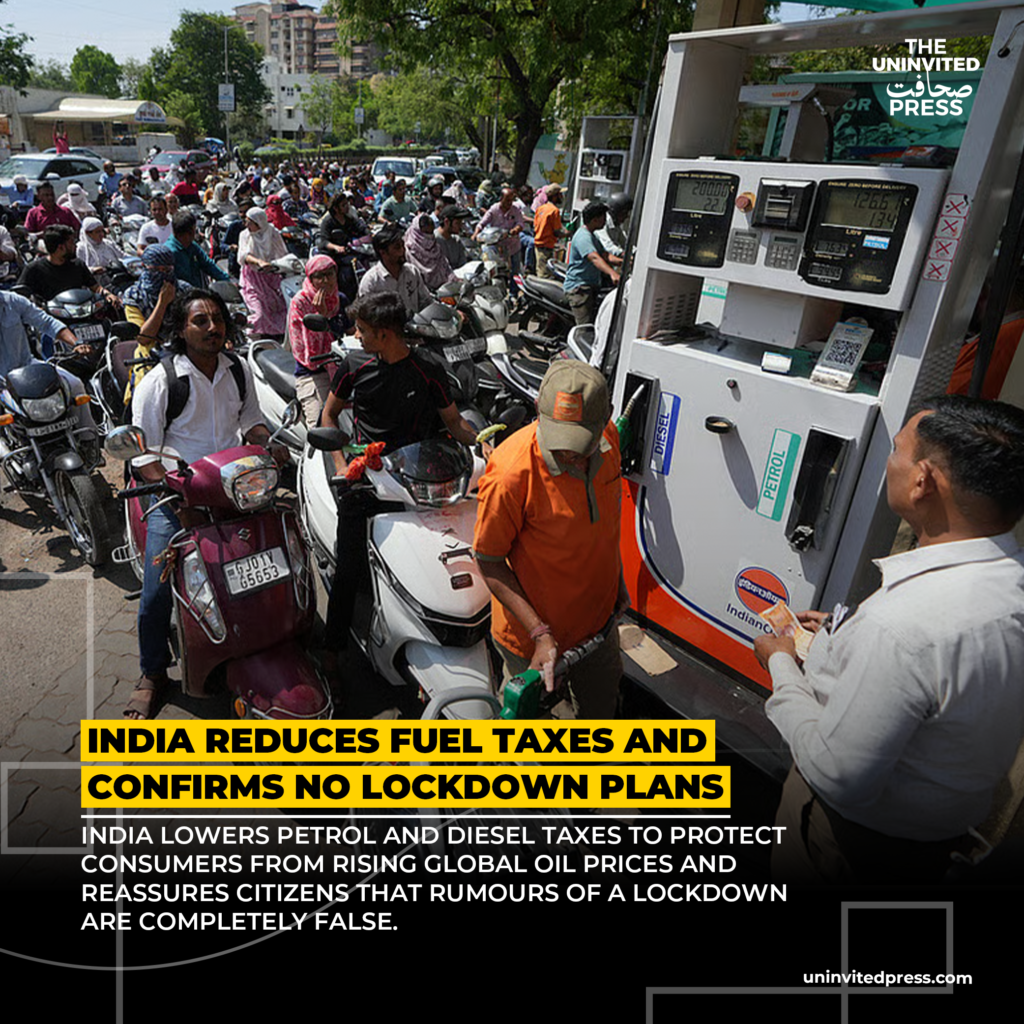
New Delhi moves to shield consumers and oil companies from fallout of Iran war as rumours of lockdown spark public anxiety.
India’s government has sharply reduced excise duties on petrol and diesel to protect consumers from rising fuel costs triggered by the ongoing war in West Asia, while firmly dismissing widespread rumours of an impending nationwide lockdown as “completely false”.
Finance Minister Nirmala Sitharaman announced on Friday that the special additional excise duty on petrol has been cut to 3 rupees ($0.032) per litre from 13 rupees, while the duty on diesel has been eliminated entirely, down from 10 rupees per litre. The reductions, effective immediately, amount to a 10-rupee cut on both fuels for domestic consumption.
“In view of the West Asia crisis, the central excise duty on petrol and diesel for domestic consumption has been reduced by 10 rupees per litre each,” Sitharaman said. “This will provide protection to consumers from rise in prices.”
The move comes as the month-long conflict between the US, Israel and Iran has disrupted global oil flows, particularly through the Strait of Hormuz, pushing international crude prices sharply higher. India, the world’s third-largest crude oil importer, relies heavily on Middle Eastern supplies.
Securing domestic supply and shielding consumers:
Petroleum Minister Hardeep Singh Puri said the government had to choose between allowing fuel prices to surge or absorbing the cost itself to shield ordinary citizens and prevent broader inflationary pressures.
The tax cuts are expected to reduce losses faced by state-owned oil marketing companies, which have been absorbing the gap between high international costs and controlled domestic retail prices. At the same time, the government has imposed export duties on diesel (21.5 rupees per litre) and aviation turbine fuel (29.5 rupees per litre) to prioritise domestic availability and discourage outflows amid global shortages.
Officials have stressed that current fuel stocks remain adequate, with strategic reserves and refinery inventories sufficient to meet demand in the near term. However, the government acknowledged that prolonged disruption in global supply chains could pose challenges.
Officials call lockdown rumours baseless:
The announcement was accompanied by strong reassurances aimed at quelling public panic. Both Sitharaman and Puri addressed circulating social media rumours suggesting the government was considering Covid-style lockdown measures due to potential fuel shortages.
“Rumours of a lockdown in India are completely false,” Puri stated. “There is no such proposal under consideration by the Government of India.”
Sitharaman echoed the message, describing the claims as “baseless” and expressing concern that some political voices were spreading misinformation. “There shall not be any lockdown. I want to reassure people that there will be no such lockdown as we saw during COVID,” she said.
Authorities urged citizens not to engage in panic buying and to rely on official updates, emphasising that essential supplies and fuel availability at petrol pumps remain stable.
Economic and political landscape:
The tax relief is expected to cost the government significant revenue-estimates suggest a potential loss of several thousand crore rupees in the short term-but officials described it as a necessary intervention to maintain economic stability.
The decision mirrors similar measures taken during past global energy shocks, including the 2022 Russia-Ukraine conflict. Analysts note that while the cuts provide immediate relief at the pump, they add pressure on India’s fiscal deficit at a time when the government is already navigating multiple economic headwinds.
India has been diversifying its crude sources and building strategic petroleum reserves in recent years, yet the country remains vulnerable to volatility in West Asian energy routes.
As the conflict in the Middle East shows no immediate signs of de-escalation, New Delhi’s balancing act-cushioning domestic prices while securing supply-will be closely watched by other major energy-importing nations in Asia.