

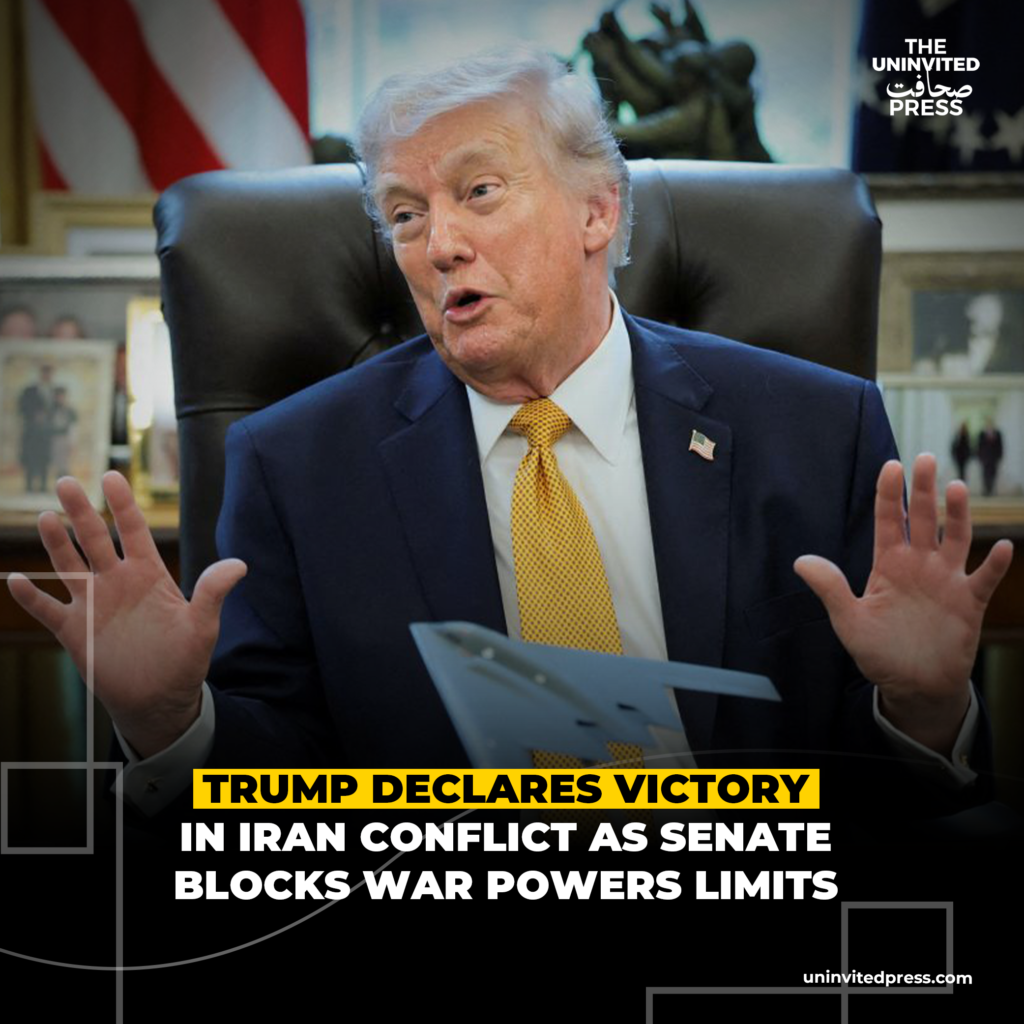
President Donald Trump claims victory in the ongoing Iran conflict while the U.S. Senate, largely along party lines, blocks efforts to limit his war powers-deepening constitutional and political clashes over U.S. military action.
Trump Declares Victory as Senate Blocks War Powers Limits:
President Donald Trump on Thursday framed the nearly month‑long military engagement against Iran as a decisive success for U.S. interests, asserting that “victory has been achieved” despite ongoing hostilities and regional tensions.
Trump’s remarks come as Republican lawmakers in the U.S. Senate successfully blocked legislation aimed at curbing his ability to wage war without explicit congressional authorization. In a 53‑to‑47 vote largely along party lines, the Senate defeated a measure that would have required the president to seek congressional approval before continuing military operations against Iran.
“Today the Senate has affirmed the commander‑in‑chief’s authority to protect the United States,” said Senate Republicans following the vote. Supporters of the president’s position argue that Trump’s actions-including strikes against Iranian military and industrial targets-respond to direct threats and fall within his constitutional powers to defend the nation.
However, critics from both parties challenged the president’s assertions of victory and authority. Senate Democratic leader Chuck Schumer warned that the conflict’s endgame remains unclear. “We do not know what victory even looks like in his eyes,” Schumer said ahead of the vote, underscoring deep unease about an open‑ended war.
Even some Republicans expressed concern about the lack of clarity on strategic goals and timelines. Lawmakers pressing for legislative checks on the conflict say the administration has failed to provide sufficient public detail on objectives or exit plans.
The war powers battle has been part of a broader political struggle over U.S. engagement in the Middle East. Democratic lawmakers introduced multiple resolutions under the War Powers Resolution seeking to force a formal congressional vote on continued military actions. All attempts in the Senate to advance those measures have failed, as Republicans argue that restrictive votes during an active conflict could undermine national security.
On the ground, the campaign against Iran has involved U.S. and allied forces conducting sustained military operations after Tehran’s ballistic missile and drone strikes on allied territory. These operations have drawn sharp responses from Iranian leadership and galvanized debate over the legal basis for U.S. involvement without formal congressional authorization.
Despite Republican victories in Congress over war powers measures, dissent within the U.S. political system persists. Some lawmakers have accused the Trump administration of bypassing the constitutional requirement that Congress has the sole authority to declare war.
Trump Frames Iran Conflict Amid Congressional War Powers Debate:
U.S.-Iran military conflict of 2026, which escalated in late February and early March after a series of Iranian missile and drone attacks targeted U.S. assets and allied nations in the Gulf region and Israel. In response, the U.S., alongside Israel, launched a coordinated military campaign striking Iranian military and nuclear infrastructure.
Amid these operations, President Donald Trump publicly framed the conflict as a success, asserting that U.S. objectives had been achieved. Simultaneously, Congress has been debating whether to limit the president’s authority to conduct military operations without formal legislative approval. This confrontation highlights the tension between executive authority and Congressional oversight in U.S. foreign military engagements.