

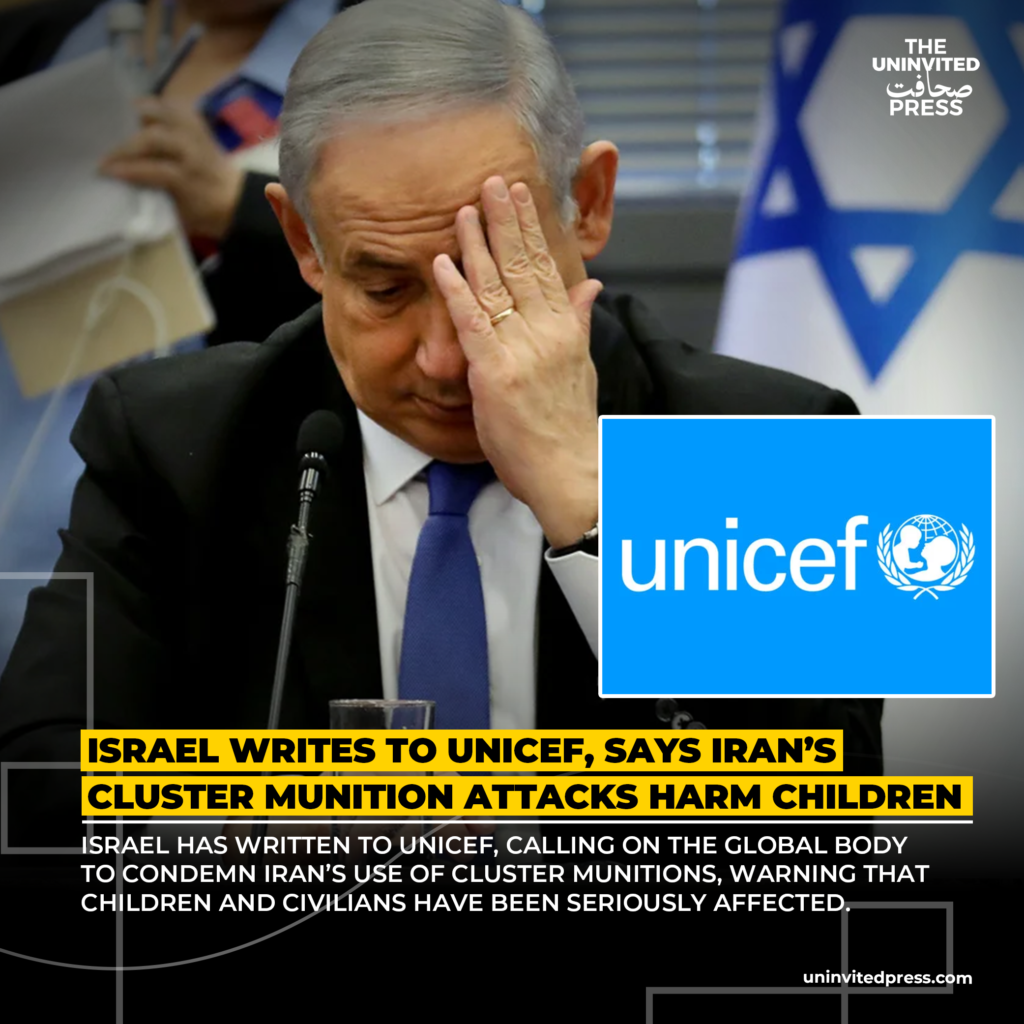
Israel has written to UNICEF demanding condemnation of Iran’s cluster munition missile attacks, citing serious harm to children and civilians in the ongoing war.
Israel Urges UNICEF to Condemn Iran Over Civilian Strikes:
Israel’s Foreign Ministry has formally written to UNICEF Executive Director Catherine Russell, demanding an immediate and public condemnation of Iran’s repeated ballistic missile attacks on Israeli civilians-attacks Israel says are increasingly armed with illegal cluster munitions that scatter indiscriminate bomblets across residential areas, maiming and killing children.
The letter, sent by MFA Deputy Director-General for UN and International Organizations Nina Ben-Ami and dated March 24, 2026, frames the strikes as direct atrocities against the most vulnerable. “Children are among the victims,” the ministry states bluntly.
Concerns Rise Over Alleged Use of Cluster Munitions in Civilian Areas:
The move comes as Israel highlights what it calls a pattern of indiscriminate warfare. According to Israeli officials and verified reporting, roughly half of the ballistic missiles Iran has fired at Israel since late February have carried cluster warheads-munitions that release dozens of small bomblets designed to saturate an area, making precise interception far more difficult and dramatically increasing civilian risk.
Credible independent outlets, including The New York Times, The Guardian, Reuters, CNN, and Haaretz, have confirmed Iran’s repeated use of cluster munitions in this conflict. Footage and Israeli military assessments show submunitions scattering over populated zones in central Israel, damaging homes, cars, playgrounds, and infrastructure. One recent strike on March 22 injured 15 people, one seriously. Experts note Iran has refined this capability, with advanced missiles like the Khorramshahr capable of dispersing up to 80 bomblets.
Cluster munitions are widely banned under the 2008 Convention on Cluster Munitions because of their long-term danger to civilians-unexploded bomblets can act like landmines for years. Neither Iran nor Israel is a party to the treaty, but Israel argues Iran’s deployment in populated areas violates international humanitarian law principles of distinction and proportionality.
Escalating Conflict Takes Heavy Toll on Children Across Region:
The current round of direct conflict ignited on February 28, 2026, with joint U.S.-Israeli strikes on Iranian targets. Iran responded with waves of ballistic missiles, some conventional, many fitted with cluster payloads. Israeli air defenses have intercepted most, but penetrations have caused mounting civilian harm. By mid-March, Israeli officials reported at least 11 cluster-munition missiles had gotten through, spreading bomblets across seven-to-eight-mile stretches in some cases.The three Bitton siblings’ deaths in early March became a national flashpoint. The family was sheltering when the missile struck. Their funerals drew widespread mourning across Israel.
UNICEF itself has not been silent on the regional toll. In statements issued in early March and updated as recently as late March, the agency reported more than 1,100 children killed or injured across the Middle East since fighting intensified. It cited 200 children killed in Iran, 91 in Lebanon, four in Israel, and one in Kuwait-underscoring that children on all sides are paying the price. UNICEF has repeatedly called for an immediate cessation of hostilities and protection of civilian infrastructure, including schools.