

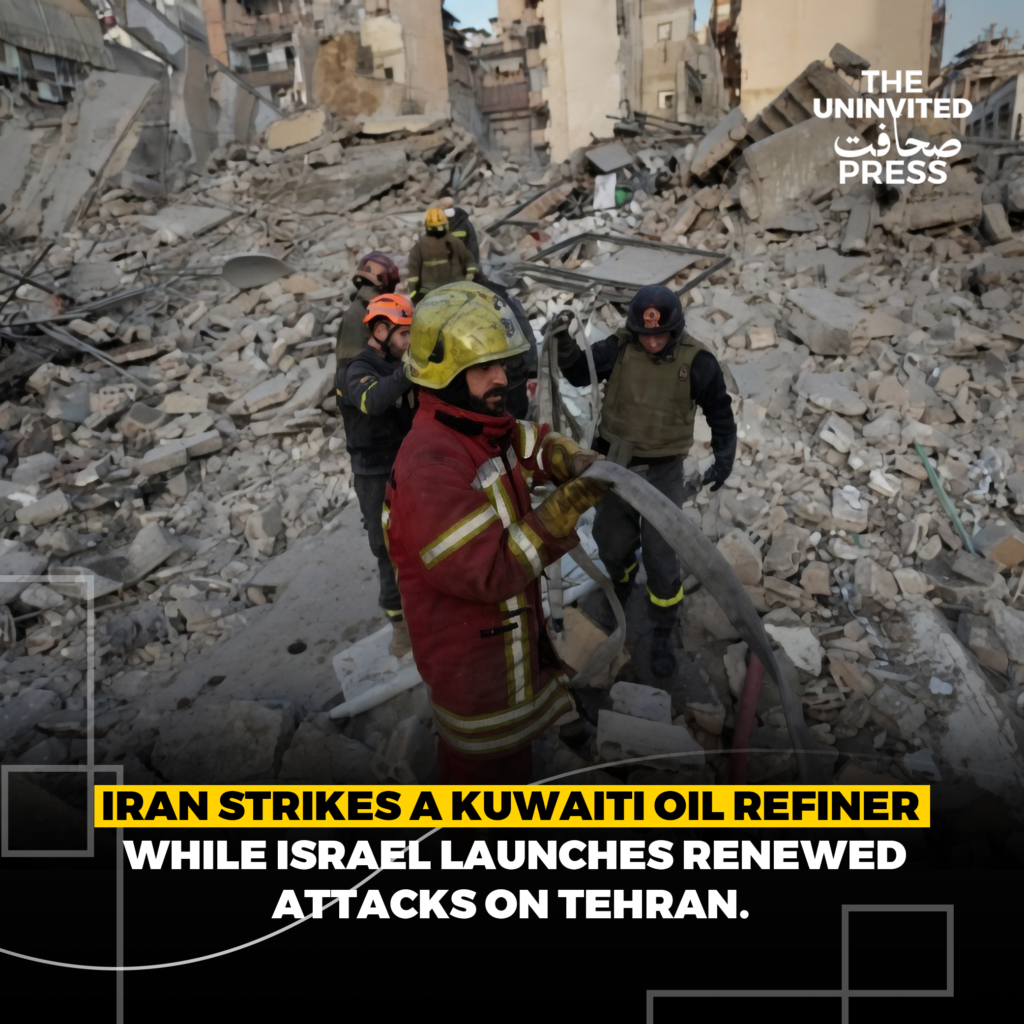
Iranian drones strike Kuwait’s Mina Al-Ahmadi refinery for the second day, sparking fires, while Israeli airstrikes hit Tehran on Nowruz amid the 2026 war.
Iranian Drones Hit Kuwait Refinery as Israeli Strikes Rock Tehran:
Iranian drones slammed into Kuwait’s massive Mina Al-Ahmadi oil refinery early Friday, sparking multiple fires just hours after the site was already damaged in a previous assault. At the same time, explosions thundered across Tehran as Israeli airstrikes pounded the Iranian capital during Nowruz celebrations, the Persian New Year. No casualties were reported from either strike, but the dual attacks mark a dangerous new phase in the 2026 Iran war that has already killed more than 1,300 people and disrupted global energy supplies.
The coordinated developments come as Iran retaliates against Gulf states for perceived support of Israel and the United States, following Israeli strikes on its vital South Pars gas field earlier this week.
From February Pre-Emptive Strikes to Friday’s Dual Attacks:
The latest strikes fit a clear pattern of escalation that began when the United States and Israel launched pre-emptive airstrikes across Iran on 28 February 2026. Those initial attacks killed Supreme Leader Ali Khamenei and dozens of senior officials, plunging the region into open war.
Iran responded with waves of missiles and drones against Israel and U.S. bases. By mid-March, the conflict broadened dramatically when Israel bombed Iran’s giant South Pars offshore gas field-the world’s largest-on 19 March. Tehran immediately vowed retaliation, turning its focus to energy infrastructure across the Gulf.
Friday’s events show Iran following through. Kuwaiti authorities described “two waves” of drones striking the Mina Al-Ahmadi site. Firefighters in protective gear were seen battling flames amid rubble, matching images circulating from the scene.
Simultaneously, Israeli strikes hit Tehran, with explosions shaking the city. Israel has not yet issued a detailed statement on Friday’s operation, but Prime Minister Benjamin Netanyahu earlier this week said Iran’s ballistic missile production had been “eliminated” and that further restraint on South Pars strikes was only at U.S. President Donald Trump’s request.
How the 2026 Iran War is Reshaping the Middle East and Global Energy?
The 2026 Iran war has already reshaped the Middle East. What started as targeted strikes on Iran’s nuclear and military sites has morphed into a grinding conflict focused on energy choke points. Iran controls the Strait of Hormuz, through which a fifth of the world’s oil passes. Attacks on Gulf refineries and Iran’s gas fields threaten to choke global supply chains.
Brent crude surged above $119 a barrel on Thursday and remained elevated Friday, up nearly 47% since the war began. The European Union has called for an immediate moratorium on strikes against energy and water facilities. China has urged all sides to ensure uninterrupted oil flows.
Inside Iran, the death of Supreme Leader Khamenei led to his son Mojtaba Khamenei taking over. The new leader has warned that Iran’s enemies “need to have their security taken away.” The Islamic Revolutionary Guard Corps has confirmed the death of its spokesman, General Ali Mohammad Naeini, in a recent U.S.-Israeli strike, underscoring the toll on Iran’s command structure.
Kuwait and other Gulf states have scaled back Eid al-Fitr celebrations amid the security threat. The war has already displaced more than a million in Lebanon and caused widespread civilian suffering across the region.