

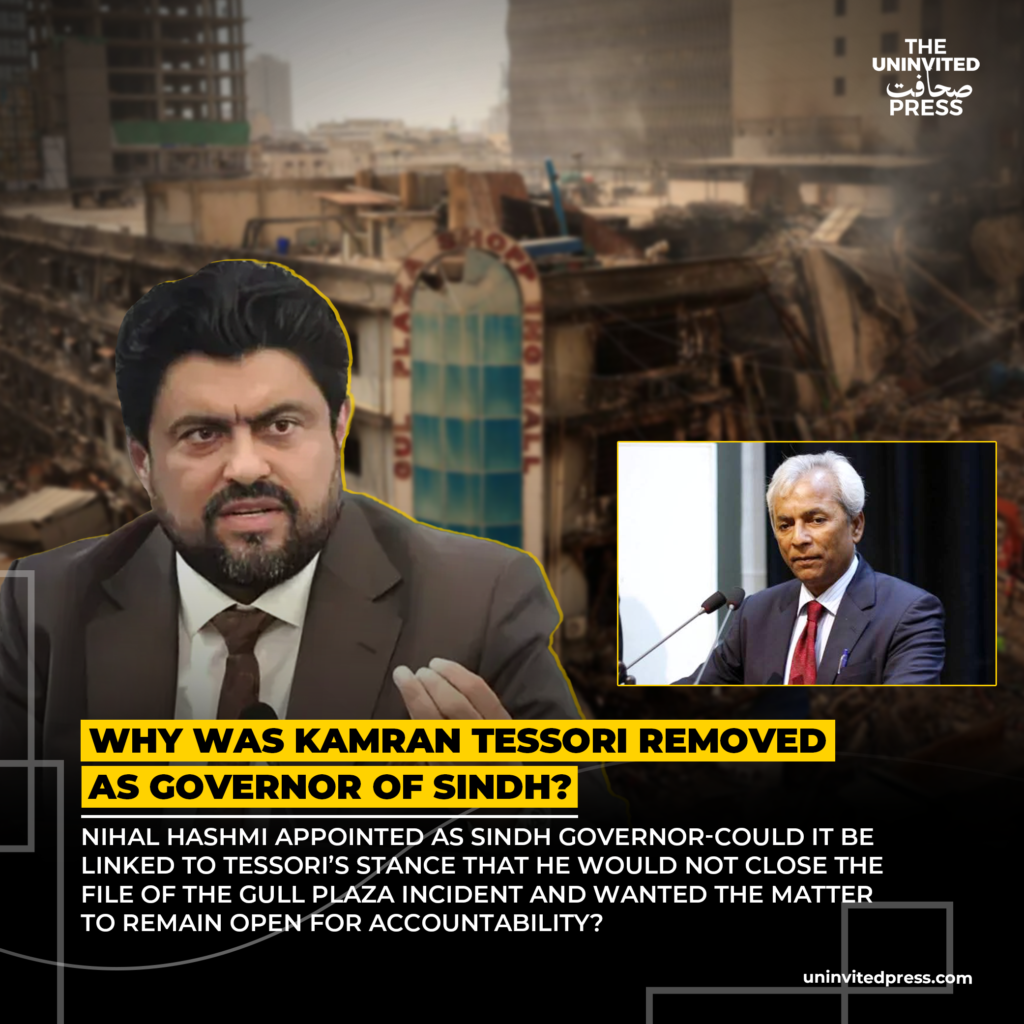
Political speculation grows after Kamran Tessori was replaced by Nihal Hashmi as the Governor of Sindh. Was his refusal to close the Gul Plaza incident file a factor behind the decision?
Why Was Kamran Tessori Removed as Governor of Sindh? Questions Rise Over Gull Plaza Accountability:
The sudden political shift in Karachi and across Sindh has sparked intense debate after Kamran Tessori was reportedly removed from his position as governor and replaced by Nihal Hashmi.
While official explanations may describe the change as a routine political decision, questions are emerging about whether Tessori’s stance on the controversial Gul Plaza incident played a role in his removal.
Observers and political analysts are now asking: Was Tessori removed because he refused to close the file on the Gull Plaza case and insisted that the matter remain open for accountability?
The Core Question Behind the Political Shift:
According to political discussions circulating in media and policy circles, Kamran Tessori reportedly maintained that the Gull Plaza incident should not be quietly closed.
Sources suggest that Tessori believed the case required continued scrutiny and accountability, arguing that sensitive incidents involving public safety and governance should remain open until full transparency is achieved.
If these reports are accurate, his position may have placed him at odds with certain political interests that preferred the matter to fade from the spotlight.
Political Context Behind the Governor Change:
In Pakistan’s political system, the governor’s position is largely ceremonial but still carries symbolic and administrative influence within a province.
Changes in such roles are often influenced by:
Internal party dynamics
Strategic political alignments
Federal-provincial relations
Emerging political controversies
The appointment of Nihal Hashmi, a senior figure with strong ties within the Pakistan Muslim League (N), may signal a recalibration of political strategy in Sindh.
My Perspective: Why the Timing Raises Questions?
From my perspective, the timing of Tessori’s removal inevitably raises questions.
If a governor publicly or privately insisted that a sensitive case like the Gull Plaza incident should remain open for accountability, it would naturally create discomfort for individuals who prefer political stability over prolonged scrutiny.
In many political systems, officials who push strongly for transparency can sometimes find themselves isolated within the power structure.
This does not necessarily prove that the Gull Plaza stance caused the removal. However, the coincidence between Tessori’s position and the leadership change is significant enough to deserve public discussion and clarity.
Accountability cases should ideally strengthen institutions, not create political consequences for those who advocate transparency.
The Bigger Issue: Transparency vs Political Stability:
The debate surrounding Tessori’s removal reflects a larger challenge in governance:
Should sensitive cases be quietly closed for political stability?
Or should they remain open until every question is answered?
For many citizens in Karachi, the Gull Plaza issue represents more than a single incident-it symbolizes whether powerful institutions are willing to hold themselves accountable.