

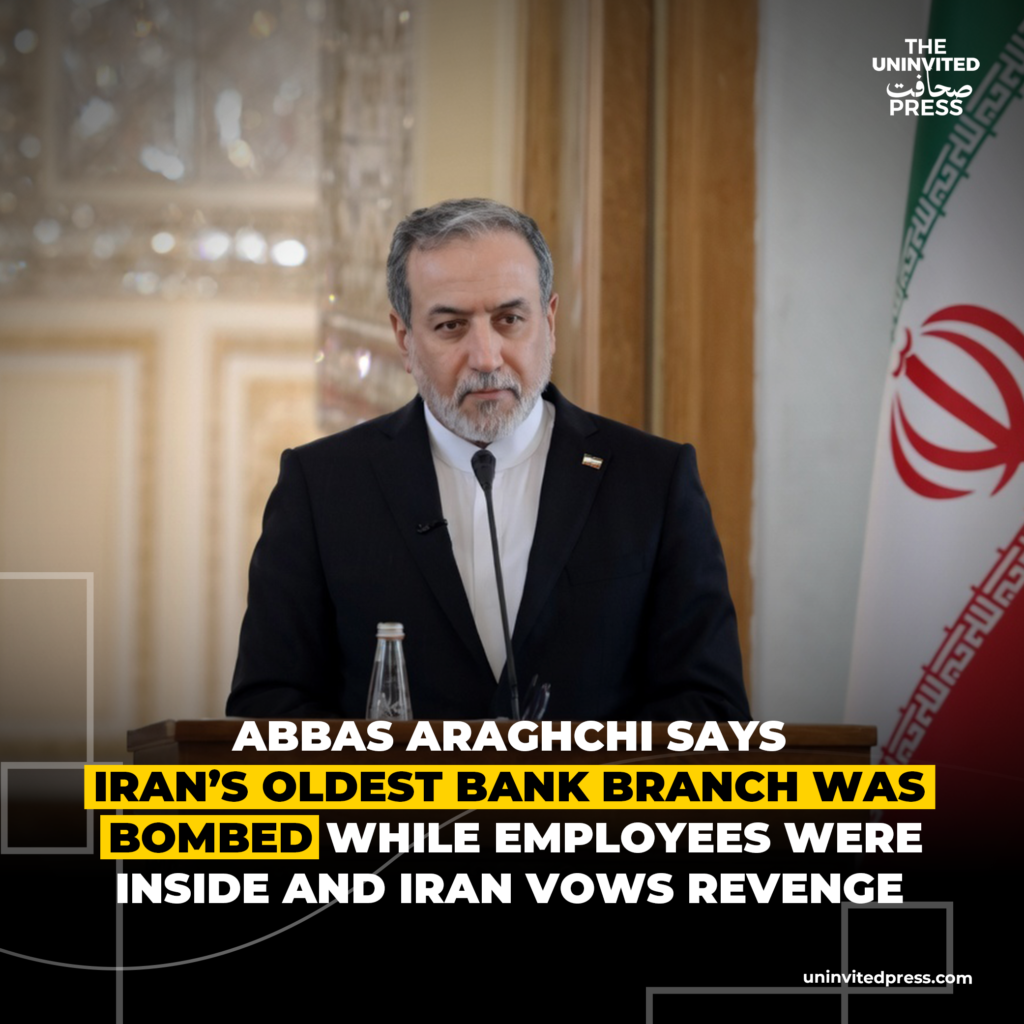
Iran’s Foreign Minister Abbas Araghchi vows revenge after a deadly strike on Bank Sepah’s data center in Tehran kills employees, amid escalating U.S.-Israeli war, threatening regional banks.
Fierce Retaliation Vowed After Deadly Strike on Bank Sepah:
Iran’s Foreign Minister Abbas Araghchi unleashed a fierce warning on March 11, declaring that the nation’s armed forces would exact retribution after a missile strike demolished the digital security center of Bank Sepah in Tehran. The attack, which occurred while employees were processing military payrolls, killed several staff members and disrupted banking services nationwide. This brazen hit on civilian infrastructure marks a new phase in the U.S.-Israeli assault on Iran, raising fears of retaliatory strikes on regional financial hubs and spiking global market jitters.
As tensions boil over in the 12-day-old conflict, the incident underscores the vulnerability of economic systems in wartime. With Iran’s New Year approaching, the disruption could hamper salary payments for millions, including military personnel, amplifying the human cost of the war that has already claimed thousands of lives.
Missile Strike on Tehran Bank Triggers Iran Retaliation Threat:
The missile strike hit Bank Sepah’s digital security center on Haghani Street in Tehran shortly after midnight on March 11, according to multiple reports. The facility was actively processing end-of-month salary payments for Iranian military personnel and members of the Islamic Revolutionary Guard Corps (IRGC) when the attack occurred, leading to the deaths of several employees. The building was completely destroyed, exacerbating nationwide disruptions to banking services that began earlier in the week.
Hours later, Foreign Minister Abbas Araghchi posted on X, describing the incident as an assault on Iran’s national infrastructure. “This time, a branch of my country’s oldest bank was bombed while full of employees,” he wrote. “They were laboring to ensure Iranians have food on the table ahead of our New Year. Our Powerful Armed Forces will exact retribution for this crime.”
Iranian state media echoed the sentiment, with a spokesperson for the Khatam al-Anbiya military command, Ebrahim Zolfaqari, stating that the attack would force Iran to target U.S.- and Israeli-linked economic centers and banks in the region. He advised civilians to stay at least one kilometer away from such institutions.
The strike followed a night of heavy bombardment across Tehran, with residents reporting low-flying warplanes and explosions that shook neighborhoods. Services at Bank Sepah and the affiliated Bank Melli remained limited to card-based transactions, with online banking suspended as a precautionary measure. No immediate disruptions to international transfers were reported, but the incident has heightened concerns over Iran’s financial stability amid the war.
Bank Sepah Strike Escalates Iran Conflict Ahead of Nowruz:
Bank Sepah, established in 1925 as the Pahlavi Army Bank, is Iran’s oldest domestically founded bank, initially created to manage military finances with capital from army pension funds. Nationalized in 1979 following the Islamic Revolution, it has grown into one of the country’s largest state-owned lenders, with over 1,700 domestic branches and international outposts in Europe. The bank has long-standing ties to Iran’s military, serving as a key payer of salaries for the armed forces and IRGC, and has been sanctioned by the U.S. for allegedly facilitating acquisitions for Iran’s missile program.
This attack is the latest in “Operation Epic Fury,” the U.S.-Israeli campaign launched on February 28, 2026, which began with strikes that killed Iran’s Supreme Leader Ali Khamenei and top commanders. The war stems from decades of tensions over Iran’s nuclear program, support for proxy groups like Hezbollah, and prior clashes, including a 2025 skirmish. By targeting financial infrastructure, the strikes aim to cripple Iran’s ability to fund its military operations, but they risk broadening the conflict to economic warfare. Over 1,800 deaths have been reported since the war’s outset, with Tehran enduring daily bombardments that have darkened skies and disrupted daily life.
For Iran, the timing is critical: The strike hit just before Nowruz, the Persian New Year on March 20, when families rely on timely payments for celebrations. This could exacerbate economic strains in a nation already grappling with sanctions and inflation.