

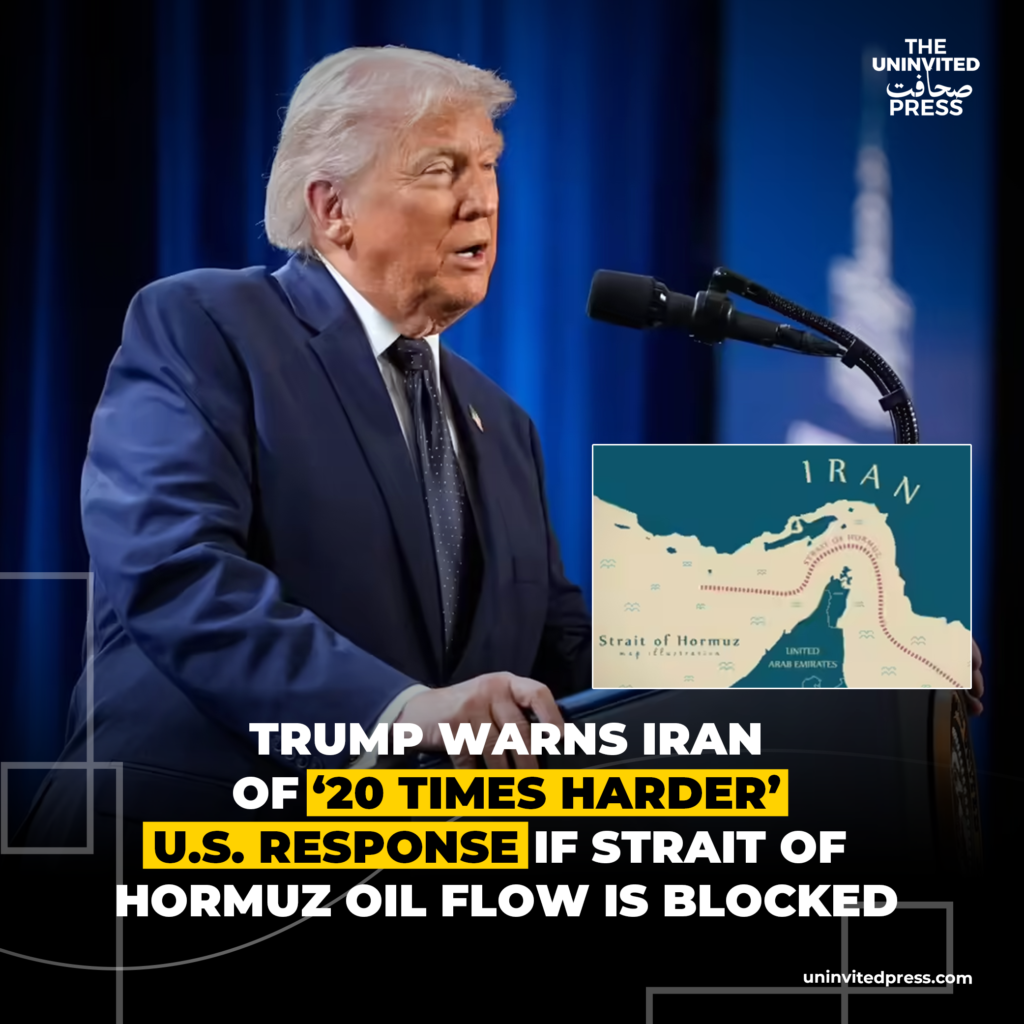
Trump warns Iran of ’20 times harder’ strikes if Strait of Hormuz oil is blocked, amid US-Israeli war; forces destroy mine vessels as tensions spike global energy fears.
Trump's Stark Warning: '20 Times Harder' Retaliation If Iran Blocks Hormuz Oil Flow:
President Donald Trump issued a dire warning to Iran, promising a U.S. response “20 times harder” than previous strikes if Tehran disrupts oil shipments in the Strait of Hormuz-a vital chokepoint carrying 20% of global oil. The statement comes as U.S. forces report neutralizing Iranian mine-laying boats, heightening fears of a broader energy crisis in the 11-day-old U.S.-Israeli conflict with Iran. With civilian deaths mounting and markets volatile, this move underscores the high stakes for global stability and energy security.
U.S. Strikes on Mine Vessels, and Iran's Retaliatory Barrages:
The escalation began with Trump’s March 9 post on Truth Social, where he stated: “If Iran does anything that stops the flow of Oil within the Strait of Hormuz, they will be hit by the United States of America TWENTY TIMES HARDER than they have been hit thus far.” He added that U.S. forces would target “easily destroyable” sites, making Iran impossible to rebuild, and invoked “Death, Fire, and Fury” while expressing hope it could be avoided. The post, viewed millions of times, framed the warning as a “gift” to oil-dependent nations like China.
The next day, March 10, CENTCOM announced U.S. forces had “eliminated” 16 Iranian mine-laying vessels near the Strait, releasing video footage of strikes on nine moored boats. Earlier reports cited 10 vessels destroyed, but updated figures confirmed the higher number. U.S. officials cited intelligence indicating Iran was preparing to deploy mines, though no active mining was confirmed at the time.
This follows the war’s outbreak on February 28, when joint U.S.-Israeli airstrikes killed Iran’s Supreme Leader Ali Khamenei and dozens of officials, targeting nuclear sites, missile facilities, and military infrastructure. Iran responded with missile barrages on U.S. bases and Israeli cities, leading to over 1,300 civilian deaths in Iran and retaliatory strikes across the region. By March 10, U.S. Defense Secretary Pete Hegseth described it as the “most intense day” of strikes yet, with U.S. and Israeli forces degrading Iran’s missile and drone capabilities.
Iranian forces have launched multiple waves of attacks, including the 35th on March 10, targeting U.S. military positions. Hezbollah, backed by Iran, has intensified rocket fire into Israel, prompting Israeli strikes in Lebanon. The Strait incidents mark a pivot to economic warfare, with Iran threatening to close the waterway in retaliation.
Strait of Hormuz Tensions Threaten Global Oil and Regional Stability:
The Strait of Hormuz, a 21-mile-wide passage at its narrowest, is the world’s most critical energy chokepoint, facilitating 25% of seaborne oil trade. Any blockade could cause oil prices to surge, as seen in past crises like the 1979 Iranian Revolution and 2019 tanker attacks.
Tensions trace back to decades of U.S.-Iran animosity, exacerbated by the 2018 U.S. withdrawal from the Iran nuclear deal under Trump. Recent escalations include Iran’s support for attacks on Israel since October 2023, culminating in Israel’s April 2025 strike on an Iranian embassy in Syria and Iran’s retaliatory missile launches. The February 28 strikes aimed at regime change, destroying key sites and leading to Mojtaba Khamenei’s succession as supreme leader on March 3.
This conflict has regional ripples: Iranian strikes on Gulf states’ oil facilities, closures of the Strait to U.S. and Israeli ships, and involvement of Iran-backed groups in Yemen, Iraq, and Syria. Global impacts include fluctuating oil prices-surging then dipping-and economic strain on oil importers. Experts warn of a “hellscape” if mines are deployed, given Iran’s stockpile of over 5,000.