

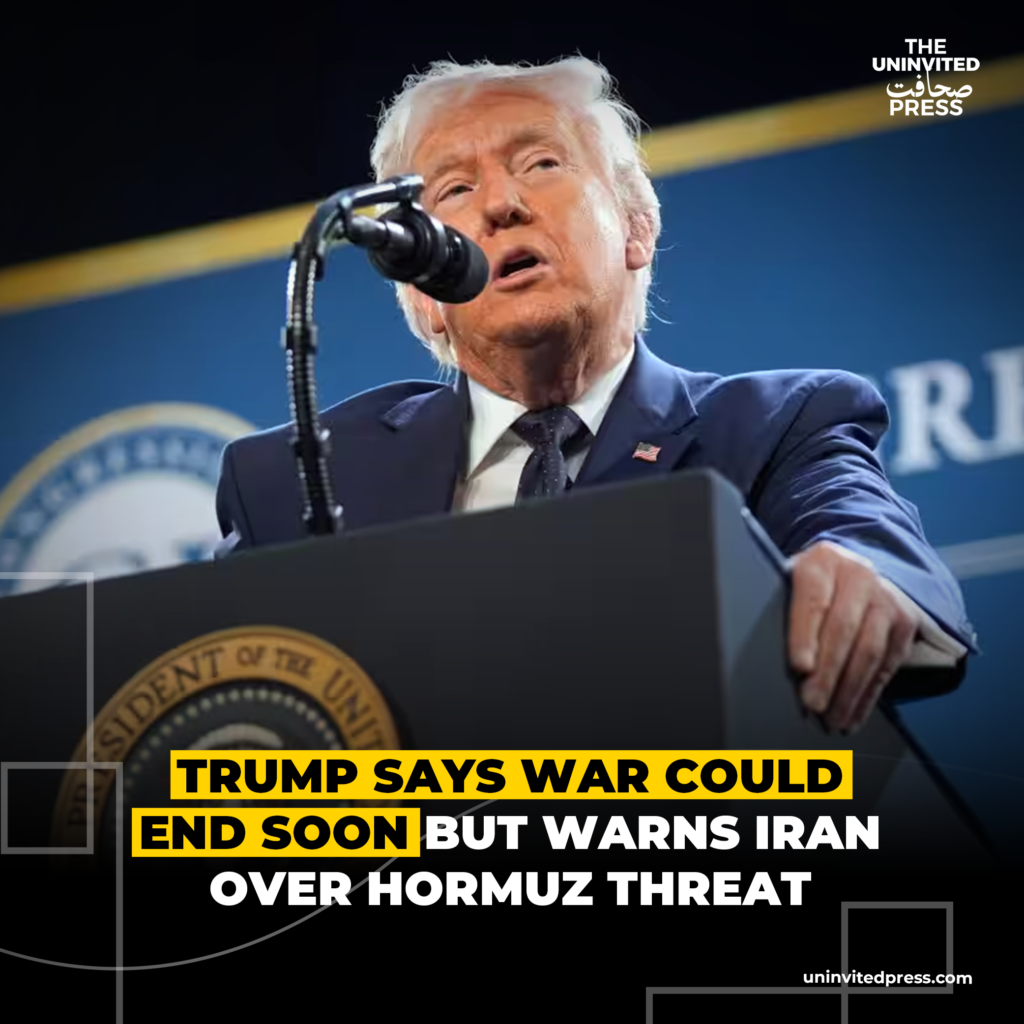
President Trump announces the U.S.-Iran war could end soon but warns of severe consequences if Tehran blocks the Strait of Hormuz, amid surging oil prices and regional attacks.
Trump Signals Imminent End to Iran Conflict While Warning Against Hormuz Closure:
In a bold address from the White House, President Donald Trump announced on March 9, 2026, that the ongoing U.S. military campaign against Iran is progressing faster than anticipated and could conclude “very soon.” However, he delivered a pointed warning to Tehran amid its threats to close the Strait of Hormuz, a critical artery for global oil shipments. The statement comes as oil prices surge and regional tensions escalate, highlighting the high stakes for energy security and international trade.
U.S. Strikes Kill Khamenei, Iran Closes Hormuz and Targets Gulf Energy:
President Trump, speaking to reporters on March 9, 2026, expressed confidence in the U.S. military’s progress against Iran, declaring the operation “ahead of schedule” and predicting an imminent end to hostilities. He emphasized that key Iranian assets, including missile launchers and leadership figures, have been neutralized, with 48 high-level officials eliminated in initial strikes.
The conflict erupted on February 28, 2026, when U.S. forces launched precision strikes that killed Iran’s Supreme Leader Ayatollah Ali Khamenei, citing intelligence of an “imminent threat” to U.S. interests and allies, particularly Israel. Trump described the action as necessary to prevent Iran from acquiring nuclear weapons, claiming it averted a catastrophe where “Israel would have been annihilated.”
In response, Iran appointed Mojtaba Khamenei, the late leader’s son and a hardline figure, as the new Supreme Leader on March 9, signaling no intention to de-escalate. Tehran retaliated by targeting energy infrastructure in Qatar and Saudi Arabia, halting liquefied natural gas production in Qatar and disrupting oil flows. Iranian Revolutionary Guards Commander Sardar Jabbari announced the closure of the Strait of Hormuz, vowing to “burn any ship” attempting passage.
Trump addressed these threats directly, stating that if Iran interferes with shipping, “they’ll get hit at a much much harder level.” He added that the U.S. Navy is prepared to escort tankers through the strait if necessary, and hinted at potentially “taking over” the waterway to ensure free flow of energy. “No matter what, the United States will ensure the FREE FLOW of ENERGY to the WORLD,” Trump posted on social media.
As of March 10, 2026, U.S. officials report seven American soldiers killed in the conflict, with operations described as “decimated” Iran’s military capacity. Global markets reacted sharply, with crude oil prices jumping 7% and natural gas up 5% due to the disruptions.
From JCPOA Withdrawal to Hormuz Chokepoint Crisis:
The U.S.-Iran war marks the most significant escalation since Trump’s return to office in January 2025, following his 2024 election victory. Tensions have simmered since Trump’s first term, when he withdrew from the 2015 Iran nuclear deal and imposed “maximum pressure” sanctions. Recent triggers include U.S. allegations of Iranian nuclear advancements and support for proxy groups like Hezbollah and the Houthis, amid broader Middle East instability.
The Strait of Hormuz is a strategic chokepoint, handling about 20% of global oil trade. Iran has repeatedly threatened closure during past crises, but this is the first outright declaration amid active warfare. The conflict has drawn in regional players, with Gulf states facing direct attacks, prompting discussions of ending neutrality.
This war underscores shifting U.S. foreign policy under Trump, emphasizing preemptive action against perceived threats, similar to operations in Venezuela cited by the president. Public support in the U.S. remains low, with polls showing only one in four Americans backing the strikes.