

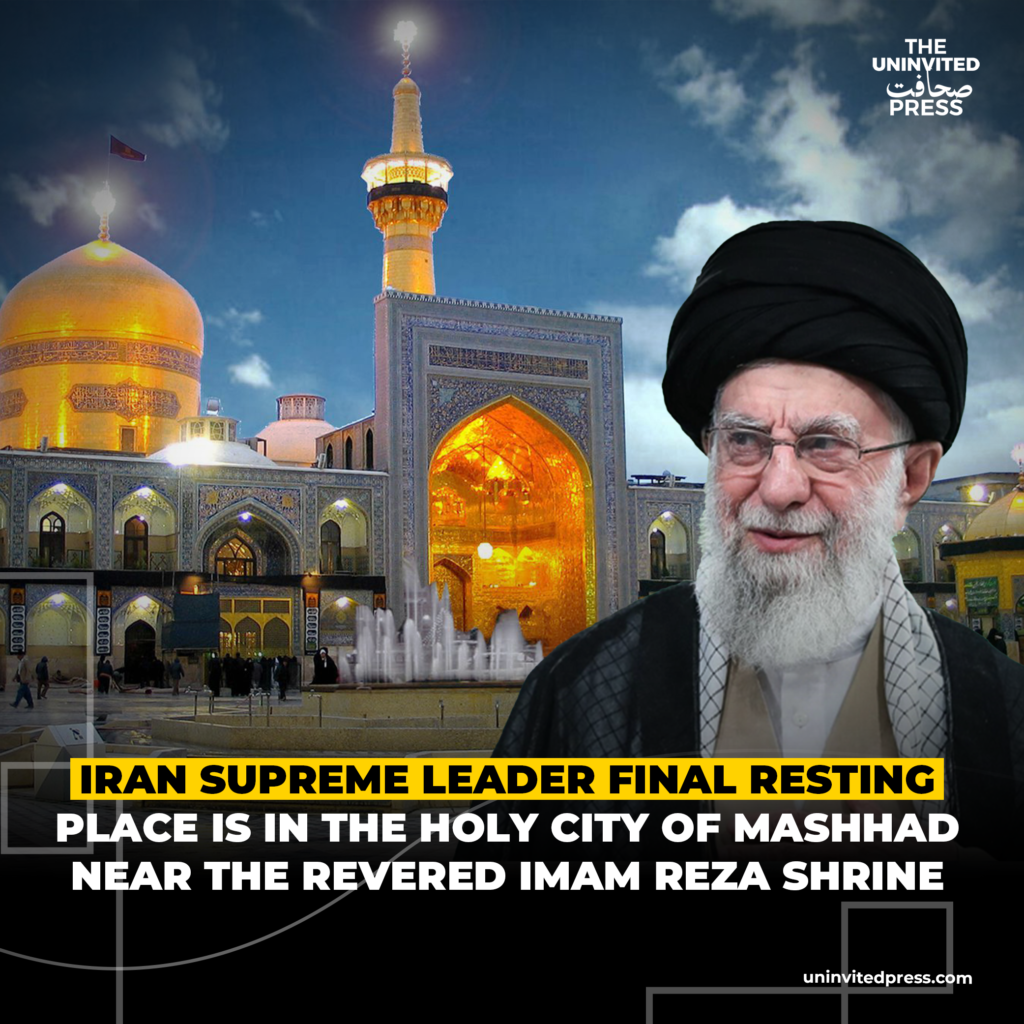
Iran’s Supreme Leader Ayatollah Khamenei, killed in US-Israeli strikes, will be buried in Mashhad’s Imam Reza Shrine amid national mourning and a tense succession battle.
Khamenei's Burial Set for Mashhad Shrine Amid National Mourning and Succession Uncertainty:
Iran’s state media announced Tuesday that Supreme Leader Ayatollah Ali Khamenei, killed in a devastating US-Israeli airstrike, will be laid to rest in his birthplace of Mashhad near the hallowed Imam Reza Shrine-a site of immense religious significance that draws millions of Shia pilgrims annually. This revelation comes as Iran declares 40 days of national mourning, forms a temporary leadership council, and braces for a fraught succession process under the shadow of ongoing warfare. Khamenei’s death at 86, after 37 years of iron-fisted rule, could unravel the Islamic Republic’s power structure, escalating Middle East tensions to unprecedented levels and raising global concerns over nuclear escalation and regional stability.
Escalation and Aftermath: Strikes, Retaliation, and Delayed Mourning:
The sequence of events began on February 28, 2026, when US and Israeli forces launched a coordinated aerial assault on Tehran, striking multiple high-value targets including Khamenei’s private residence. Iranian state media confirmed his death early the next day, reporting he was in his office at the time of the attack. The strikes, described by US President Donald Trump as aimed at regime change, continued into subsequent days, hitting cities across Iran and resulting in over 900 civilian and military casualties, according to Iran’s health ministry.
In response, Iran fired ballistic missiles at Israeli and US positions, with reports of casualties in Israel. On March 1, a temporary leadership council was formed per Iran’s constitution, comprising President Masoud Pezeshkian, Judiciary Chief Gholamhossein Mohseni Ejei, and a Guardian Council representative. By March 3, the semi-official Fars news agency revealed burial plans for Mashhad, though a planned farewell ceremony in Tehran was postponed due to security threats from ongoing bombardments.
Crowds gathered in Tehran and Mashhad to mourn, with black flags adorning streets and shrines. Israeli forces reportedly struck an Assembly of Experts meeting on March 3, killing several clerics involved in the succession process.
Khamenei's Legacy, Symbolic Burial, and the Risks of Succession Crisis:
Khamenei’s rule began in 1989 following the death of Ayatollah Ruhollah Khomeini, the Islamic Revolution’s founder. As supreme leader, he wielded ultimate authority over Iran’s military, judiciary, and foreign policy, fostering alliances with proxy groups like Hezbollah and Hamas while pursuing nuclear ambitions that drew international sanctions. His enmity toward the US and Israel intensified after the 2020 US assassination of General Qasem Soleimani, leading to proxy wars and direct confrontations, including a 2025 Israel-Iran conflict.
The 2026 strikes appear rooted in escalating attacks: Iran’s support for regional militias prompted US-Israeli retaliation, culminating in “Operation Epic Fury.” Mashhad’s selection as burial site holds deep symbolism-it’s Iran’s second-largest city, Khamenei’s birthplace, and home to the Imam Reza Shrine, Shia Islam’s third-holiest site after Mecca and Medina. The shrine, attracting 30 million visitors yearly, underscores Khamenei’s clerical legacy.
This wartime death is unprecedented, testing Iran’s theocratic system amid internal dissent from economic woes and past protests. It could trigger power struggles between hardliners, moderates, and the Revolutionary Guards (IRGC), potentially destabilizing the region further.