

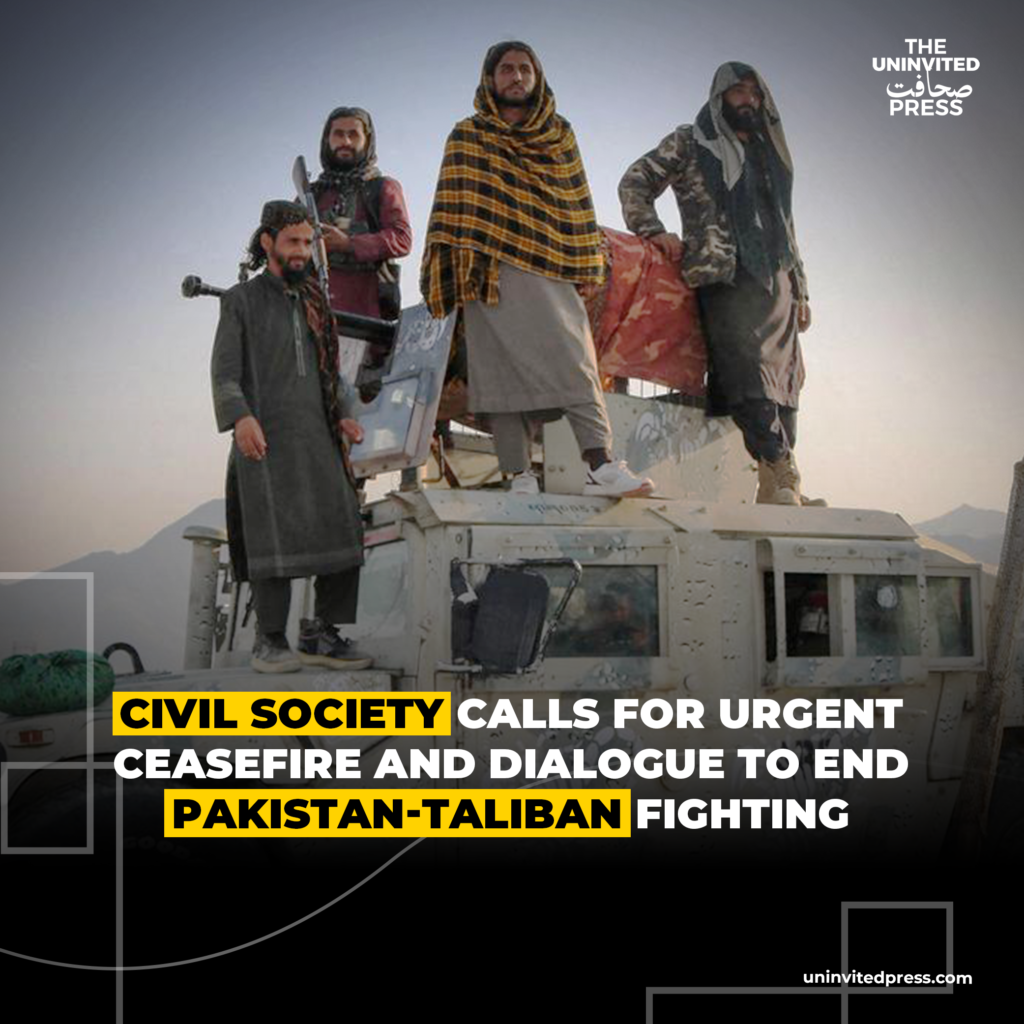
Civil society groups demand urgent ceasefire in Pakistan-Taliban border war, condemning civilian deaths and urging dialogue amid escalating clashes in March 2026.
Humanitarian Plea Amid Escalating War:
Civil society organizations across Afghanistan and Pakistan are raising alarms over the intensifying border conflict, issuing joint calls for an immediate ceasefire and political talks to halt the violence that has already killed dozens of civilians. As fighting enters its second week, these pleas highlight the dire humanitarian toll, with thousands displaced and essential aid disrupted in a region already scarred by decades of instability.
This outcry from activists and NGOs underscores a growing consensus that military action alone cannot resolve deep-rooted grievances, potentially pressuring both sides toward negotiation amid international mediation efforts.
AHRO Condemns Strikes, Urges Dialogue:
The Afghanistan Human Rights Organization (AHRO) condemned Pakistani airstrikes on Afghan territory, citing civilian casualties and property damage, and called for an immediate ceasefire, a UN-led investigation, and adherence to international law. On March 4, civil society and human rights groups echoed these demands, urging political dialogue and protection of civilians as the conflict escalates.
The clashes began on February 21 with Pakistani strikes on alleged TTP and ISIS-K camps in Nangarhar, Paktika, and Khost, killing 18 civilians. Afghan forces retaliated, claiming 55 Pakistani soldiers killed and border posts seized. Pakistan launched Operation Ghazab Lil Haq, targeting Taliban positions in Kabul, Kandahar, and elsewhere. Heavy shelling continued, including strikes on Bagram air base and a refugee camp in Kunar province, killing at least three civilians and displacing 650 families. By March 5, fighting persisted across seven Afghan border provinces, with UN reports of at least 42 civilian deaths and 104 injuries.
Pashtun Divide Fuels Pakistan-Taliban Clash:
The Durand Line, drawn in 1893 by British colonial authorities, has been a perennial source of dispute, with Afghanistan rejecting it as an artificial division of Pashtun ethnic groups. Relations worsened after the Taliban’s 2021 takeover in Kabul, as Pakistan accused them of harboring TTP militants responsible for over 600 attacks in Pakistan during 2025.
A ceasefire in October 2025, mediated by Qatar and Turkey, collapsed amid failed talks in November, leading to the current escalation. Recent terror incidents in Pakistan, including a mosque bombing in Islamabad killing 36, prompted the February 21 strikes.
The conflict risks empowering extremists like TTP and ISIS-K, disrupting trade routes vital to the China-Pakistan Economic Corridor, and destabilizing nuclear-armed Pakistan. Afghanistan’s recovery from recent earthquakes is further hampered, with strikes targeting vulnerable refugee camps.