

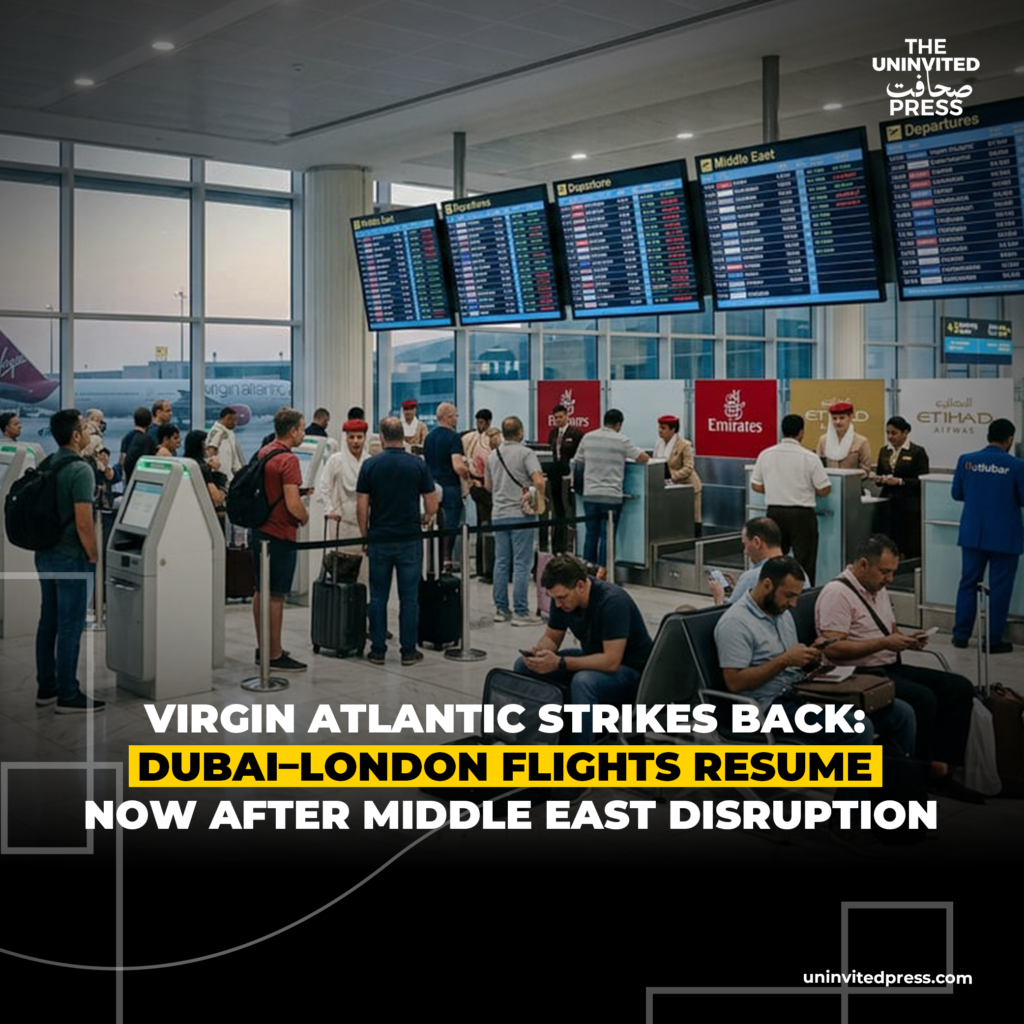
Virgin Atlantic resumes Dubai-London flights on March 3, 2026, after US-Israeli strikes on Iran disrupt Middle East airspace, signaling recovery amid ongoing tensions.
Virgin Atlantic Restarts Dubai-London Flights:
Virgin Atlantic has restarted its daily flights between London Heathrow and Dubai, marking a critical step toward normalizing air travel disrupted by the US-Israeli strikes on Iran. The resumption, effective March 3, 2026, comes after days of cancellations that left thousands stranded amid closed airspace across the Gulf, highlighting the fragility of global aviation in conflict zones.
This move not only aids passengers but signals a tentative de-escalation in the region, though ongoing rerouting could extend flight times and underscore persistent risks.
Conflict Erupts: Strikes, Closures, and Flight Chaos:
The disruption began on February 28, 2026, when the US and Israel launched coordinated strikes on Iranian targets, including leadership compounds and nuclear facilities in Tehran, Isfahan, and other cities. These attacks, codenamed Operation Epic Fury by the US and Operation Roaring Lion by Israel, resulted in the assassination of Iran’s Supreme Leader Ali Khamenei and prompted Iran to close the Strait of Hormuz and retaliate with missile strikes. The conflict quickly escalated, leading to widespread airspace closures in the Middle East, affecting major hubs like Dubai and Abu Dhabi.
Virgin Atlantic suspended its Dubai and Riyadh services immediately, canceling flights such as VS400 from London to Dubai on February 28, March 1, and March 2, and equivalent return legs. Other carriers, including Emirates and Etihad, followed suit, with some extending halts until March 6. By March 2, limited airspace reopening allowed repatriation flights, paving the way for commercial resumptions.
On March 3, Virgin Atlantic became one of the first European airlines to restart, with VS400 departing London Heathrow for Dubai and VS242 for Riyadh. The return flight VS401 from Dubai arrived in London on March 4, about an hour late due to rerouting. Riyadh returns resumed similarly. No safety issues were reported on these flights, though passengers experienced minor delays.
Scenes at Dubai International Airport showed passengers queuing for check-in amid heightened security. As of March 6, Virgin Atlantic continues operations, advising travelers to check statuses online. The airline has covered expenses for affected passengers and offered flexible re-bookings.
From Failed Talks to Aviation Disruption:
The strikes stem from long-standing tensions over Iran’s nuclear program. In early February 2026, indirect US-Iran talks in Oman failed to curb enrichment activities, which the IAEA noted exceeded civilian needs. US President Donald Trump cited this as justification for strikes, aiming to prevent nuclear weapon development and achieve regime change. Israel, facing threats from Iran-backed groups like Hezbollah, joined to target missile sites and leadership.
Historically, aviation has been vulnerable in the region; similar disruptions occurred during the 2023-2024 Israel-Hamas war and 2019 US-Iran tensions. The February 28 attacks closed key air corridors, halting over 1,000 daily flights through Dubai alone, the world’s busiest international hub. Economic impacts include billions in losses for airlines and tourism-dependent UAE.
It boosts confidence in regional stability, aiding UAE’s economy where aviation contributes 13% to GDP. However, it exposes ongoing vulnerabilities, with potential for renewed closures if Iran retaliates further.