

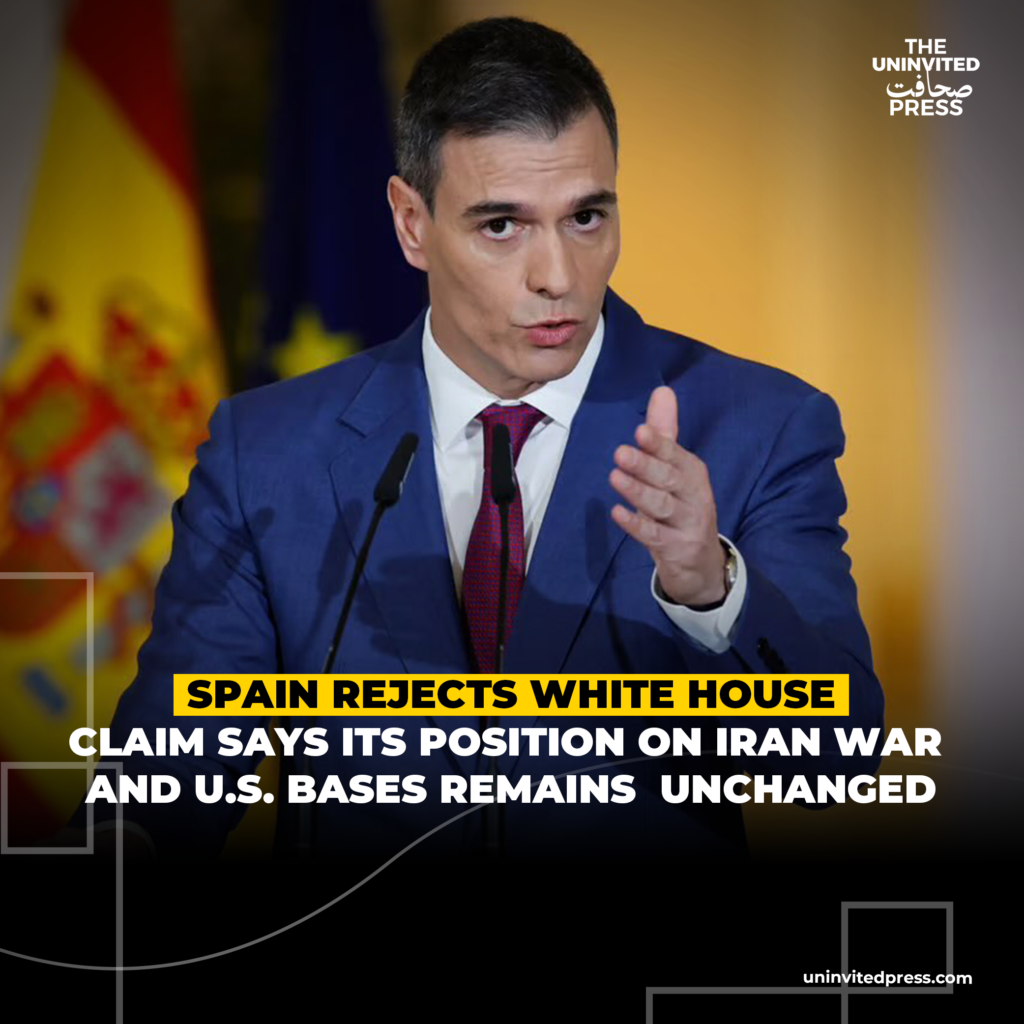
Spain categorically denies White House claim of cooperation in Iran war, affirming unchanged stance on U.S. bases amid rising diplomatic tensions and Middle East conflict.
Spain Firmly Rejects White House Claim on Iran War Cooperation:
Spain has swiftly dismissed a White House claim that it has agreed to support U.S. military operations in the ongoing war against Iran, insisting its policy on the conflict and the use of American bases on Spanish soil remains unaltered. The rebuttal from Foreign Minister José Manuel Albares highlights deepening rifts between NATO allies amid a rapidly widening regional crisis that has already claimed hundreds of lives and disrupted global markets. This clash could signal broader challenges for U.S. efforts to rally international support in its joint campaign with Israel.
Timeline of the Diplomatic Clash:
The diplomatic exchange unfolded rapidly on March 4, 2026, against the backdrop of the fifth day of intense U.S.-Israeli military operations in Iran. White House Press Secretary Karoline Leavitt told reporters during a briefing that Spain had “heard the president’s message yesterday loud and clear” and had “agreed to cooperate with the U.S. military.” She implied coordination was already underway between U.S. and Spanish counterparts, framing it as a response to President Donald Trump’s earlier threat to sever trade ties with Madrid.
Mere hours later, Spanish Foreign Minister José Manuel Albares appeared on Cadena SER radio and categorically refuted the claim. “The position of the Spanish government regarding the war in the Middle East, the bombing of Iran and the use of our bases has not changed one iota,” Albares stated. He emphasized that any use of Spanish bases must adhere to bilateral agreements and international law, specifically requiring U.N. authorization for operations beyond defensive purposes.
This incident caps a tense sequence of events. The U.S.-Israel offensive, dubbed “Operation Epic Fury,” began on February 28, 2026, with airstrikes that killed Iran’s Supreme Leader Ayatollah Ali Khamenei and other top officials, triggering retaliatory attacks from Tehran across the region. By March 1, Spain’s Prime Minister Pedro Sánchez publicly condemned the strikes as “an unjustified and dangerous military intervention” violating international law. Madrid then barred U.S. forces from using the jointly operated bases in Rota (a naval facility) and Morón (an air base) for the campaign, leading to the Pentagon relocating tanker aircraft elsewhere.
On March 3, Trump escalated by warning of a complete trade cutoff with Spain, accusing it of endangering American lives by withholding support. Leavitt’s claim the next day appeared to suggest a breakthrough, but Albares’ swift denial quashed that narrative, calling the White House assertion baseless.
Spain Asserts Veto, Avoids U.S. Involvement in Iran Conflict:
Spain’s stance is rooted in a long-standing defense pact with the U.S., dating back to the 1953 Madrid Pact, which allows American forces access to bases in exchange for security guarantees. However, the agreement grants Spain veto power over non-NATO operations, a clause Madrid has invoked here to align with its emphasis on multilateralism and de-escalation.
Under Socialist Prime Minister Pedro Sánchez, who has led Spain since 2018, the government has frequently diverged from U.S. policies in the Middle East. Sánchez has criticized past U.S. actions, including in Iraq and Gaza, and positioned Spain as a proponent of international law and dialogue. This war marks a flashpoint: The U.S.-Israel strikes have hit over 2,000 targets in Iran, killing more than 920 people according to Iranian reports, while expanding to involve Hezbollah in Lebanon, and strikes on U.S. assets in the Gulf. Iran’s retaliatory drone and missile attacks have targeted U.S. embassies, bases, and allies like Bahrain and Kuwait, raising fears of a broader regional conflagration.
The conflict’s origins trace to escalating U.S.-Iran tensions in January 2026, fueled by Iran’s nuclear program and internal crackdowns following 2025-2026 protests. Failed nuclear talks in Geneva on February 26 preceded the strikes, with Trump opting for military action to dismantle Iran’s leadership and capabilities. For Spain, refusing base access avoids entanglement in what it views as an unauthorized war, but it risks economic fallout-U.S.-Spain trade exceeds $50 billion annually, with Spain exporting goods like machinery and pharmaceuticals.