

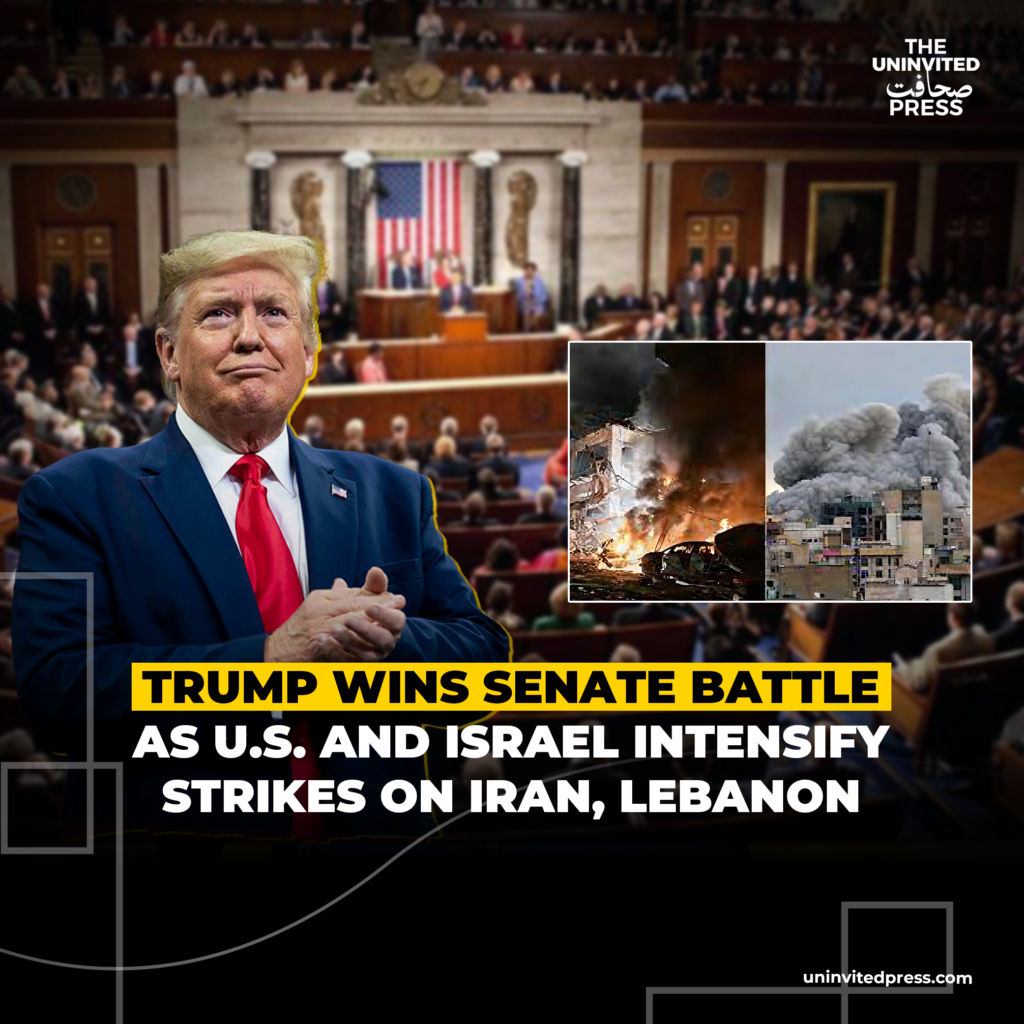
Trump triumphs in Senate as Republicans block Iran war curbs; US-Israel airstrikes escalate in Tehran and Beirut amid rising deaths and oil disruptions.
Trump Secures Senate Win as Iran-Lebanon Strikes Escalate:
President Donald Trump secured a crucial Senate victory on March 4, 2026, as Republicans blocked a bipartisan war powers resolution that would have required congressional approval for ongoing military actions against Iran. The 53-47 vote came amid escalating U.S.-Israeli airstrikes on Tehran and Hezbollah positions in Beirut, marking the fifth day of a conflict that has claimed over 1,000 lives and disrupted global oil supplies. This defeat for critics highlights deep partisan rifts in Washington, empowering Trump to press forward with what he calls a “decisive” operation, while raising fears of a prolonged war that could engulf more nations and spike energy prices worldwide.
Senate Blocks War Powers as US-Israel Strikes:
The Senate showdown unfolded on March 4, 2026, with Republicans voting largely along party lines to defeat a procedural motion advancing the war powers resolution sponsored by Democratic Sen. Tim Kaine. The measure, which passed the House earlier, aimed to invoke the 1973 War Powers Act, requiring Trump to seek congressional authorization for further hostilities against Iran unless defending against imminent attack. Only one Republican, Sen. Rand Paul, supported it, while one Democrat opposed.
Trump praised the outcome during a White House briefing, stating the U.S. is “in a very strong position” and “doing very well on the war front.” He projected the campaign could last four to eight weeks but emphasized flexibility, saying “whatever it takes.”
Simultaneously, military operations ramped up. U.S. and Israeli forces conducted over 60 attack waves on Iran, hitting central command in Tehran, nuclear sites like Natanz, and leadership compounds. The conflict, dubbed “Operation Epic Fury,” began February 28 with strikes that killed Supreme Leader Ayatollah Ali Khamenei and other officials. By March 3, Hezbollah entered the fray, launching missiles from Lebanon into Israel, prompting Israeli airstrikes on Beirut’s southern suburbs and other militant sites.
Iran retaliated with missile and drone attacks on U.S. bases in the Gulf, Israeli territory, and allies like Bahrain and Kuwait. On March 4, strikes hit the U.S. Embassy in Riyadh, leading to closures across the region. Lebanese state media reported at least 31 killed in Israeli strikes that day.
Roots of the Conflict and Path to Escalation:
The war stems from years of U.S.-Iran tensions, exacerbated by Iran’s nuclear program, support for proxies like Hezbollah, and failed diplomacy. Trump withdrew from the 2015 nuclear deal in 2018, imposing sanctions that crippled Iran’s economy. Escalations peaked in early 2026 with stalled Geneva talks and Iran’s uranium enrichment advances.
Israel, viewing Iran as an existential threat, has long advocated strikes on its nuclear facilities. Hezbollah’s involvement revives memories of the 2006 Lebanon War, where the group fought Israel to a stalemate. The current offensive aims at regime change, with U.S. officials like Defense Secretary Pete Hegseth stating the U.S. is “accelerating, not decelerating.”