

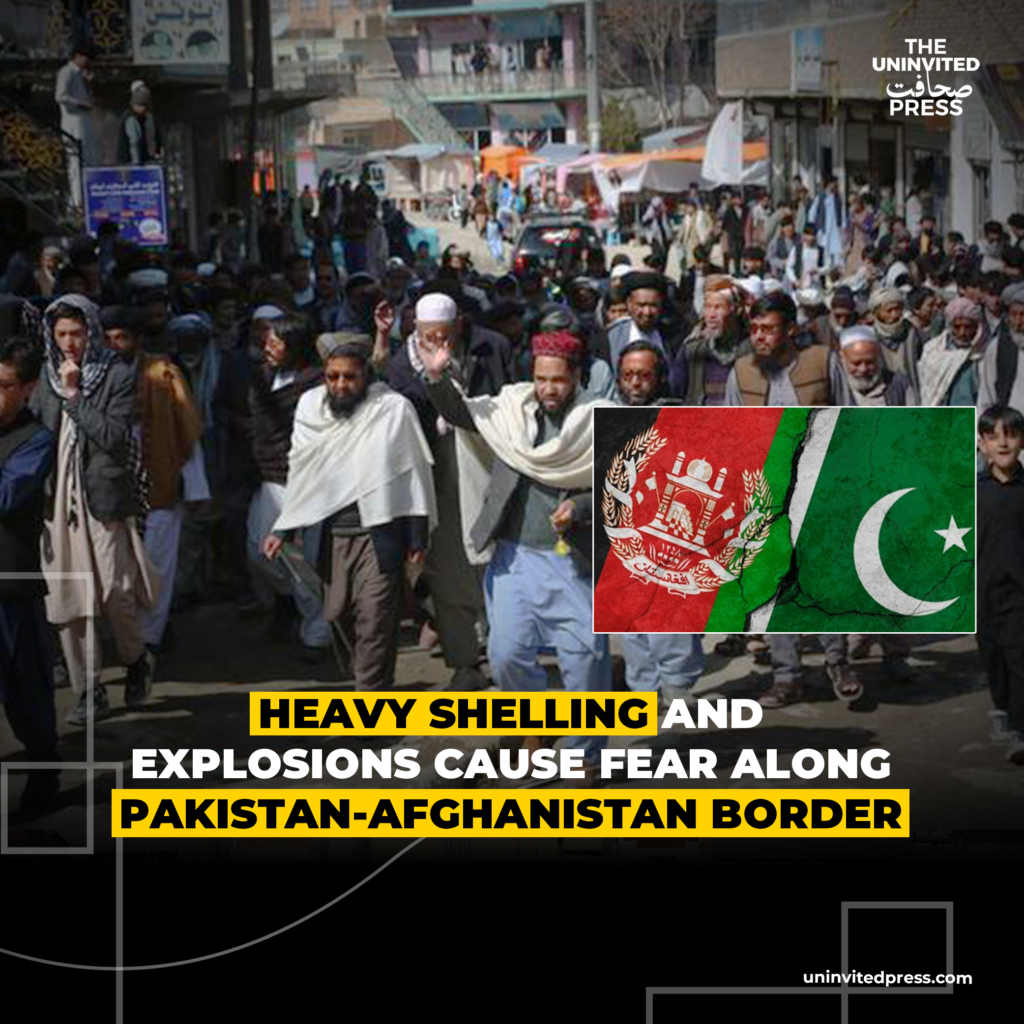
Heavy shelling along Pakistan-Afghanistan border sparks fear, displacing 1,500 families and killing dozens of civilians as clashes enter seventh day in March 2026.
Civilians Trapped in the Crossfire: Seventh Day of Terror Along the Border:
Intense artillery fire and blasts are terrorizing communities along the Pakistan-Afghanistan frontier, with families caught in the crossfire during evening hours when shelling peaks. As the conflict hits its seventh day, thousands have been uprooted, seeking refuge in makeshift camps amid mounting civilian deaths that highlight the human cost of this escalating feud.
This border violence, rooted in accusations of militant harboring, threatens to spiral into a wider regional instability, exacerbating Afghanistan’s humanitarian woes and straining Pakistan’s security efforts.
February 21 to March 5: How Border Skirmishes Exploded into Full-Scale Retaliation?
The clashes intensified on February 21 when Pakistan launched airstrikes in Afghanistan’s Nangarhar, Paktika, and Khost provinces, targeting alleged camps of the Tehrik-i-Taliban Pakistan (TTP) and ISIS-K. These strikes followed terror attacks in Pakistan, including a mosque bombing in Islamabad killing 36. Afghanistan reported 18 civilian deaths from these initial strikes.
By February 24, border firefights erupted, with Afghanistan accusing Pakistan of starting the violence. On February 26, Afghan forces mounted a major retaliatory operation, claiming to kill 55 Pakistani soldiers and seize posts. Pakistan countered with Operation Ghazab Lil Haq, striking Taliban infrastructure in Kabul, Kandahar, and other areas.
Heavy shelling dominated from February 27 onward, with Pakistani airstrikes hitting Bagram air base and ammunition depots, confirmed by satellite imagery. Afghanistan claimed downing a Pakistani jet, later clarified as a mistake. By March 3, clashes killed 67 Afghan fighters per Pakistan, with one Pakistani soldier dead.
On March 4, artillery struck a refugee camp in Kunar, killing three and injuring seven, displacing 650 families. Explosions and shelling have forced residents to flee, with sounds echoing during iftar in Ramadan.
As of March 5, strikes destroyed a Taliban brigade headquarters in Kandahar. Fighting continues, worsening displacements.
Durand Line Dispute: From 1893 to Today’s War:
The Durand Line, established in 1893, remains disputed, with Afghanistan rejecting it as a colonial imposition dividing Pashtun communities. Post-2021 Taliban rule in Kabul, relations soured over Pakistan’s claims that TTP militants operate from Afghan soil, fueling over 600 attacks in Pakistan in 2025.
A 2025 ceasefire collapsed amid failed talks. Recent terror incidents in Pakistan prompted the February strikes, escalating to “open war” as declared by Pakistan’s defense minister.
It risks empowering extremists, disrupting trade, and involving nuclear-armed Pakistan in prolonged instability. Afghanistan’s earthquake recovery is hampered, with strikes hitting vulnerable camps.