

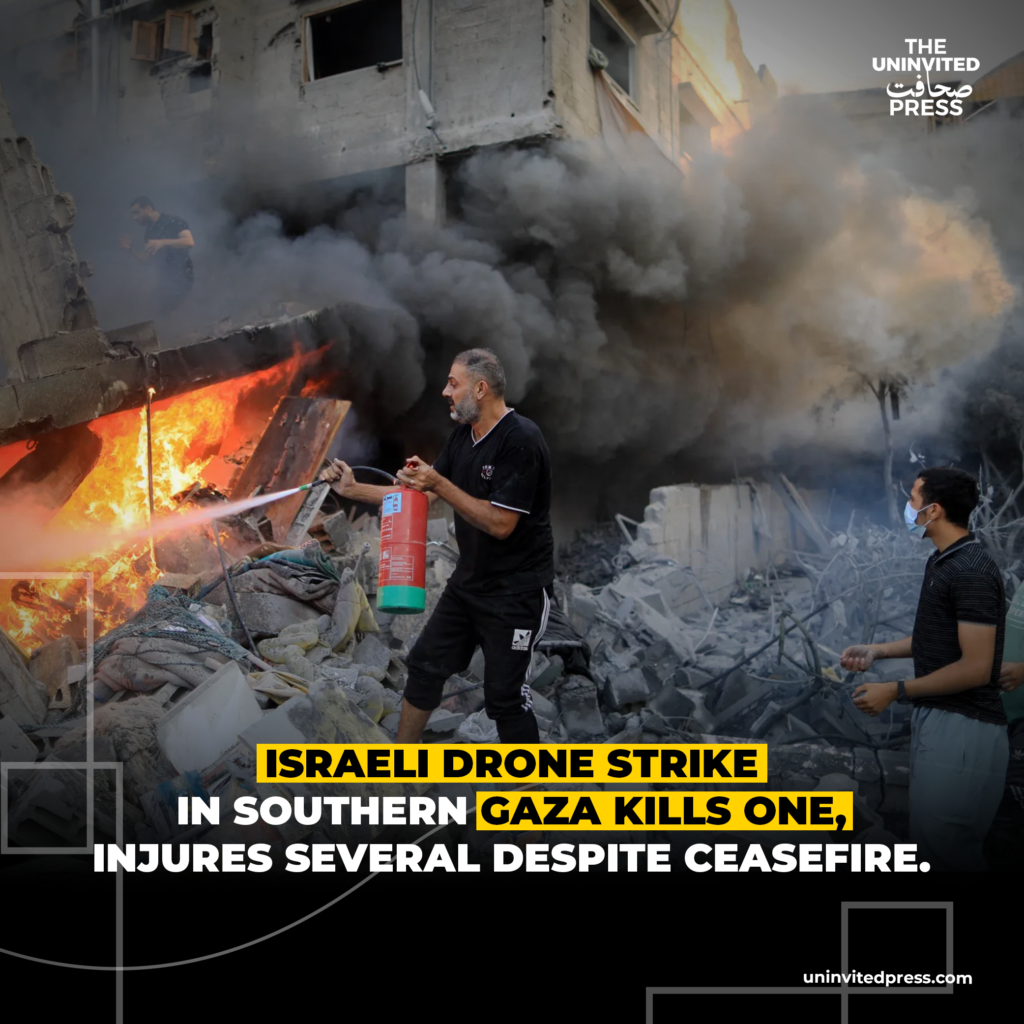
Israeli drone strike south of Khan Younis kills one Palestinian and injures several others in latest reported breach of the fragile Gaza ceasefire, February 2026.
Drone Strike Hits Civilians South of Khan Younis:
A Palestinian was killed and several others wounded late Tuesday when an Israeli reconnaissance drone struck a group of civilians in the Ard Al-Zaytoun area south of Khan Younis in the southern Gaza Strip, Palestinian medical and media sources reported Wednesday.
The strike, one of multiple incidents across the enclave in the past 24 hours, sent casualties to Nasser Hospital and triggered immediate rescue efforts amid burning rubble and thick smoke-scenes captured in graphic imagery showing local men desperately fighting flames with fire extinguishers in the devastated landscape.
Multiple Strikes and Civilian Casualties Across Gaza:
Medical sources told WAFA and Anadolu Agency that the drone targeted civilians in the Mawasi area west of Khan Younis, a zone long designated for displaced families. The victim’s body and the injured arrived at Nasser Hospital, the main facility still functioning in southern Gaza despite repeated damage during the 2023-2025 war.
Separate but concurrent incidents included Israeli shelling in the nearby Ard al-Laymoun area south of Khan Younis, where 27-year-old Akram Hassan al-Arjani was killed, and quadcopter drone fire wounding a civilian near Abu Hussein School in northern Gaza. Gaza’s Government Media Office and Health Ministry described the attacks as clear breaches of the truce.
Rescue footage and stills from the scene show thick black smoke billowing from piles of concrete and twisted rebar, with civilians in everyday clothing-one man in a black sports shirt wielding a red fire extinguisher-battling flames while others stand amid the debris. The imagery, widely circulated by local journalists and The Uninvited Press, captures the raw human cost in an area where many residents had only recently begun tentative returns to assess ruined homes.
Gaza Ceasefire Remains Unstable as Violations Persist:
The October 2025 ceasefire, brokered by the United States under President Donald Trump and witnessed by leaders in Egypt and Qatar, ended more than two years of devastating conflict that began with the October 7, 2023 Hamas attacks. The deal initially brought cautious hope: phased hostage releases, increased humanitarian aid convoys, and Israeli troop pullbacks.
By February 2026, however, the second phase-which envisions Hamas surrendering heavy weapons, an international force taking security responsibility, and massive reconstruction funded by Gulf and Western donors-remains largely on paper. Israeli officials have insisted on complete Hamas disarmament before full withdrawal, while Hamas has demanded guarantees of a permanent end to the blockade and a political horizon toward statehood.
Gaza authorities say Israeli forces have carried out hundreds of ceasefire violations since October 10, 2025, including shootings near the yellow line, artillery shelling, and targeted drone and airstrikes. The cumulative death toll from these incidents now exceeds 600, according to the Gaza Health Ministry-a figure cited across Palestinian, Turkish, and Syrian state media but not independently verified by the UN in every case.
Southern Gaza, particularly the Mawasi “humanitarian zone” and areas around Khan Younis, has seen repeated incidents. Many residents displaced multiple times during the war remain in tents and makeshift shelters, vulnerable to any renewed military activity. Reconstruction has barely begun; power remains intermittent, clean water scarce, and hospitals operating at a fraction of capacity.