

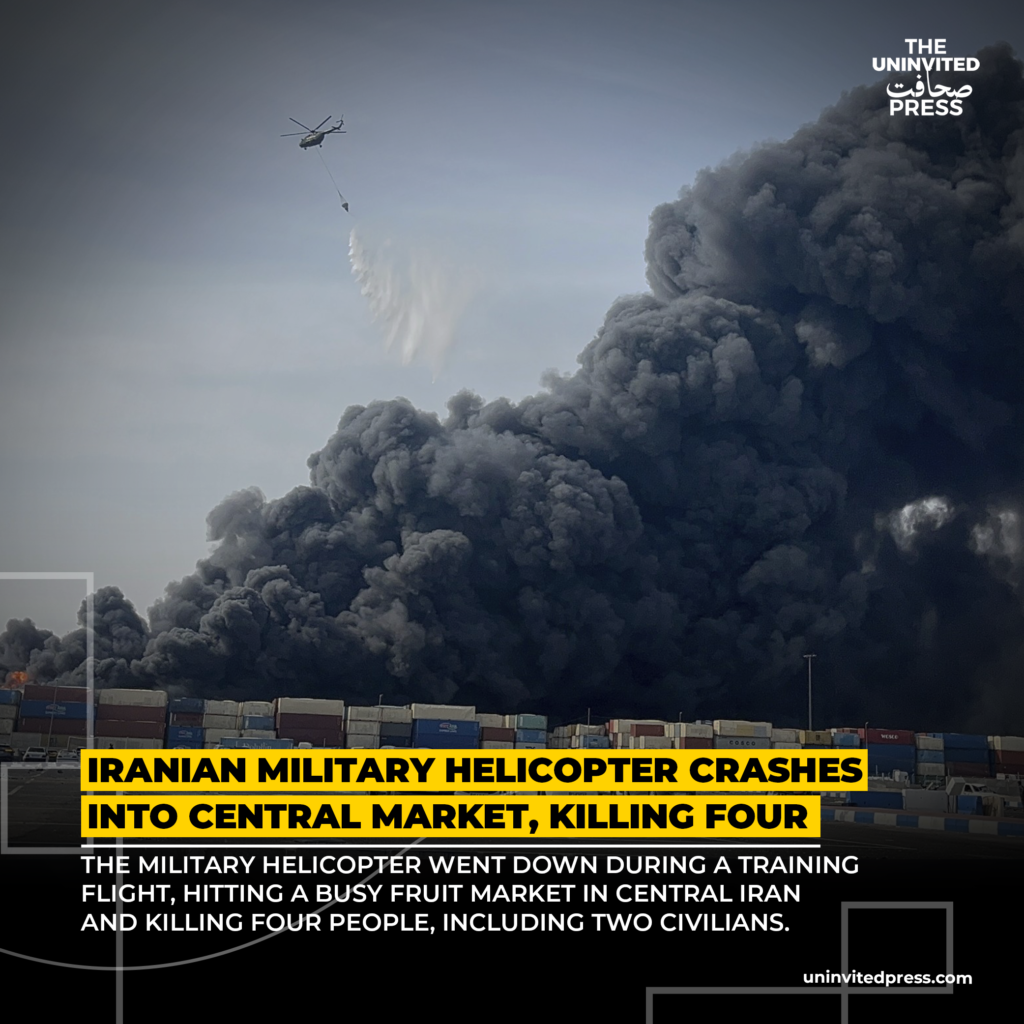
Iranian Army helicopter crashes into fruit market in Dorcheh, Isfahan province on Feb 24 2026, killing pilot, co-pilot and two civilians during training flight.
Iran Army Helicopter Crashes into Crowded Market, Killing Four:
DORCHEH, Iran: A routine training flight by an Iranian Army helicopter ended in tragedy on Tuesday when the aircraft plunged into a crowded wholesale fruit and vegetable market in central Iran, killing four people and sending thick black smoke billowing across the stalls.
The crash struck shortly after 9 a.m. local time in Dorcheh, a town in Khomeyni Shahr County, Isfahan province, about 330 km south of Tehran. The helicopter slammed directly into market stalls, igniting a fire that emergency services quickly brought under control.
Four lives were lost in an instant: the pilot and co-pilot on board, plus two merchants working on the ground in one of the region’s busiest produce hubs.
Training Mission Crash Under Investigation as Officials Seal Site:
According to Iranian state television and semiofficial outlets including Tasnim and Fars, the helicopter was on a standard training mission when it went down in the Dorcheh wholesale fruit and vegetable market. Rescue teams reached the site within minutes, extinguishing the fire and recovering the bodies.
Footage aired on state TV showed twisted debris scattered among overturned crates of produce, thick smoke rising against the morning sky, and emergency crews working amid shipping containers that line the edge of the market compound. The Iranian Red Crescent Society released photos confirming the scale of the impact zone.
All four fatalities were confirmed within hours; the two military aviators and two civilian vendors. No other serious injuries have been officially reported, though local accounts describe chaos as shoppers and workers fled the scene.
The helicopter has been identified as a Bell AH-1J Cobra variant (Iranian-modified Panha 2091 Toufan) operated by the Islamic Republic of Iran Army Aviation. Preliminary assessments shared by officials point to a technical malfunction, though the exact cause-mechanical failure, maintenance issue, or other factor-is still under active investigation.
By mid-afternoon, judicial authorities had sealed the site. Isfahan judiciary head Asadollah Jafari announced a formal case, with the Khomeyni Shahr public prosecutor and military prosecutor personally inspecting the wreckage and ordering a full technical review.
Aging Fleet and Sanctions Renew Safety Concerns After Second Crash:
Iran’s military aviation has faced persistent challenges for decades. The majority of its rotary and fixed-wing fleet dates to before the 1979 Islamic Revolution, when the country operated one of the most advanced air forces in the region with U.S.-supplied equipment. Comprehensive sanctions imposed after the revolution have severely restricted access to original spare parts, forcing reliance on reverse-engineered components, third-party suppliers, and creative maintenance practices.
This crash is the second serious Iranian military aviation incident in less than a week. On February 18, a U.S.-built F-4 Phantom fighter jet crashed during a training flight near Hamedan in western Iran, killing one pilot. Both incidents involved training missions and have renewed questions about fleet readiness.
Isfahan province is a strategic military hub, home to a major air base and sensitive facilities. While the Dorcheh market crash appears unrelated to any external threat or conflict, it occurs against the backdrop of heightened regional tensions following last year’s Iran-Israel exchanges.
Aviation experts have repeatedly warned that Iran’s aging aircraft, combined with the cumulative effect of sanctions, create elevated risks during high-tempo training operations. Tuesday’s tragedy brings those risks into sharp, public focus in a busy civilian marketplace-turning a routine military exercise into a deadly reminder of the human cost when systems pushed to their limits finally give way.