

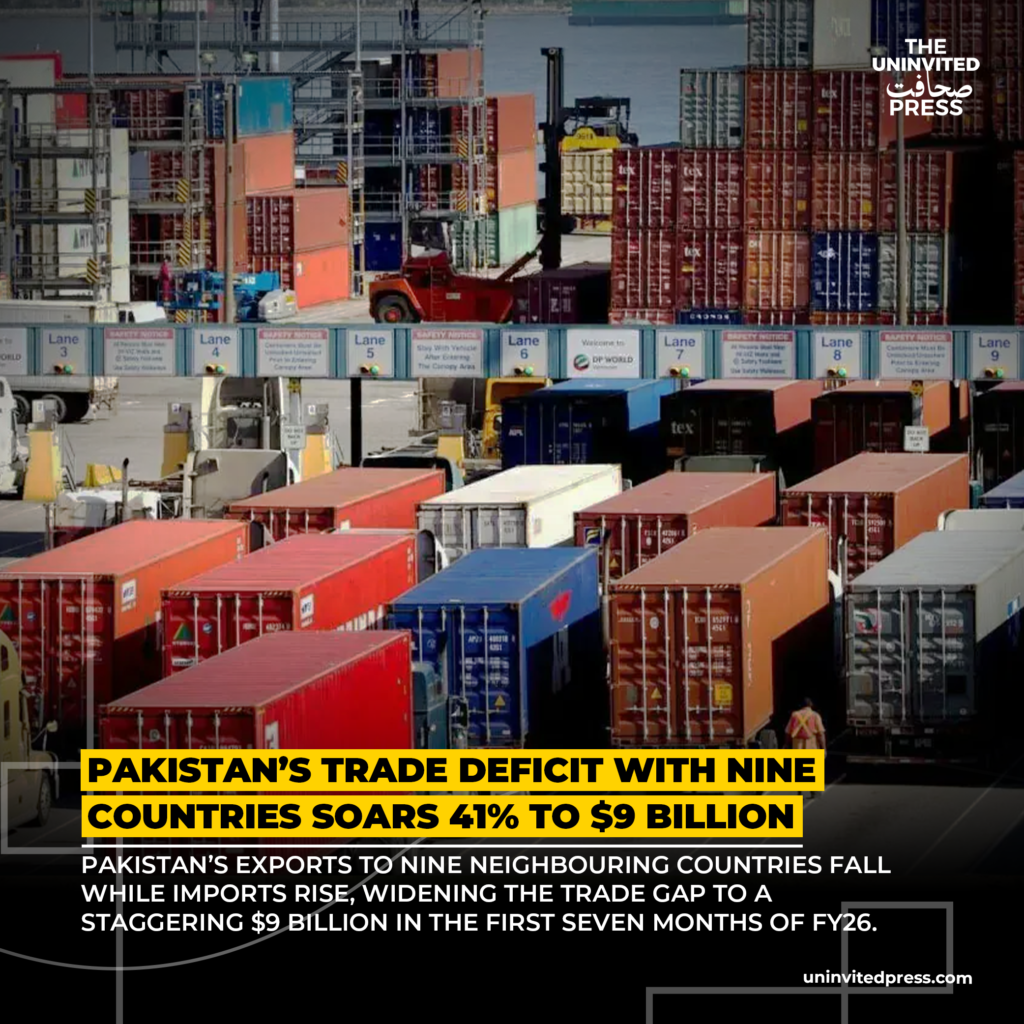
Pakistan’s trade deficit with nine regional countries surged 41% to $9.001 billion in July-January FY26 as exports fell 17% and imports from China rose 25%.
Pakistan’s Regional Trade Gap Widens Sharply, Raising Economic Alarm:
ISLAMABAD: Pakistan’s trade imbalance with its nine key regional partners has ballooned dramatically, surging 41.37% to $9.001 billion in the first seven months of fiscal year 2026 (July-January), according to fresh data from the State Bank of Pakistan. Exports to these markets collapsed by 16.86% to $2.307 billion, while imports climbed 23.69% to $11.31 billion-a stark reversal that is draining foreign reserves and highlighting chronic weaknesses in the country’s export engine.
The deficit spike, reported February 24, 2026, by Dawn and Profit Pakistan Today, comes as Pakistan grapples with a fragile economic recovery, persistent inflation pressures, and the fallout from prolonged border closures with Afghanistan.
Regional Trade Slump Deepens Pakistan’s Economic Strain:
The deterioration accelerated sharply in FY26. In the comparable period of FY25, the regional deficit stood at $6.367 billion. By end-FY25 (July-June), it had grown to $12.297 billion-already a 29.42% jump from the prior year. The first seven months of FY26 pushed it even further, with exports dropping across most partners.
China remains the overwhelming source of imports, with the $11.097 billion inflow reflecting ongoing CPEC-related capital goods and industrial inputs. Exports to China dipped modestly by 1.02% to $1.467 billion, showing little reciprocal benefit from the massive infrastructure partnership.
The sharpest decline came with Afghanistan. Bilateral trade-once a bright spot for Pakistani cement, fruits, vegetables, and potatoes-has been frozen since October 10, 2025, following deadly border clashes, Pakistani airstrikes targeting Tehreek-e-Taliban Pakistan (TTP) militants in Afghanistan, and mutual accusations over cross-border terrorism. The closure, now stretching beyond four months, is the longest in recent history. Trucks remain stranded at Torkham and Chaman crossings, with daily economic losses estimated at around $1 million per side in earlier months. Pakistani exporters report monthly losses in the hundreds of millions, while Afghan supplies of fruits and vegetables have vanished, driving up domestic prices for tomatoes (up over 400% at peak) and apples.
Other neighbors saw declines too: exports to Bangladesh fell 10.48%, to Sri Lanka 28.89%. Trade with India remains minimal due to longstanding political tensions, though small increases in some directions offer little offset.
Nationally, the picture is consistent but less extreme: goods exports fell 7.11% to $18.19 billion, imports rose 9.49% to $40.26 billion, yielding a $22.07 billion deficit (up 28.4%). Remittances and services have provided some cushion, but the current account flipped to a $1.07 billion deficit in 7MFY26 after last year’s surplus.
Border Politics and Trade Imbalances Hit Pakistan’s Economy:
Pakistan has long run large deficits with China because it imports far more than it exports-a pattern rooted in the China-Pakistan Economic Corridor, which has delivered power plants, roads and special economic zones but has yet to translate into a surge of Pakistani goods heading the other way. Trade with India remains negligible due to political tensions. Afghanistan, until October 2025, was a rare bright spot for non-traditional exports; its sudden closure-the longest in recent history-has stranded trucks, glutted domestic markets (notably potatoes) and wiped out revenue for border communities on both sides.
The Taliban administration has accused Islamabad of using trade as leverage; Prime Minister Shehbaz Sharif has countered that Pakistan was “forced” to act because Kabul failed to curb cross-border militancy by the TTP. Whatever the rights and wrongs, the economic cost is now quantified-and it is substantial.