

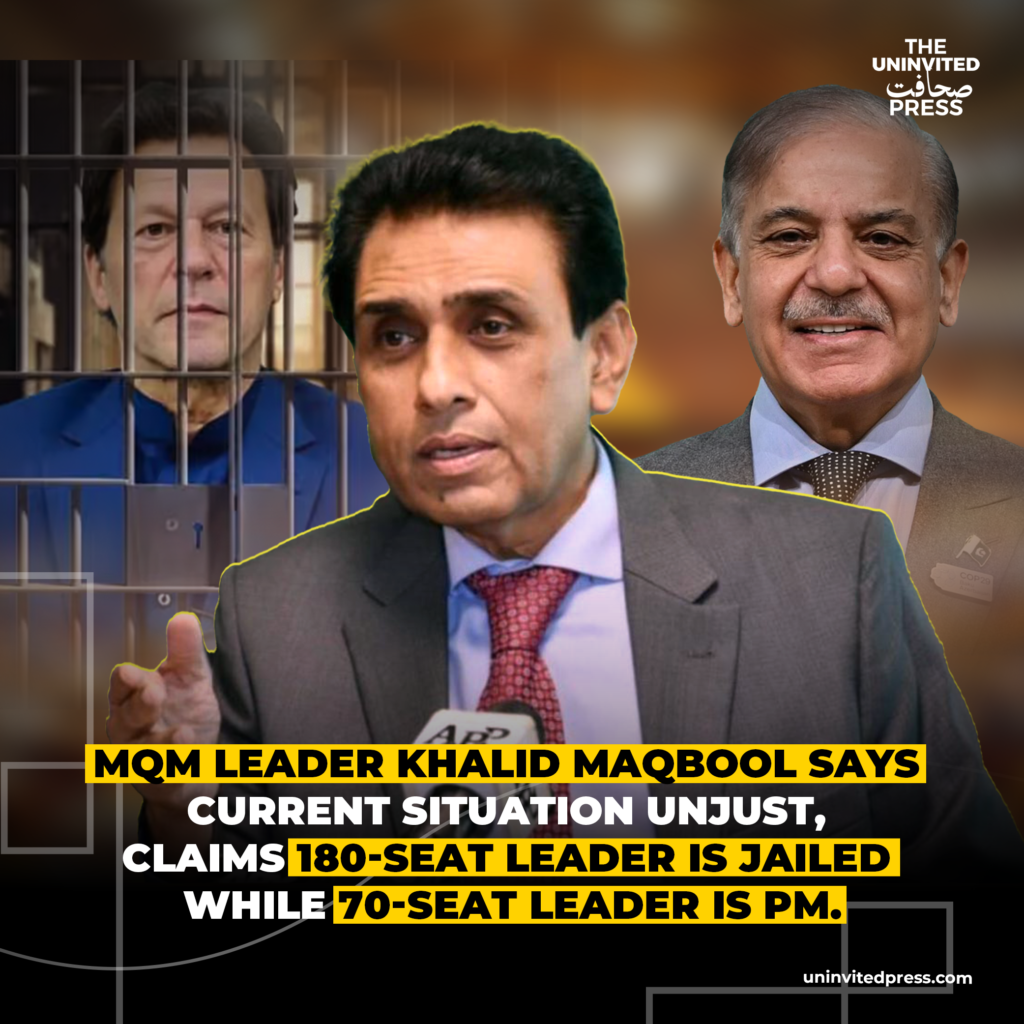
MQM’s Khalid Maqbool Siddiqui calls Pakistan’s politics ‘injustice’ as Imran Khan (180 seats claimed) stays jailed while Shehbaz Sharif (70 seats) leads as PM.
180-Seat Mandate Behind Bars, 70-Seat Rival Rules:
In a stunning rebuke that has sent shockwaves through Pakistan’s already fractured political landscape, Muttahida Qaumi Movement-Pakistan (MQM-P) Convener and Federal Minister for Education Khalid Maqbool Siddiqui has labeled the country’s current governance “sheer injustice and cruelty.” Speaking publicly, Siddiqui highlighted what he sees as a glaring disparity: a leader whose party claims a commanding 180-seat victory in the National Assembly remains imprisoned, while another with support from just 70 seats occupies the prime minister’s office. This pointed criticism comes from within the ruling coalition, raising questions about internal stability and the future of the government amid ongoing tensions over elections, justice, and provincial power-sharing.
MQM-P’s Siddiqui Slams Pakistan’s Political System, Targets PTI, PML-N, and PPP:
The controversy erupted on February 22, 2026, when Siddiqui addressed a gathering in Karachi, MQM-P’s stronghold. According to verified reports, he directly questioned the fairness of Pakistan’s political system, stating, “This is sheer injustice and cruelty that a leader backed by 180 seats remains in jail while another with only 70 seats is serving as Prime Minister.” The remarks were captured in video footage and widely shared on social media platforms, amplifying their reach. Siddiqui’s comments appear to reference Imran Khan, the founder of Pakistan Tehreek-e-Insaf (PTI), who has been incarcerated since August 2023 on multiple charges including corruption and incitement. Khan’s party has long maintained that it secured over 180 seats in the February 8, 2024, general elections but was robbed of victory through widespread rigging. In contrast, Shehbaz Sharif of the Pakistan Muslim League-Nawaz (PML-N) leads the current government with a coalition that includes MQM-P, formed after PML-N secured around 75 seats.
Siddiqui’s speech did not stop at national leadership. He also targeted the Pakistan Peoples Party (PPP), another key coalition ally, accusing it of ruling Sindh through an “artificial majority” and passing unconstitutional resolutions. He specifically criticized a recent Sindh Assembly resolution opposing the division of the province, calling it a challenge to Pakistan’s federal structure. “Can any agreement relating to the Constitution of Pakistan be approved by only one state?” Siddiqui asked rhetorically, emphasizing that such moves undermine national unity. This escalation follows a heated confrontation in the Sindh Assembly on February 20, 2026, where MQM-P lawmakers exchanged threats, leading to the suspension of one member. The incident underscores rising intra-party and inter-party frictions within the coalition.
Pakistan’s Political Turmoil: From 2024 Elections to Coalition Frictions:
Pakistan’s political turmoil traces back to the contentious 2024 elections, widely criticized for irregularities. Official results showed PTI-backed independents winning 93 National Assembly seats, PML-N 75, and PPP 54. However, PTI leaders, including Khan from prison, claimed their tally was manipulated down from over 180, with allegations of vote tampering supported by international observers like the European Union, which noted “lack of a level playing field.” In the aftermath, a coalition government was formed in March 2024, with Shehbaz Sharif elected PM for a second time, backed by PML-N, PPP, MQM-P, and smaller parties. MQM-P, representing urban Sindh’s Muhajir community, joined the alliance after securing 17 seats, gaining key ministerial roles including Siddiqui’s education portfolio.
Imran Khan’s ouster via a no-confidence vote in April 2022 set the stage for this ongoing saga. Khan, a former cricket star turned populist leader, accused the military establishment and opposition of orchestrating his removal, claims that fueled massive protests and his subsequent arrests. Since then, PTI has faced a crackdown, with thousands of workers detained and the party barred from using its election symbol, forcing candidates to run as independents. Khan remains in Adiala Jail, Rawalpindi, facing over 150 cases, though some convictions have been overturned on appeal. The 2024 elections were delayed amid security concerns and economic woes, including inflation and IMF bailouts, but the results deepened divisions. MQM-P’s history adds layers: Founded in the 1980s to advocate for Muhajir rights, the party has splintered over time but remains influential in Karachi. Siddiqui, a former IT minister, took over as convener in 2018 amid internal purges and has navigated alliances with both PTI and the current coalition.