

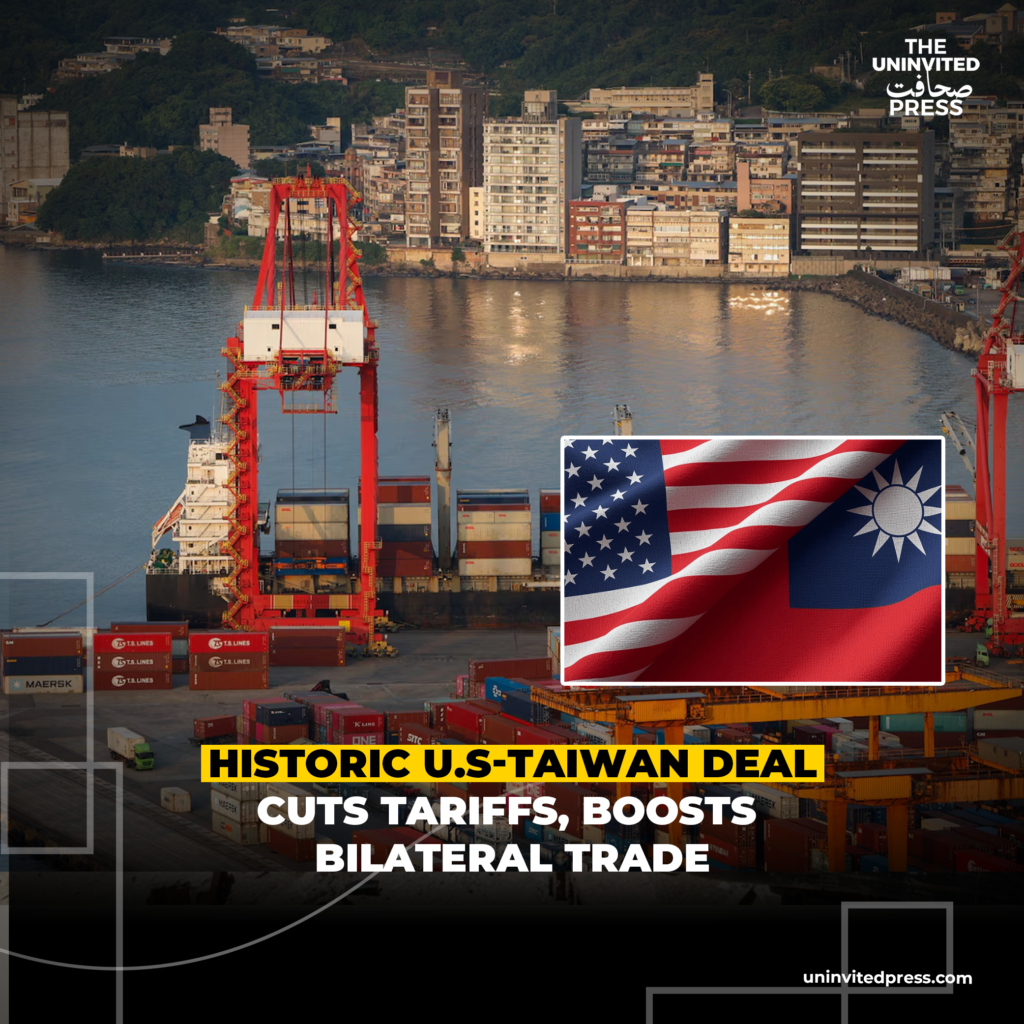
Landmark US-Taiwan trade deal cuts tariffs to 15%, secures $85B in U.S. goods purchases and $250B investments, strengthening supply chains amid China tensions-a boost for bilateral economic ties.
$85B U.S.-Taiwan Trade Pact Sparks Beijing Anger:
Washington and Taipei have inked a game-changing trade pact that slashes tariffs on Taiwanese exports and commits Taiwan to buying nearly $85 billion in American goods over the next four years. The deal, signed amid escalating U.S.-China frictions, could supercharge bilateral trade while bolstering critical supply chains in semiconductors and energy. But it has already drawn sharp rebuke from Beijing, heightening geopolitical stakes in the Asia-Pacific region.
This reciprocal agreement marks a pivotal shift in U.S.-Taiwan economic relations, aligning Taiwan’s tariff treatment with that of key U.S. allies like Japan and South Korea. It comes as global trade flows grapple with protectionism, supply disruptions, and the race for technological dominance.
Feb 12 Deal: 15% Tariff Cap, $85B Trade, $250B Tech Push:
The deal was finalized in Washington on February 12, with U.S. officials hailing it as a win for American workers and farmers. Under the terms, the U.S. caps additional tariffs on Taiwanese imports at 15% on top of most-favored-nation (MFN) rates where applicable, effectively lowering the average rate on Taiwanese goods to around 12.3% when exemptions are factored in. This is a reduction from the 20% rate initially imposed under the Trump administration’s broader tariff policies, which had threatened rates as high as 32%.
In exchange, Taiwan agrees to eliminate or reduce tariffs on nearly all U.S. goods, covering categories like autos, chemicals, machinery, health products, dairy, and pork. The pact also dismantles non-tariff barriers, such as accepting U.S. auto safety standards without additional testing-previously limited to just 75 units per model-and recognizing U.S. FDA approvals for medical devices and pharmaceuticals within six months.
A cornerstone of the agreement is Taiwan’s commitment to purchase $84.8 billion in U.S.-origin goods from 2025 to 2029. This breaks down to $44.4 billion in liquefied natural gas (LNG) and crude oil, $25.2 billion in power equipment, industrial machinery, and materials, and $15.2 billion in civil aircraft and engines. These purchases must align with Taiwan’s laws and are facilitated through designated entities.
Additionally, the deal encourages Taiwanese investments in the U.S., with firms pledging at least $250 billion to expand semiconductor manufacturing, artificial intelligence, and related high-tech production. This includes building new facilities and R&D hubs, supported by U.S. financing from institutions like the Export-Import Bank.
The agreement also addresses broader issues: strengthening intellectual property protections, prohibiting forced labor in supply chains, enforcing environmental standards, and promoting digital trade without discriminatory taxes or data localization requirements. For agriculture, Taiwan adopts international standards for residues in beef and pork, streamlines inspections, and recognizes U.S. sanitary systems.
Trump Tariffs to Taiwan Chips: Cold War Trade:
This pact emerges from years of U.S.-Taiwan trade talks, accelerated by the Trump administration’s “America First” agenda. Tariffs on Taiwanese goods were first hiked in 2025 as part of broader measures targeting Asian exports, amid concerns over trade imbalances and supply chain vulnerabilities exposed by the COVID-19 pandemic and U.S.-China decoupling.
Taiwan, a global leader in semiconductors-producing over 60% of the world’s chips-has been caught in the crossfire of U.S.-China rivalry. The island’s exports to the U.S. surged in recent years, driven by demand for AI and electronics, but faced escalating tariffs. Bilateral trade hit $150 billion in 2025, with the U.S. running a deficit due to imports of Taiwanese tech components.
Historically, U.S.-Taiwan relations operate through unofficial channels like AIT and TECRO, as Washington does not formally recognize Taiwan under the “One China” policy. Yet, economic ties have deepened via initiatives like the 2023 U.S.-Taiwan Initiative on 21st-Century Trade, which focused on facilitation without tariff cuts. This new deal goes further, reflecting U.S. efforts to diversify away from China, where tariffs remain high at 25% on many goods.
With China’s economy strained by its own tariffs and slowing growth, the U.S.-Taiwan pact could redirect investment flows, potentially eroding Beijing’s influence in regional supply chains. Taiwan’s President Lai Ching-te, elected in 2024 on a pro-U.S. platform, has prioritized economic resilience amid military threats from across the strait.