

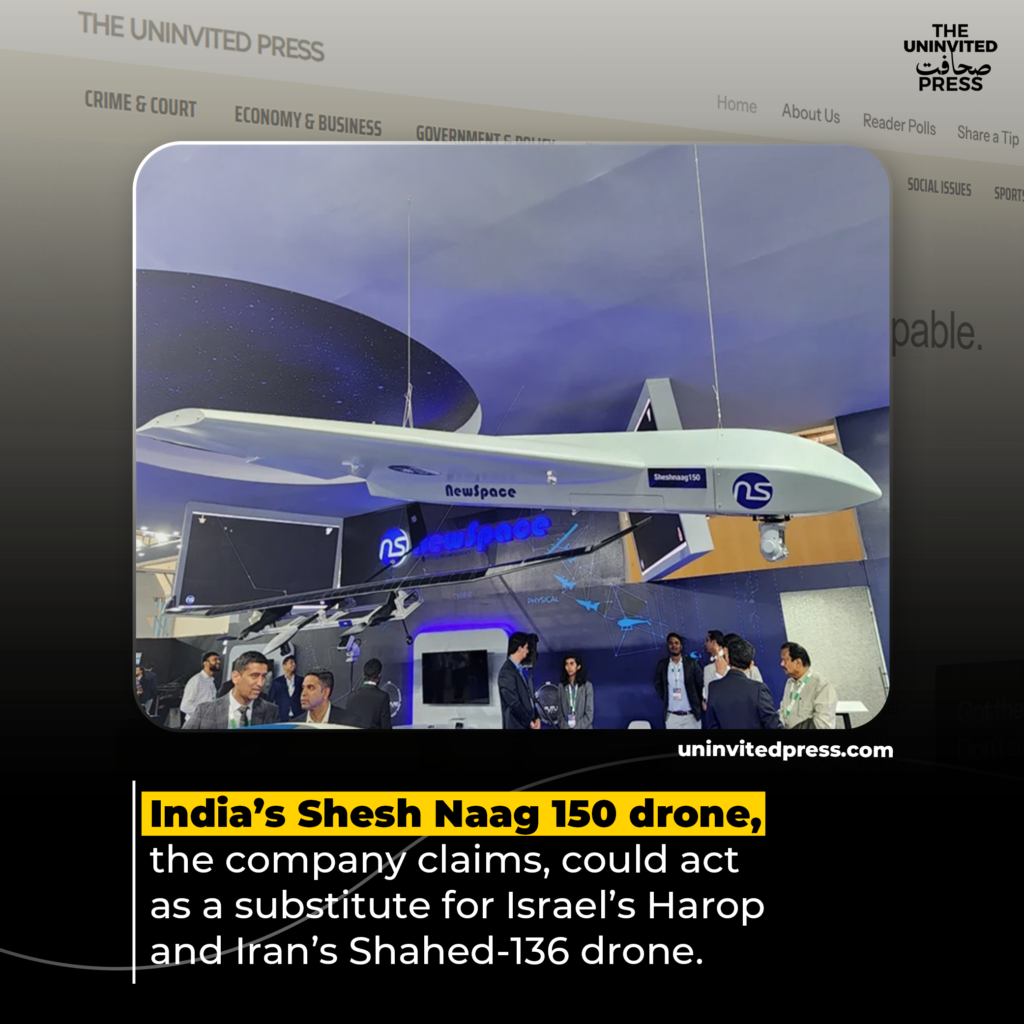
Bengaluru Startup’s AI-Powered Swarm Weapon Hits Key Milestones, Challenging Israeli and Iranian Designs on Range, Cost, and Autonomy.
Sheshnaag 150: India’s Answer to Global Combat Drones:
A homegrown Indian drone unveiled at a major international defence exhibition is drawing sharp attention for its claimed ability to match or surpass two of the world’s most infamous loitering munitions; Israel’s combat-proven Harop and Iran’s widely exported Shahed-136. The Sheshnaag 150, developed by NewSpace Research and Technologies in Bengaluru, combines long endurance, heavy payload, and advanced swarm intelligence in a single platform. Defence analysts say the system could mark a turning point for India’s push toward self-reliance in high-end unmanned strike capabilities, especially as drone swarms increasingly dominate modern conflicts.
India Advances in Autonomous Strike Drones:
Development of the Sheshnaag 150 accelerated after India’s 2020 border clashes with China exposed gaps in long-range precision strike options that did not rely heavily on imported systems. NRT began focused work on a family of collaborative UAVs around 2023, building on earlier demonstrations of small-drone swarming.
In February 2025 the platform achieved its first powered flight at a test range in Karnataka, staying airborne for two hours and successfully executing a simulated terminal dive with high accuracy. Engineers validated the airframe’s stability, engine reliability, and basic guidance systems during this phase.
By late 2025 NRT progressed to more complex autonomy trials. In November the company demonstrated coordinated behaviour among multiple Sheshnaag airframes, allowing the group to re-task dynamically, share sensor data, and prioritise targets without continuous ground control. This milestone brought the system closer to what military planners call “Level-5” autonomy-where drones operate as a self-organising network capable of saturation attacks against defended airspace.
At the World Defence Show in Riyadh in February 2026, NRT displayed a full-scale model alongside live-flight footage and performance data. Company representatives described the drone as a “theatre-level asset” suitable for deep penetration missions, suppression of enemy air defences, and electronic warfare support. They positioned it explicitly as an alternative to both the Israeli Harop (used extensively by several air forces for tactical suppression) and the Iranian Shahed-136 (known for low-cost, long-range saturation strikes in Ukraine and elsewhere).
India’s Sheshnaag 150 Takes on Harop and Shahed Drones:
The name Sheshnaag draws from Hindu mythology-the thousand-headed serpent that supports the universe-symbolising the drone’s intended ability to operate in large coordinated groups. The platform belongs to a broader category of loitering munitions, often called “kamikaze drones,” which hover over a battlespace, identify targets using onboard sensors, and then crash into them with an explosive warhead.
Israel pioneered the category with the Harop, introduced in the mid-2000s. The Harop carries a 23 kg warhead, offers roughly 1,000 km range, and has been used in multiple conflicts to destroy radar sites, missile launchers, and command posts. Its strength lies in man-in-the-loop control and proven reliability.
Iran developed the Shahed-136 in the late 2010s as a cheaper, longer-range option. With a 50 kg warhead and claimed 2,000 km reach, it became notorious after Russia began using large numbers (rebranded Geran-2) against Ukrainian infrastructure from 2022 onward. The Shahed’s low unit cost-estimated below $50,000-allows attackers to saturate air defences and force defenders to expend expensive interceptors.
India historically imported Harop systems for its air force but faced delays, cost escalations, and geopolitical sensitivities around Israeli technology. At the same time, Chinese drone incursions along the Line of Actual Control and Pakistan’s growing UAV capabilities created urgent demand for indigenous alternatives. The Sheshnaag programme aligns with the Indian government’s Aatmanirbhar Bharat (self-reliant India) initiative, which encourages private companies to develop advanced defence systems through schemes such as iDEX (Innovations for Defence Excellence).
What sets the Sheshnaag 150 apart from both the Harop and Shahed is its emphasis on swarm intelligence. Rather than relying solely on individual precision or sheer numbers, NRT’s software allows drones to communicate, adapt mission plans in real time, and distribute tasks-scouting, jamming, or striking-across the group. This approach draws lessons from Ukraine, where low-cost swarms have overwhelmed expensive air-defence systems.