

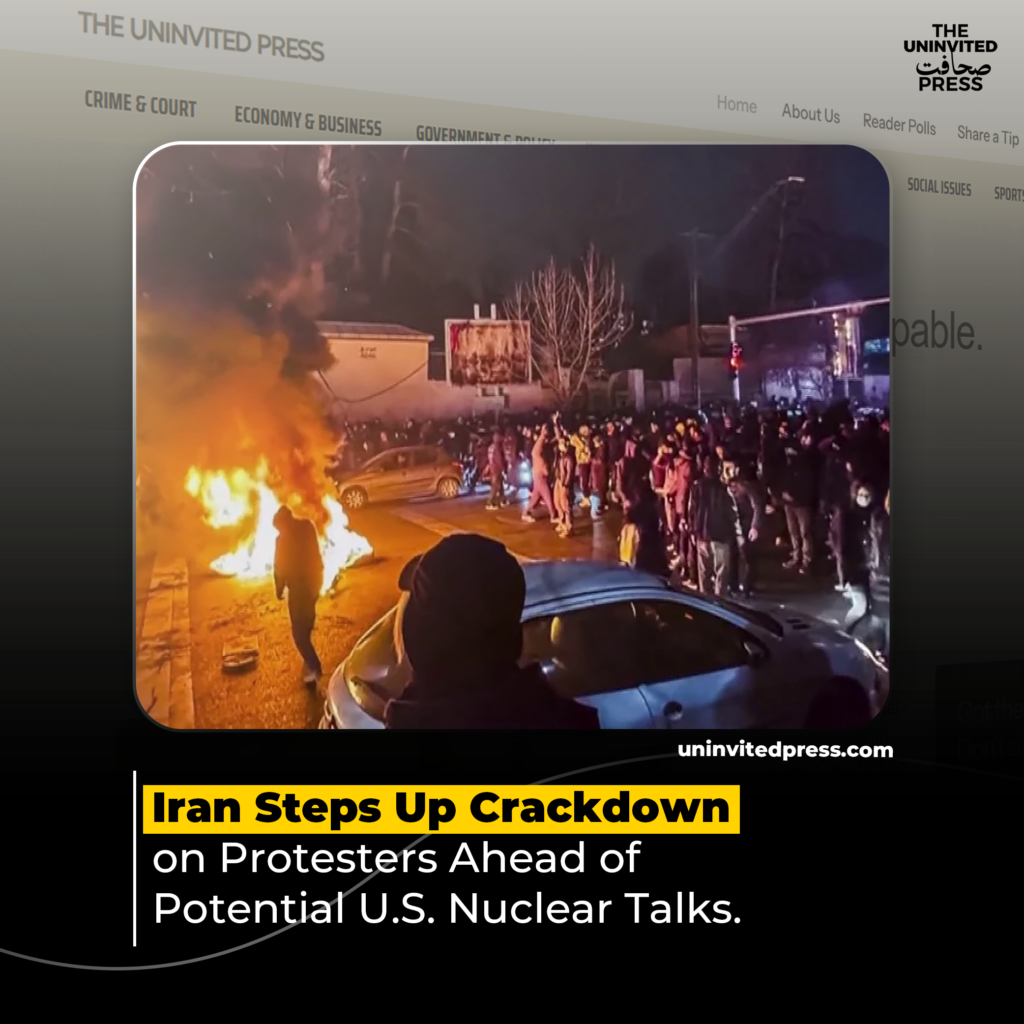
Iran arrests reformists amid crackdown on January 2026 protests, as US nuclear talks resume in Oman with no breakthroughs, raising risks in Tehran.
Iran Tightens Crackdown as Nuclear Talks Press On:
Iranian authorities ramped up arrests of reformist politicians and activists on February 8 and 9, 2026, expanding a post-protest purge that has already claimed thousands of lives and detained tens of thousands. This escalation coincides with indirect US-Iran nuclear talks in Oman, where both sides described initial discussions as positive but made no breakthroughs, signaling Tehran’s strategy to project strength at home while testing diplomatic waters abroad. As the regime braces for potential US military action, these moves risk deepening internal divisions and derailing fragile negotiations, with global powers watching closely for signs of escalation in the volatile Middle East.
Iran Tightens Crackdown Amid Renewed US Nuclear Talks:
The latest wave of arrests began late February 8 when IRGC agents detained Azar Mansouri, head of the Reformists Front, at her Tehran home. Mohsen Aminzadeh and Ebrahim Asgharzadeh followed, with Javad Emam arrested early February 9. Summons were issued for others like Mohsen Armin and Feizollah Arab Sorkhi to appear at Evin Prison. The judiciary’s Mizan agency announced indictments February 9, labeling them supporters of the US and Israel without public evidence.
This follows January’s protests, sparked December 28, 2025, by rial devaluation and inflation, escalating to anti-regime chants across 31 provinces. Major violence peaked January 8-9, with security forces using live fire in over 400 cities. Supreme Leader Khamenei reportedly ordered a “no-mercy” response January 9, leading to mass casualties. Protests subsided by mid-January under repression.
Parallel to this, US-Iran talks resumed February 7 in Muscat, indirect via Omani mediators. Both sides called it a “good start,” with Iran gauging US seriousness. No deals emerged, but further rounds are expected this week. Iran hinted at diluting uranium from 60% to 20% for sanctions relief, but rejected limits on missiles or proxies.
Arrests extended beyond reformists; activists and filmmakers signing protest statements were detained February 9-10. This widens a crackdown post-January unrest, where hospital data suggests over 1,800 killed in Tehran alone.
Iran Turmoil: Protests, Repression and Economic Collapse:
Iran’s 2026 protests continue a cycle of dissent fueled by economic collapse and repression. The rial’s plunge-worsened by US sanctions and 2025 war costs-triggered January outbreaks, with inflation doubling food prices. This mirrors 2019 fuel riots (1,500 dead) and 2022 Mahsa Amini protests (hundreds killed). The 2025 Israel-Iran war-12 days after Israeli strikes on nuclear sites-left Iran rebuilding amid paranoia, arresting thousands for espionage.
Arrested reformists have historic ties: Mansouri leads a coalition for gradual change; Aminzadeh served under Khatami; Asgharzadeh, from 1979 embassy siege, turned moderate. They align with President Pezeshkian, whose reforms face hardliner opposition. Talks revive the 2015 JCPOA, abandoned by Trump in 2018. Post-2025 war, indirect Oman sessions started February 7, with Trump deploying forces. Iran’s foreign meddling claims justify repression.
Government admits 3,117 dead; HRANA verifies 6,961, with UN estimating over 20,000. Over 40,000 arrested, many in makeshift sites facing mass trials. Crackdown exposes regime fragility, potentially reigniting protests if US strikes occur, while talks test Trump’s “maximum pressure.”