

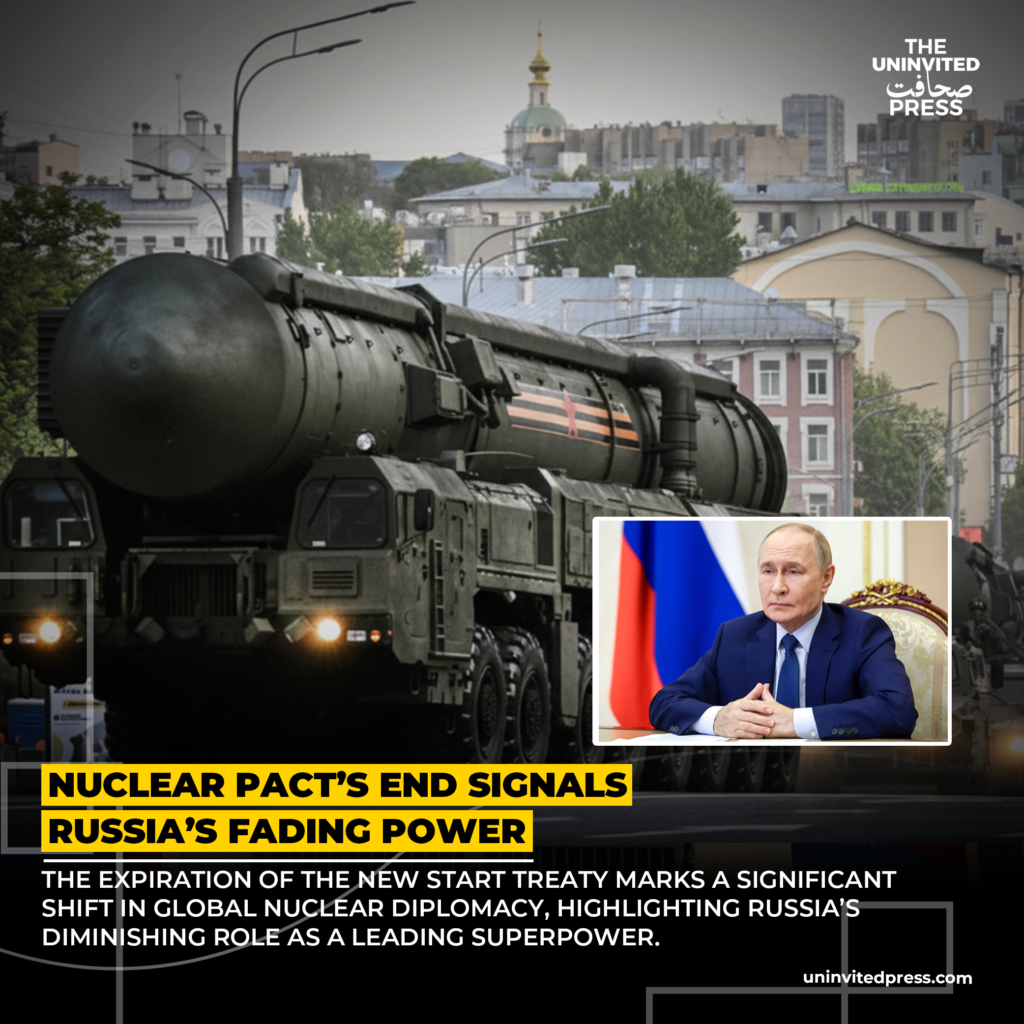
Final Pillar of Bilateral Arms Control Crumbles, Sparking Global Alarms Over Escalation Risks Amid Ukraine War. The New START nuclear arms treaty between the US and Russia expired on February 5, 2026, ending verifiable limits on strategic weapons and raising fears of a new arms race amid global tensions.
New START Expires: 90% of Nuclear Warheads Now Unrestricted:
The New START treaty, the sole remaining accord capping the world’s two largest nuclear arsenals, officially expired on February 5, 2026, after no agreement on extension or replacement. This marks the first time since 1972 that the US and Russia face no legally binding limits on their strategic nuclear weapons, heightening fears of miscalculations in an already tense geopolitical landscape.
With over 90% of global nuclear warheads between them, the lapse could erode transparency and stability, potentially fueling an arms race. UN Secretary-General António Guterres called it a “grave moment” for international security, underscoring the human stakes in a world where nuclear risks are at their highest in decades.
New START: Born in Prague, Dead After Ukraine:
The treaty’s end unfolded against a backdrop of deteriorating relations. Signed on April 8, 2010, in Prague by US President Barack Obama and Russian President Dmitry Medvedev, New START replaced the 1991 START I and aimed to slash Cold War-era stockpiles. It entered force on February 5, 2011, with a 10-year term and a five-year extension option.
Both nations met the central limits by February 5, 2018: 1,550 warheads, 700 deployed delivery systems, and 800 total launchers. Verification included 18 annual on-site inspections, data exchanges twice a year, and telemetry sharing on launches. By February 2023, parties had conducted 328 inspections and exchanged over 25,000 notifications.
Tensions escalated with Russia’s invasion of Ukraine in February 2022. In February 2023, Putin announced Russia’s suspension, citing US support for Ukraine as undermining the treaty. The US responded by halting inspections and data sharing, though both remained below limits.
In September 2025, Putin proposed informally observing limits for one year post-expiration to allow negotiations, provided the US refrained from actions threatening Russia’s security. No formal US reply followed. Reports of last-minute talks in Abu Dhabi surfaced on February 5, but Trump dismissed extension, calling for a “new, improved” deal.
The treaty lapsed at midnight GMT on February 4 (February 5 in some time zones), with Russia’s Foreign Ministry declaring obligations no longer binding absent US reciprocity.
Former US President Barack Obama (left) and Russian President Dmitry Medvedev sign the New START treaty in Prague, April 8, 2010.
How Arms Control Gave Birth to-and Lost-New START?
New START’s roots trace to the Cold War’s arms control framework, beginning with SALT I in 1972, which capped nuclear delivery vehicles. START I (1991) reduced warheads by 30-40%, while START II (1993) never entered force. The 2002 SORT treaty further cut deployed warheads to 1,700-2,200 but lacked verification.
New START built on this, emphasizing verifiable reductions amid post-9/11 cooperation. Its significance lay in transparency; inspections prevented surprises, fostering stability despite rivalries.
The 2019 US withdrawal from the INF Treaty-banning intermediate-range missiles-foreshadowed erosion, with both sides accusing violations. Russia’s 2022 Ukraine invasion accelerated the breakdown, linking arms control to broader conflicts.
Why it matters?
Without limits, uncertainty grows. Russia could deploy more warheads on modernized systems like Sarmat ICBMs, while the US advances Sentinel missiles. Costs may deter rapid build-ups-Russia’s economy strains under sanctions, US faces budget pressures-but opacity heightens risks. China’s expanding arsenal (potentially 1,000 warheads by 2030) complicates matters, as Trump insists on inclusion.
Human impact: Nuclear risks affect billions. Guterres warned of the “highest” use risk in decades, echoing Doomsday Clock at 90 seconds to midnight. For civilians in conflict zones like Ukraine, escalation threats loom larger.