

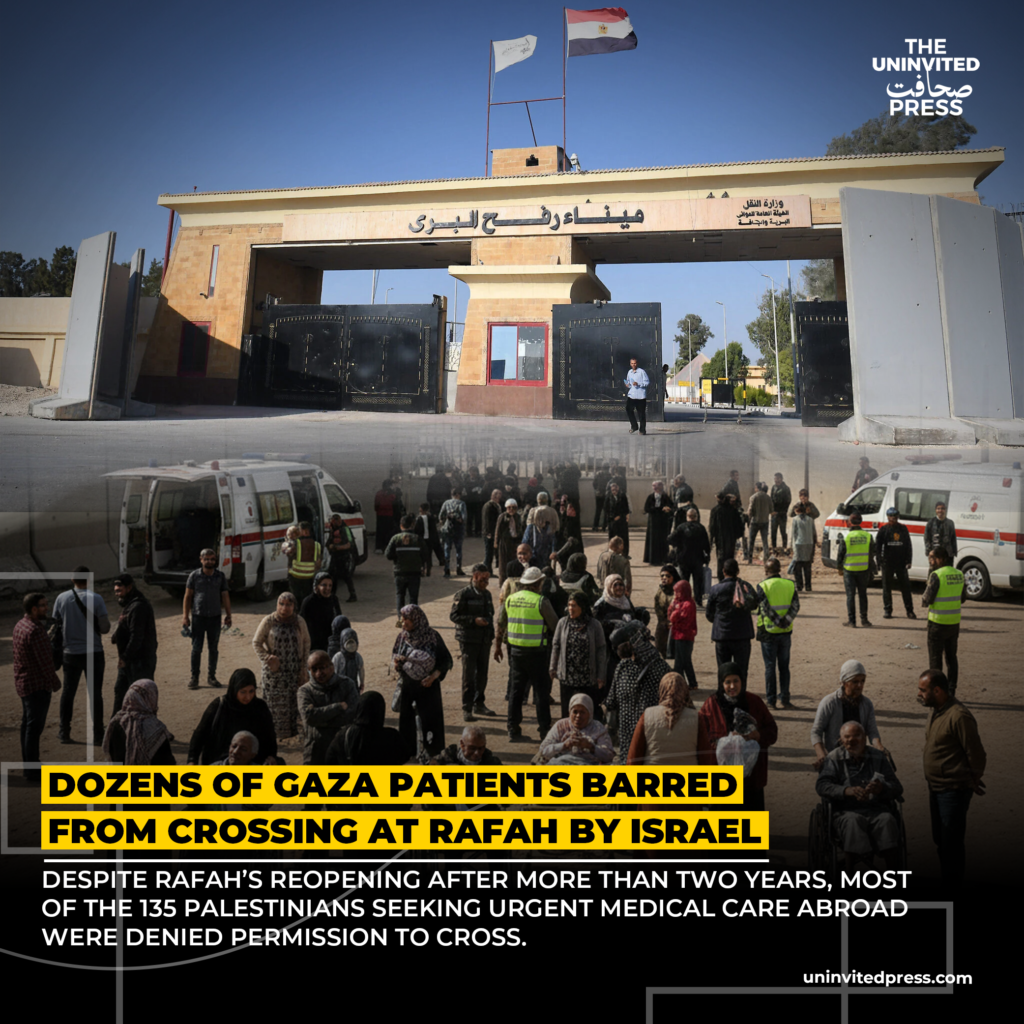
Israel bars dozens of Gaza patients from crossing reopened Rafah border for urgent medical care, allowing only a handful amid 20,000 waiting list, sparking humanitarian alarms in Gaza Strip.
One Day Open, Lives Still Blocked at Rafah:
The Rafah border crossing between Gaza and Egypt creaked open on February 1, 2026, marking the first limited movement in nearly two years amid a fragile U.S.-brokered ceasefire. Yet, Israeli restrictions dashed hopes for thousands: on day one, just five critically ill Palestinians were permitted to exit for medical treatment, leaving dozens more-including cancer patients and the severely wounded-stranded and in peril. This bottleneck, as Gaza’s health system lies in ruins after over two years of war, underscores a humanitarian crisis where delayed care could mean death for many, straining international calls for unimpeded aid and exposing the precarious path to recovery in a territory where basic medical needs go unmet.
Deadly Delays Continue at Rafah Crossing:
The Rafah crossing, Gaza’s sole gateway to Egypt not controlled by Israel, reopened on February 1, 2026, after Israeli forces seized it in May 2024. This partial unsealing, part of the ceasefire’s second phase, was meant to allow 50 people to exit and 50 to enter daily, per Israeli officials. However, the rollout faltered immediately.
On day one, only five patients crossed into Egypt for treatment, according to Gaza’s Health Ministry and eyewitness reports. The next day saw 16 evacuations, still well below expectations. Dozens gathered at the crossing, including 135 documented by Al Jazeera on February 2, but most were turned away after prolonged waits. Patients like Ibrahim Al-Batran, a dialysis-dependent resident of Deir al-Balah, packed bags in hope but remained stuck, telling CNN, “Many people have died while waiting for treatment.”
The process involves joint Israeli-Egyptian screening, with no cargo permitted yet. Egyptian ambulances transported the few approved cases to hospitals in North Sinai. By February 3, UN reports confirmed the slow pace continued, with Al-Shifa Hospital’s director warning it equated to a “death sentence” for the backlog.
Trapped in Rafah: Gaza’s Medical Crisis:
Rafah’s closure dates to May 7, 2024, when Israeli forces took control during an offensive against Hamas in southern Gaza. This severed Gaza’s last non-Israeli border link, exacerbating a humanitarian catastrophe. Prior, Rafah handled limited aid and evacuations, but the war-triggered by Hamas’s October 7, 2023, attack killing 1,200 Israelis-devastated Gaza’s health infrastructure. Over 44,000 Palestinians died, per Gaza Health Ministry figures, with hospitals bombed, supplies blocked, and 85% of the population displaced.
Pre-war, Gaza relied on external care for complex cases like cancer or organ failure, with 50-100 patients exiting daily via Rafah. The closure trapped thousands, leading to preventable deaths-WHO estimates 12,000 needed evacuation by mid-2025. A brief 2025 ceasefire allowed some outflows, but full reopening stalled until the October 2025 truce.
Egypt, mediating with Qatar and the U.S., pushed for reopening amid international pressure. Israel’s conditions-remote vetting via video to avoid physical presence-reflect security fears of Hamas exploitation.