

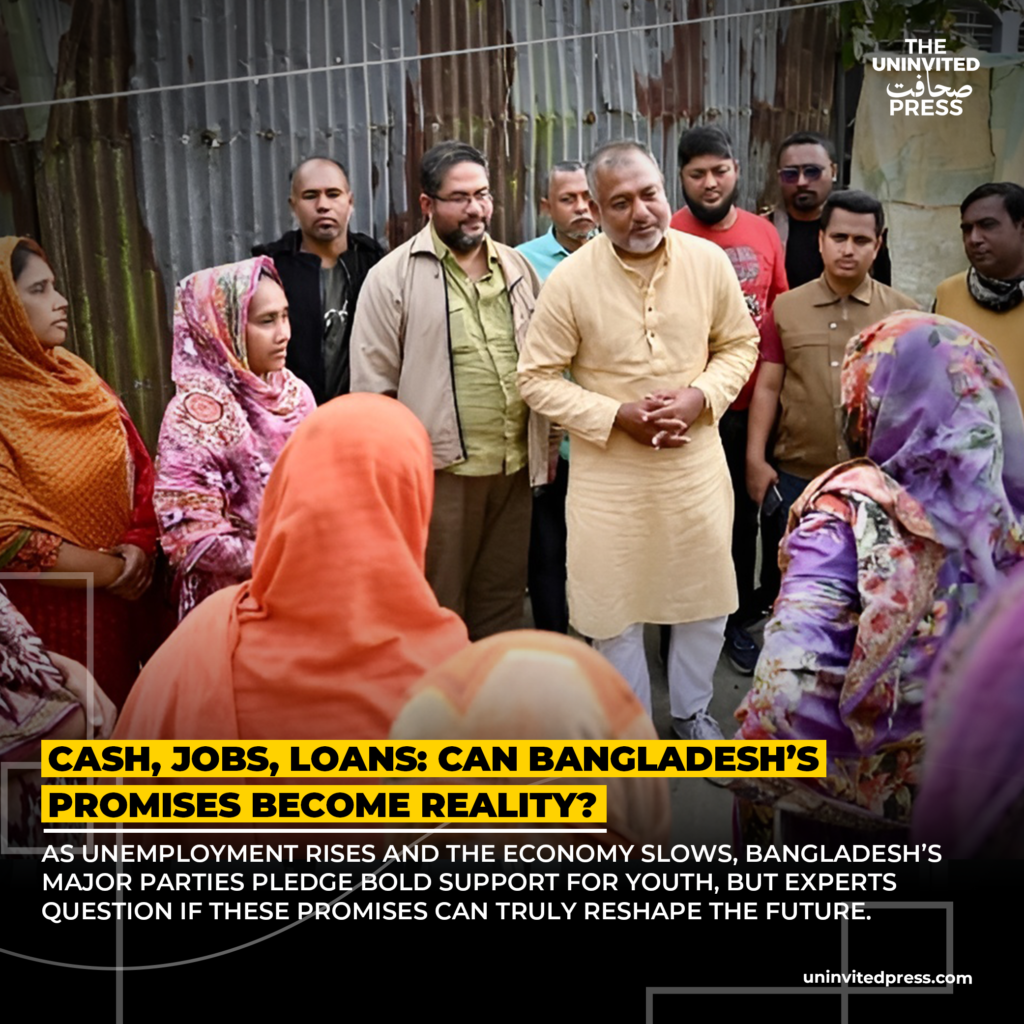
Bangladesh’s major parties pledge jobs, cash, and loans for youth amid rising unemployment and slowing economy ahead of February 12, 2026 elections.
Bangladesh’s Youth Vote: Jobs and Cash Promises Amid Crisis:
With Bangladesh’s economy sputtering and youth unemployment hitting crisis levels, political parties are rolling out sweeping promises of cash handouts, job creation, and low-interest loans to capture the hearts-and votes-of the nation’s young population. As the country heads to its first truly competitive election in years on February 12, 2026, these pledges aim to address a slowing GDP and rising joblessness that have left millions in limbo. But experts warn that without structural reforms, these bold visions risk becoming empty rhetoric, potentially deepening public disillusionment in a post-uprising era where youth-led protests toppled a long-standing regime.
Jobs vs Loans: Parties Battle for the Youth Vote:
Bangladesh’s political landscape ignited in late 2025 as parties released manifestos packed with youth-focused incentives. The BNP, leading a coalition, promised to create 10 million jobs within 18 months and introduce unemployment allowances for educated jobseekers. Their “Family Card” system would provide monthly cash or food support to empower female heads of households.
Jamaat-e-Islami countered with a plan to train 10 million youth over five years through district-level “job banks” and tech labs, aiming to place 5 million in employment. They also pledged interest-free loans of up to 10,000 taka ($80) per month for unemployed graduates for two years, plus education loans for 100,000 students and scholarships for 100 to study abroad annually.
The youth-led National Citizen Party (NCP), born from the 2024 uprising, vowed 10 million jobs in five years, a 100 billion taka ($800 million) fund for women and youth entrepreneurs, and tax exemptions for new SMEs. They also proposed lowering the voting age to 16 and providing basic military training to 30,000 youths annually.
These announcements followed the signing of a Child Rights Manifesto by 12 parties in December 2025, committing to child-focused policies like education and health reforms. The pledges come amid a voter registration drive that added millions of young voters, making this the largest election since independence with 127 million eligible participants.
Bangladesh’s 2026 Election: Youth Job Crisis in Focus:
Bangladesh’s current economic woes trace back to the 2024 student-led uprising that ousted Sheikh Hasina’s Awami League after 15 years in power. The movement, sparked by job quota protests, exposed deep frustrations over corruption, inequality, and youth unemployment. An interim government under Nobel laureate Muhammad Yunus took charge, launching reforms via 11 commissions and a National Consensus Charter signed by 25 parties in October 2025.
Historically, Bangladesh achieved rapid growth, averaging 6-7% GDP annually pre-pandemic, driven by garments exports. But COVID-19, global inflation, and the 2024 turmoil disrupted this, leading to factory closures, export dips, and remittance drops. Unemployment rose from 4.2% in 2023 to 4.7% in 2024, per World Bank figures, with youth (18-35) comprising one-third of the 77 million labor force facing skills gaps and limited opportunities.
With 127 million electors, the February 12 polls coincide with a referendum on 48 constitutional changes, testing the transition to stable democracy. Success could stabilize the economy, projected to rebound to 4.7-5% growth in FY2026 by IMF and ADB. Failure risks further unrest, as surveys show 97% of youth intend to vote but demand credible, time-bound commitments.