

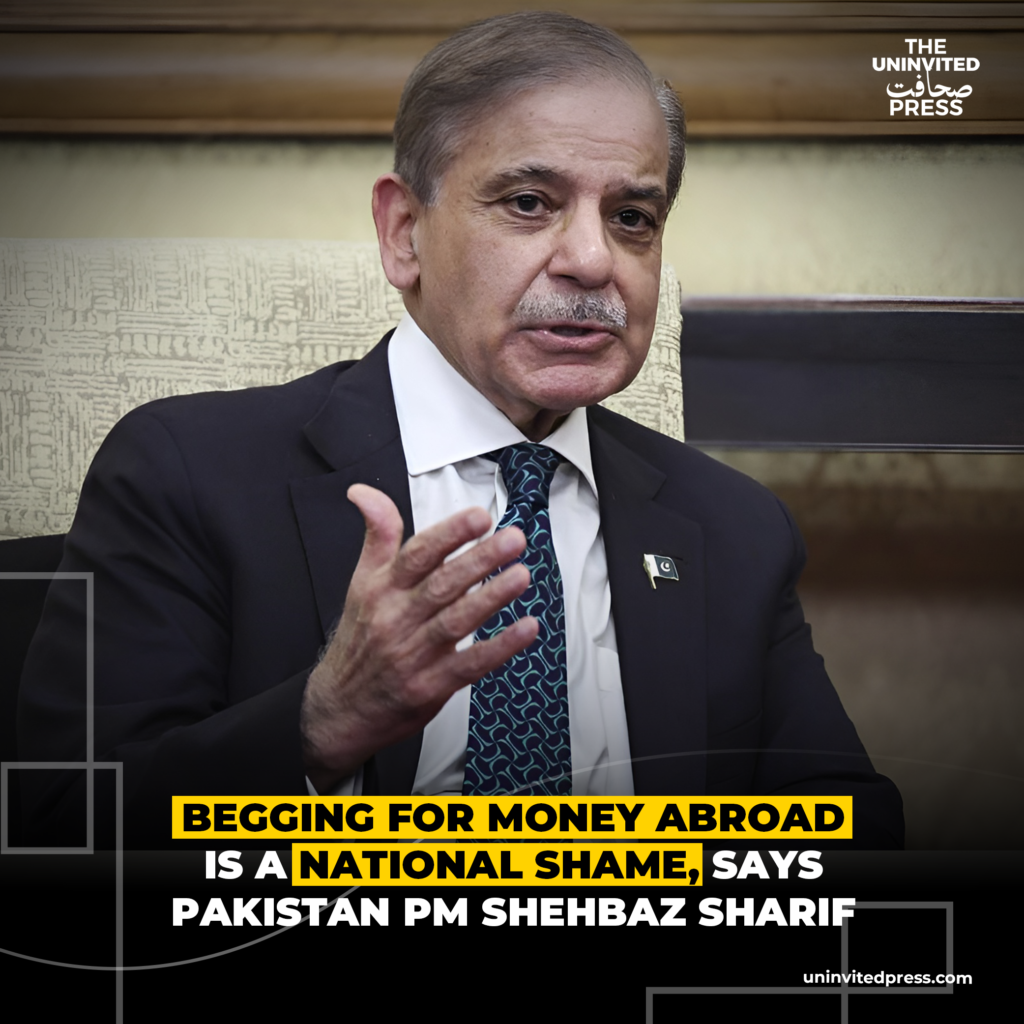
Amid crippling debt and IMF lifelines, Sharif admits he and Army Chief Asim Munir bow in shame while seeking billions from allies.
PM Sharif Calls Foreign Aid Trips a ‘National Humiliation,’ Warns of Pakistan’s Debt Trap:
Pakistan’s Prime Minister Shehbaz Sharif delivered a raw admission on January 31, 2026, declaring that traveling abroad to beg for financial aid has become a profound national embarrassment. Speaking in Islamabad, Sharif revealed the personal toll of Pakistan’s debt dependency, stating that both he and Army Chief Field Marshal Asim Munir feel “ashamed” during these missions. This candid outcry underscores the fragility of Pakistan’s economy, where foreign loans prop up reserves but erode sovereignty, forcing concessions that Sharif says the nation “cannot say no to.” As IMF negotiations continue, the statement highlights a tipping point: can Pakistan break free from its “begging bowl” cycle, or will debt servitude deepen?
Pakistan’s Debt Struggle: ‘We Bow in Shame’ Amid IMF and Foreign Aid Reliance:
In a moment of unfiltered candor rare for a sitting leader, Pakistan’s Prime Minister Shehbaz Sharif laid bare the human cost of his country’s economic woes. “We feel ashamed when Field Marshal Asim Munir and I go around the world begging for money,” Sharif told a gathering of business leaders in Islamabad on January 31, 2026. “Taking loans is a huge burden on our self-respect. Our heads bow down in shame. We cannot say no to many things they want us to do.”
Sharif’s speech followed recent IMF approvals that injected vital funds but imposed stringent conditions, including tight monetary policies and spending restraints. Just weeks earlier, on December 10, 2025, the IMF’s Executive Board completed reviews under the EFF and RSF, unlocking about $1.2 billion in disbursements. This brought total support to $3.3 billion, helping Pakistan repay debts and bolster reserves that had dipped perilously low in prior years.
Sharif highlighted specific instances of aid-seeking, thanking “all-weather friend” China, as well as Saudi Arabia, the UAE, and Qatar for rollovers and investments. For example, the UAE recently renewed a $2 billion loan, while Qatar committed $3 billion in investments and LNG supplies. These interventions have doubled foreign reserves to $14.5 billion by the end of fiscal year 2025, with projections for them to exceed $20 billion by December 2026.
This isn’t Sharif’s first such confession. In 2023 and earlier speeches, he echoed similar sentiments about Pakistan’s “beggar” status, but the January 31 address marks a escalation, directly implicating the military leadership in the ordeal. The timing aligns with fresh economic data showing modest recovery-GDP growth at 3 percent in fiscal 2025, expected to edge up to 3.2 percent in 2026-but overshadowed by persistent vulnerabilities like recent floods that spiked food prices and inflation to around 6.3 percent.
Decades of Debt and Mismanagement: Sharif Lays Bare Pakistan’s Economic Peril:
Pakistan’s economic crisis didn’t erupt overnight; it’s the culmination of decades of structural weaknesses, amplified by global shocks and domestic mismanagement. The nation has turned to the IMF 23 times since 1958, more than any other country, earning it the moniker of a “perpetual borrower.” Public debt has ballooned to over Rs 76,000 billion-nearly doubling in four years-forcing debt servicing to consume half the annual budget and starving funds for development.
Key contributors include heavy borrowing for the China-Pakistan Economic Corridor (CPEC), which promised infrastructure booms but saddled Pakistan with opaque debts to Beijing. Political instability, including the ouster of Imran Khan in 2022 and Sharif’s return in 2024, exacerbated the slide. Inflation peaked at 23.4 percent in 2023-24 before easing, while poverty and unemployment surged, affecting millions. Natural disasters, like the 2022 floods that displaced 33 million and caused $30 billion in damages, further strained resources, leading to the RSF’s climate-focused aid.
The significance of Sharif’s words lies in their exposure of a “hybrid regime” dynamic, where civilian and military leaders jointly shoulder the begging burden. This rare acknowledgment signals internal frustration and could rally domestic support for reforms, but it also risks eroding public confidence if not followed by action. Globally, it spotlights Pakistan’s precarious position: a nuclear-armed nation teetering on the edge, where economic collapse could fuel regional instability.