

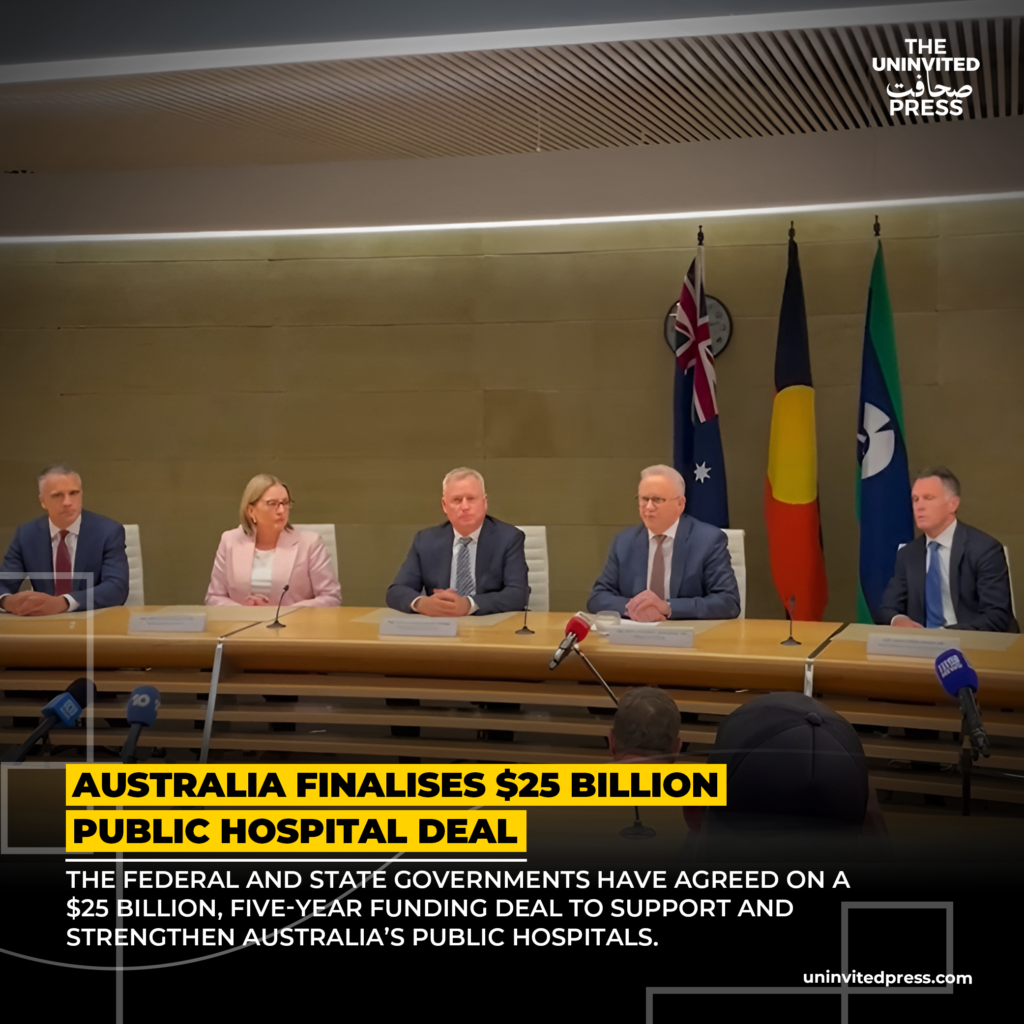
Australia’s governments have agreed on a $25 billion boost for public hospitals over five years, ending a standoff and reforming NDIS growth. Federal and state leaders end months-long impasse with record funding injection to ease hospital strains and reform disability support.
Australia Commits $25 Billion to Public Hospitals in Historic Healthcare Boost:
In a pivotal move for Australia’s overburdened health system, Prime Minister Anthony Albanese announced a landmark agreement on Friday, committing an extra $25 billion to public hospitals over the next five years. This deal, struck at National Cabinet in Sydney, not only boosts federal spending to a record $219.6 billion but also ties in crucial reforms to the National Disability Insurance Scheme (NDIS), aiming to curb its escalating costs. As hospitals grapple with longer wait times and bed shortages, this infusion could provide much-needed relief-but experts warn it’s just a start.
Boost in Federal Funding to Address Hospital Strain and Reduce Bed Shortages:
The agreement marks the end of a protracted standoff that began when the previous five-year hospital funding deal expired in mid-2025. Governments initially agreed to a one-year extension with a $1.7 billion federal top-up, but negotiations for a longer-term pact stalled amid disputes over funding shares and linked NDIS reforms.
In December 2025, the federal government tabled a $23 billion offer, which states deemed insufficient to meet a 2023 National Cabinet commitment to raise the Commonwealth’s share to 42.5% by 2030 and 45% by 2035. Tensions escalated, with premiers accusing Canberra of short-changing hospitals amid inflation-driven costs and workforce shortages.
By January 2026, with pressure mounting ahead of elections and hospital crises deepening, National Cabinet reconvened in Sydney. After intense talks, Albanese upped the ante by $2 billion, securing the deal. The Prime Minister hailed it as “one of the most significant national reforms in living memory,” emphasizing its focus on patient care over politics.
Key elements include targeted investments to reduce “bed blocks”-where elderly or disabled patients occupy hospital beds due to inadequate aged care or disability supports. The agreement also builds on existing initiatives like the 1800 MEDICARE hotline, 137 Urgent Care Clinics (120 already operational), and expanded bulk billing, which has added 1,300 new fully bulk-billed centers.
$25 Billion Federal Funding Deal Aims to Ease Hospital Strain and Tackle NDIS Challenges:
Australia’s public hospitals have been under immense strain for years. Demand has surged due to an aging population-expected to see one in five Australians over 65 by 2040-coupled with post-COVID backlogs in elective surgeries and emergency care. Wait times for procedures have ballooned, with some patients facing delays of over a year, while emergency departments report record presentations.
The funding model, where the Commonwealth covers about 40% of costs and states the rest, has long been contentious. The 2020 agreement under the Morrison government capped federal growth at 6.5%, which critics say failed to keep pace with real-world pressures like inflation and workforce shortages. In 2023, National Cabinet pledged to reverse the federal share’s decline, but implementation lagged, leading to the 2025 impasse.
Linked NDIS reforms add another layer. The scheme, designed to support Australians with disabilities, has seen costs spiral to over $40 billion annually, prompting calls for sustainability. States agreed to co-fund “foundational supports” for milder disabilities outside the NDIS, but progress was slow, tying into hospital talks.
This deal’s significance lies in its potential to alleviate immediate pressures while laying groundwork for systemic changes. However, as verified through official transcripts and reports, it doesn’t scrap the growth cap entirely, leaving room for future debates.