

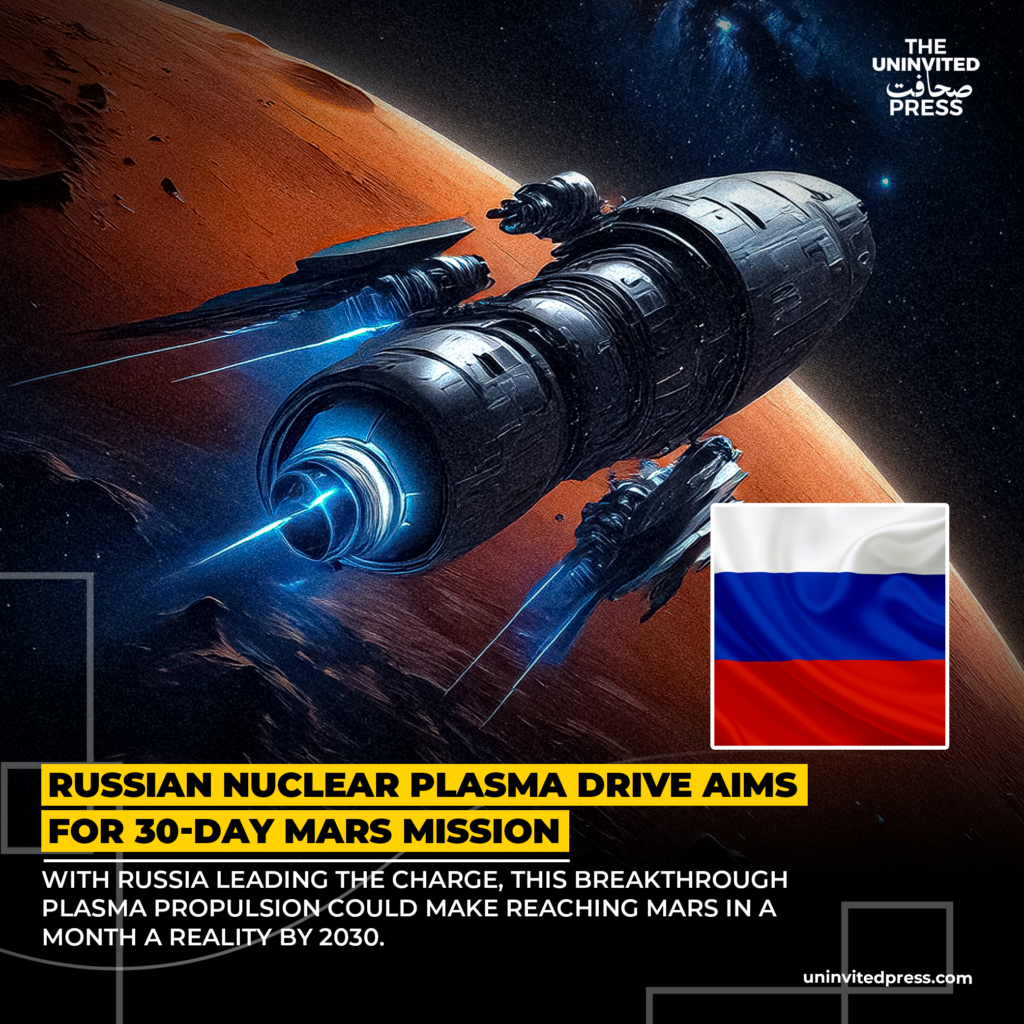
Russia’s Rosatom tests plasma rocket prototype for 30-day Mars trips, using nuclear power for high-speed propulsion. Aims for 2030 readiness amid space race.
Rosatom’s Plasma Rocket Could Revolutionize Mars Travel and Space Race:
Russian state nuclear agency Rosatom has tested a groundbreaking plasma rocket engine prototype that could cut the journey to Mars from six months to as little as 30 days. The technology, which uses electromagnetic fields to accelerate plasma to extreme speeds, promises to make manned missions more feasible by reducing exposure to cosmic radiation and enabling quicker returns.
This development thrusts Russia back into the spotlight of the space race, where nations vie for dominance in propulsion tech. With NASA and China pursuing similar innovations, Rosatom’s progress could accelerate human exploration of the Red Planet, potentially by the 2030s, transforming how we approach the cosmos.
Russia’s Nuclear Space Tug Prototype Aims for Rapid Interplanetary Travel:
Rosatom’s journey into advanced propulsion began with conceptual work in the 2010s, but the prototype’s reveal came on February 15, 2024, via state media outlet TASS. The engine, part of the “nuclear space tug” initiative, operates by heating propellant into plasma and expelling it at high velocity using magnetic fields. Initial tests demonstrated thrust levels suitable for interplanetary travel.
By mid-2024, Rosatom confirmed the engine had undergone vacuum chamber testing, simulating space conditions. Anatoly Koroteyev stated in a press release that the system could enable a Mars round-trip in under 100 days, with one-way transit as short as 30 days under optimal conditions. The prototype uses a nuclear reactor to generate electricity, avoiding the fuel limitations of chemical engines.
No setbacks have been publicly reported, though development continues under Russia’s Federal Space Program. The engine is eyed for integration with the Zeus nuclear tug, a spacecraft designed to tow payloads to distant destinations.
Plasma Propulsion Push: Russia Aims to Cut Mars Journey to 30 Days:
Electric propulsion systems like plasma engines have roots in the 1960s, with early Soviet experiments leading to Hall thrusters used on satellites today. Unlike chemical rockets, which burn fuel for short, powerful bursts, plasma engines provide continuous low-thrust acceleration, ideal for long-haul space travel.
Russia’s focus intensified after 2018, when President Vladimir Putin announced nuclear propulsion priorities. Rosatom, managing the project since 2020, allocated 4.2 billion rubles (about $50 million) for development. This aligns with Russia’s lunar program, including the Luna-25 mission (which failed in 2023) and plans for a joint lunar base with China by 2035.
Current Mars missions, like NASA’s Perseverance rover, take 7 months due to Hohmann transfer orbits and fuel constraints. Shorter trips reduce astronaut health risks-radiation doses could drop by 80 percent-and lower costs by minimizing life support needs. In the global context, NASA’s nuclear thermal rocket (targeted for 2030s tests) and China’s similar efforts highlight a competitive landscape. SpaceX’s Starship, while chemical-based, aims for Mars by 2026, but plasma tech could complement it for crew safety.
Geopolitically, sanctions since 2022 have isolated Russia’s space sector, ending NASA collaborations on the ISS. Rosatom’s independent progress demonstrates resilience, potentially positioning Russia as a partner or rival in future international missions.