

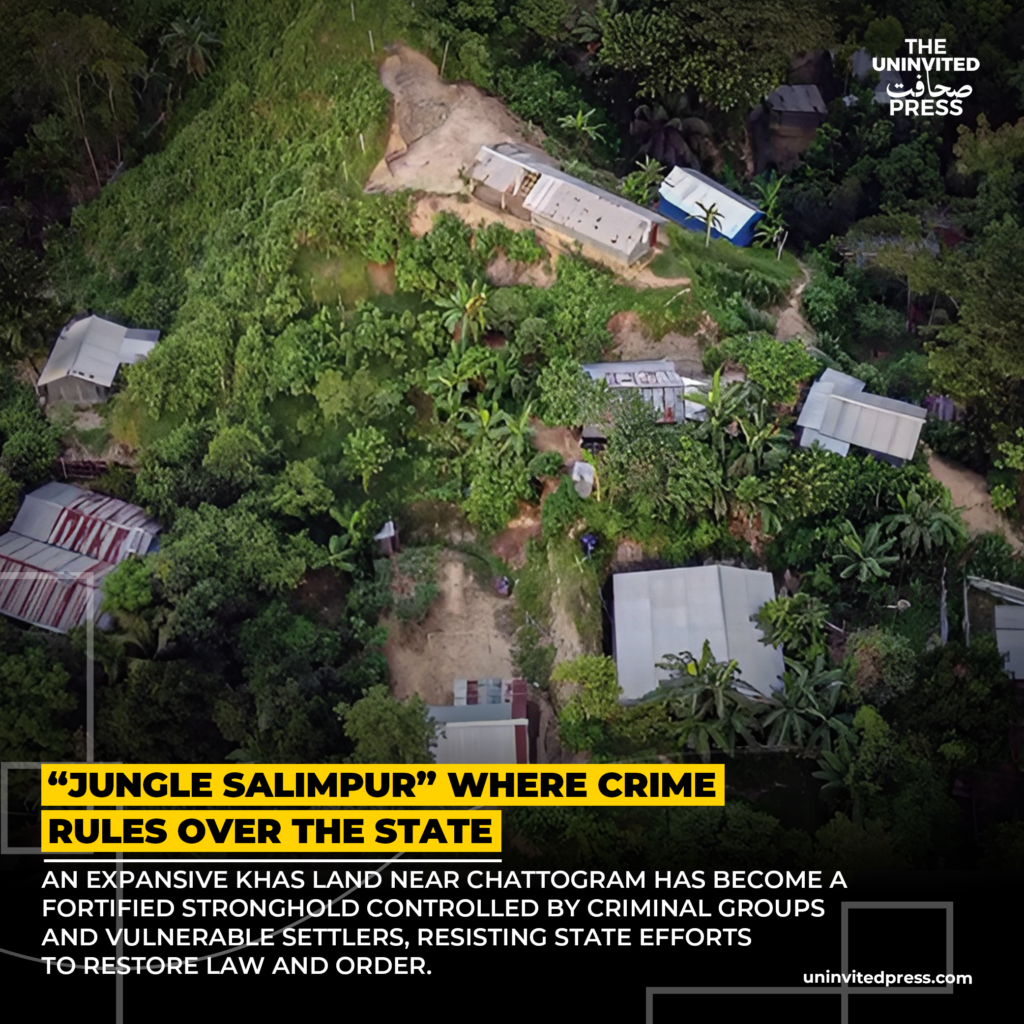
Armed groups and land grabbers turn 3,100 acres of government khas land near Chattogram into a de-facto criminal enclave, resisting law enforcement and blocking state authority.
Inside Jungle Salimpur’s Shadow Rule:
Chattogram, Bangladesh-In the hilly tracts of Jungle Salimpur near Sitakunda, state authority has all but collapsed under the weight of years of illegal settlement, organized crime and armed resistance. Once designated government khas land, the area’s estimated Tk 30,000-crore property has morphed into a fortified stronghold where criminal networks dictate terms, ambushing law enforcement and blocking efforts to restore order. The killing of a Rapid Action Battalion (RAB) officer in January 2026 underlined the severity of the challenge.
Inside Jungle Salimpur: How Illegal Occupation Turned State Land Into a Battleground?
Jungle Salimpur, a rugged hillside of about 3,100 acres of government-owned khas land near Chattogram city, has long been contested territory. Over decades, illegal settlements mushroomed across steep hills and valleys as land grabbers, backed at times by local power brokers and political alignments, occupied swathes of state land.
Authorities say the land was carved up through hill cutting, illicit plot sales and encroachments, turning it into a near-impenetrable zone where armed elements popped up to defend illegal gains. Those elements now maintain checkposts, issue their own IDs for residents, and warn outsiders-including security personnel-to stay away.
Violence has become part of daily dynamics. In mid-January 2026, during an operation to arrest suspected armed criminals, a team from Rapid Action Battalion-7 was ambushed by hundreds of assailants allegedly belonging to local factions when authorized law enforcers entered the area. One RAB officer, Deputy Assistant Director Md Motaleb Hossain Bhuiyan, was killed, and three others critically injured in the attack.
A police case was later filed naming 29 individuals and up to 200 unidentified suspects connected to the attack. Subsequently, three suspects-Yunus Ali, Jahid Hossain and Mohammad Arif-were arrested, and pistols seized that were looted during the clash.
From Khas Land to No-Go Zone: The Making of Jungle Salimpur:
Jungle Salimpur’s transformation into a criminal fortress is not a recent phenomenon. Starting in the 1990s and early 2000s, land speculators and squatters began occupying these hillsides, cutting terrain and selling plots on fraudulent or non-judicial documents. Over time it developed into a self-contained settlement of tens of thousands of people, many of whom are landless migrants seeking affordable housing.
The area’s huge economic value-with land along the Bayezid Link Road fetching high market prices-has become a major driver for ongoing conflict. Attempts by past administrations to install development projects on this land-including parks, IT facilities, and correctional infrastructure-were thwarted as the government never succeeded in regaining control.
Given the steep, forested terrain, law enforcement has often been at a disadvantage, with occupants using geography to gain early warning of entering forces and mounting ambushes. In recent years, police, RAB and journalists have been attacked or repelled during enforcement drives.