

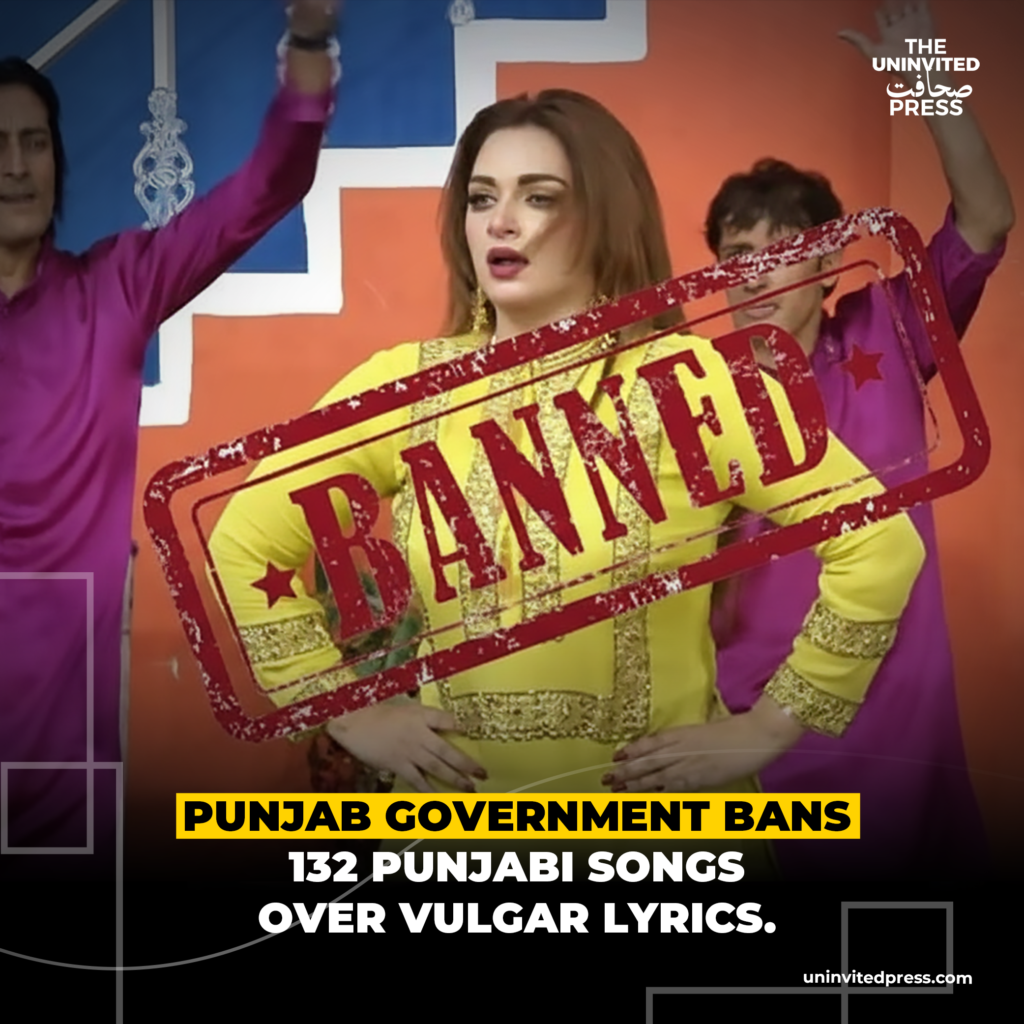
Government enforces strict decency rules, sparking confusion and debate amid Basant revival buzz. Punjab government in Pakistan bans 132 Punjabi songs from theaters for obscene lyrics on January 26, 2026.
Punjab Draws the Line: Song Ban Sparks Culture vs. Censorship Debate:
In a bold push to curb what officials call a slide into vulgarity, the Punjab government has banned 132 Punjabi songs from all theater and stage performances, citing unethical and double-meaning lyrics that violate established guidelines. Announced via a notification from the Punjab Council of the Arts on January 26, 2026, the move has ignited social media firestorms, with initial misconceptions tying it to the upcoming Basant festival revival. This clampdown raises sharp questions about artistic freedom in Pakistan’s vibrant Punjabi entertainment scene, where theater has long been a cultural staple but often criticized for crossing lines into indecency.
The ban targets songs deemed “stains on the name of music,” according to Punjab Information and Culture Minister Azma Bokhari, who emphasized that such content erodes public morality. As Basant-the kite-flying festival returning after an 18-year hiatus-approaches in early February, the timing has fueled speculation, though officials insist the restrictions are limited to professional performances.
Official Order and Public Backlash: How the Song Ban Unfolded?
The ban was formalized through a notification from the Punjab Council of the Arts on January 26, 2026, directing all divisional and district arts council directors, deputy directors, and private theater owners to halt performances of the listed songs. The document, which leaked quickly to media outlets, prohibits these tracks in any theatrical or stage context, citing violations of standard operating procedures established in August 2025.
By January 27, Minister Azma Bokhari addressed the growing uproar in a SAMAA TV interview, clarifying the scope and lambasting the songs’ content. Social media platforms, particularly X, saw viral posts mistakenly claiming the ban extended to Basant celebrations, prompting Bokhari to question, “Where is Basant mentioned in the notification?”
Examples from the banned list, such as “Kundi na kharka Soniya sidha andar aa” and “Aaj khulde aang aang mera ve,” highlight the government’s focus on lyrics perceived as sexually suggestive or vulgar. No full public list was released in the sources reviewed, though partial excerpts circulated online.
Culture, Morality, and Timing: The Deeper Context Behind Punjab’s Song Ban:
This ban is rooted in longstanding concerns over Pakistani theater’s reputation for vulgarity, which Minister Bokhari contrasted with international standards where dance and performance are treated as art forms without descending into indecency. Punjab’s theater scene, especially Punjabi-language productions, has faced criticism for years, with songs often featuring double entendres that appeal to audiences but draw ire from conservative quarters.
The timing coincides with the revival of Basant, banned since 2005 due to deadly kite string accidents but set for a controlled return in Lahore from February 6-8, 2026. While the song ban is officially unrelated, separate police guidelines for Basant include noise restrictions and arrests for loud music, adding to the confusion.
Historically, similar crackdowns have occurred; for instance, in 2022, Indian Punjab restricted songs promoting gun culture, but this Pakistani move focuses on sexual innuendo. The significance lies in balancing cultural expression with societal norms in a province where Punjabi music is a major export, influencing global diaspora communities.