

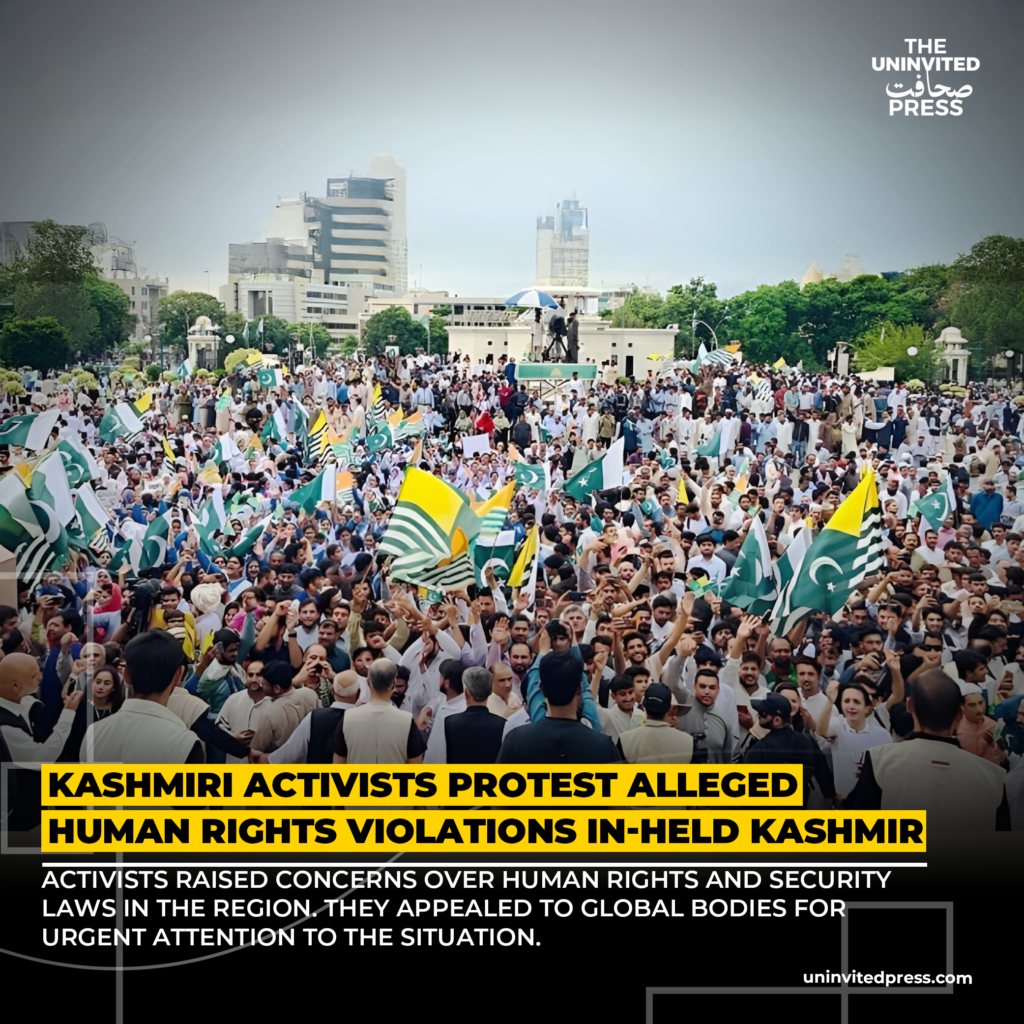
Kashmiri activists in Pakistan protested alleged human rights violations in Indian-administered Kashmir on India’s Republic Day, marking it as ‘Black Day’ with rallies calling for UN intervention in the disputed region.
Kashmir Dispute Rekindled as Republic Day Marked by ‘Black Day’ Protests in Pakistan and AJK:
On January 26, 2026, while India marked its Republic Day with nationwide parades and ceremonies, activists and residents in Pakistan and Azad Jammu and Kashmir (AJK) observed the occasion as a “Black Day.” Protesters gathered in multiple cities to condemn what they describe as ongoing human rights abuses and illegal occupation in Indian-administered Jammu and Kashmir. The rallies, featuring black flags, placards, and speeches, aimed to spotlight the region’s plight and urge international intervention in the decades-old territorial conflict.
These demonstrations underscore the deep divisions over Kashmir, a flashpoint between nuclear-armed neighbors India and Pakistan since 1947. Participants, including Kashmiri refugees and local leaders, reiterated demands for self-determination, framing India’s governance as oppressive and undemocratic.
Black Day Rallies Spread Across Pakistan and AJK, Spotlighting Kashmir After Article 370 Revocation:
The protests unfolded across Pakistan-controlled territories on Monday, January 26, 2026. In Muzaffarabad, the capital of AJK, activists from PHJK staged a sit-in outside the local press club, displaying posters that highlighted alleged family separations, violence against women, and systemic oppression in Indian-administered Kashmir. Similar gatherings occurred in other AJK districts, where large crowds reaffirmed support for the Kashmiri freedom struggle and rejected India’s claims of democracy in the region.
In Lahore, protesters assembled at Azadi Chowk and outside the press club, carrying black flags and 50 posters illustrating claimed atrocities. The event, organized by Kashmir Centre Lahore, included Boy Scouts and drew a cross-section of participants. In Islamabad, the APHC led a demonstration to denounce India’s occupation, marking the day as one of mourning rather than celebration.
Speakers at these events repeatedly referenced India’s August 5, 2019, decision to abrogate Article 370 of its constitution, which revoked the special autonomous status of Jammu and Kashmir. They described this as a turning point that intensified a military siege, imposed curfews, and stripped residents of basic rights. Protesters chanted slogans against Indian forces and displayed messages accusing India of turning the valley into an “open prison” through heavy troop deployments and draconian laws.
The day’s activities remained peaceful, with no reports of clashes or disruptions from Pakistani authorities. Organizers emphasized the symbolic nature of the “Black Day” observance, a tradition dating back years, to counter India’s Republic Day narrative and highlight the unresolved Kashmir issue.
Roots of the Conflict: A Historical Overview and Ongoing Tensions:
The Kashmir dispute traces back to the 1947 partition of British India, when the princely state of Jammu and Kashmir became a contested territory between newly independent India and Pakistan. Both nations claim the region in full but control only parts; India administers about 55% (including Jammu, Kashmir Valley, and Ladakh), Pakistan controls around 30% (AJK and Gilgit-Baltistan), and China holds the remaining 15%.
United Nations Security Council resolutions from 1948 called for a plebiscite to determine the region’s future, allowing residents to choose affiliation with India or Pakistan. However, no such referendum has occurred, leading to three wars between India and Pakistan (1947-48, 1965, 1999) and ongoing skirmishes along the Line of Control (LoC).
India’s 2019 move to integrate Jammu and Kashmir more fully into the union by revoking its semi-autonomous status was hailed domestically as a step toward development and equality but condemned by Pakistan as illegal and unilateral. In the years since, India has held assembly elections in the region, with the first post-2019 polls in 2024 resulting in a government led by the National Conference party. India points to infrastructure projects, tourism growth, and reduced militancy as signs of progress.
Pakistan, meanwhile, views the changes as a violation of international law and UN resolutions, arguing they exacerbate human rights issues. Annual “Black Day” protests on India’s Republic Day have become a fixture, amplifying these claims. The 2026 observances come amid broader regional tensions, including recent unrest in Pakistan-administered Kashmir over economic grievances like electricity prices and subsidies, which have sometimes turned violent.