

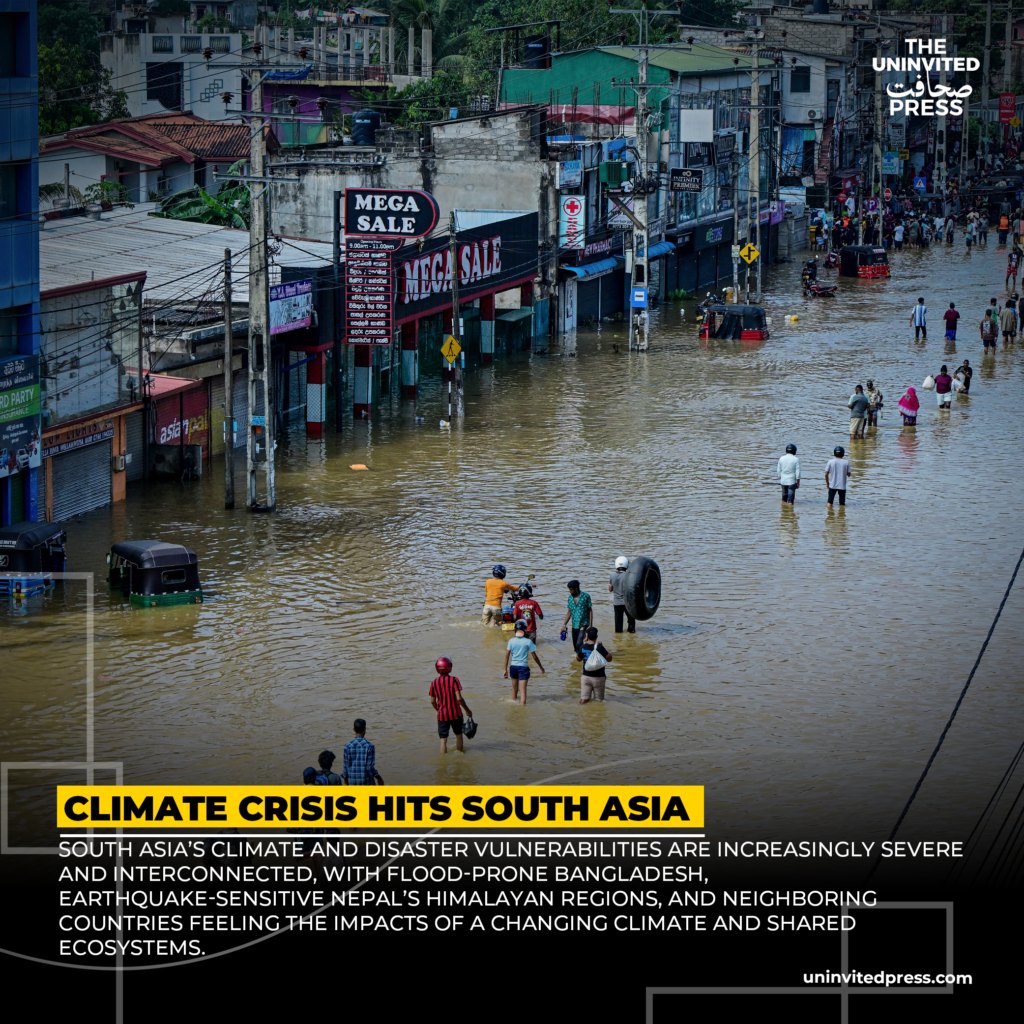
South Asia’s climate disasters-floods in Bangladesh, landslides in Nepal-expose interconnected vulnerabilities in shared Himalayan ecosystems, urging regional action amid rising heat and economic losses.
2025: South Asia's Climate Breaking Point-Floods, Heat, and Borderless Crises:
South Asia’s climate nightmare intensified in 2025, with relentless floods ravaging Bangladesh, Nepal, Pakistan, and India, killing hundreds and displacing millions while amplifying interconnected threats across borders. From Bangladesh’s salinity-choked coasts to Nepal’s quake-prone Himalayas, these events reveal how shared rivers and melting glaciers are fueling a cascade of crises. The stakes are dire: economic devastation, mass migration, and ecosystem collapse threaten the region’s future, urging swift adaptation before it’s too late.
South Asia's Climate Disasters in Numbers and Human Cost:
The year 2025 marked a brutal escalation in South Asia’s climate ordeal. In Bangladesh, flash floods in July submerged vast areas of Feni, Noakhali, and Lakshmipur districts, affecting nearly 78,000 people in Feni alone and triggering outbreaks of diarrhea and skin infections. By late August, another wave hit southeastern regions, stranding over 582,000 families and damaging critical infrastructure like roads and bridges. Nationwide, floods claimed 71 lives, destroyed 296,852 hectares of cropland, and caused USD 121.6 million in fisheries losses. Salinity intrusion worsened, spiking hypertension cases in coastal zones.
Nepal faced similar havoc. In October 2025, severe floods and landslides in eastern regions, including Darjeeling in India, killed at least 50 people and damaged over 16,000 homes. Pakistan endured deadly monsoon floods from June to August, claiming over 700 lives, with Buner district hit hardest. Sri Lanka suffered from Cyclone Ditwah in November, killing more than 600 and devastating the entire island. India and Afghanistan grappled with droughts and reduced snowfall, signaling broader water crises.
These disasters unfolded against a backdrop of extreme heat. South Asia warmed faster than the global average in 2025, with nearly 90% of the population at risk of extreme heat by 2030. Heatwaves in April-May disrupted education for 33 million children in Bangladesh, some losing up to eight weeks of school.
South Asia at the Climate Crossroads: Interlinked Risks in a Rapidly Warming Region:
South Asia has long been a hotspot for climate vulnerabilities, but 2025’s events highlight how interconnections amplify risks. The region’s geography-dense populations, monsoon-dependent agriculture, and shared river systems like the Ganges, Brahmaputra, and Indus-makes it uniquely exposed. Himalayan glaciers, melting at double the 1990s rate, feed these rivers, causing glacial lake outburst floods (GLOFs) like the 2023 Sikkim event. This “Third Pole” supports 2 billion people downstream, but warming threatens water security, agriculture, and energy.
Historically, South Asia has endured major disasters: the 1970 Bhola cyclone killed 500,000 in Bangladesh, while the 2005 Kashmir earthquake claimed 86,000 lives. But climate change is intensifying frequency and severity. IPCC reports confirm Asia warms nearly twice as fast as the global average, driving more glacial overflows, flash floods, and landslides. Biodiversity hotspots like the Western Ghats and Sundaland face shifts in ecosystems, with coral reefs and forests at risk.
Economic tolls are staggering. South Asia could lose up to 10% of GDP by mid-century from climate impacts. In 2025, floods alone caused USD 3 billion in annual losses for Bangladesh. Pollution-related deaths hit 1.7 million in India in 2022, a trend worsening with fossil fuels.