

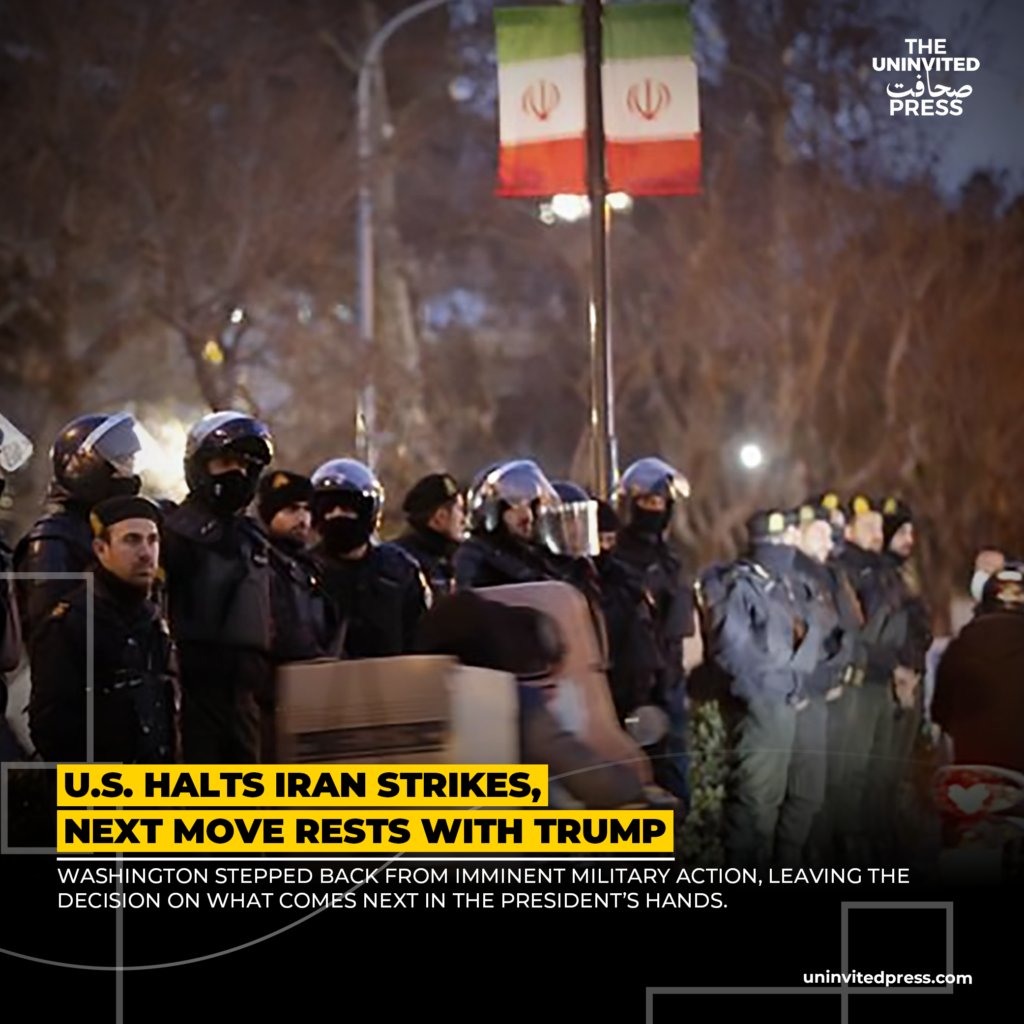
US halts military strikes on Iran after Tehran cancels protester executions, but President Trump keeps options open amid ongoing crackdown and heightened Middle East tensions.
Trump Holds Fire on Iran Strikes After Tehran Halts Mass Executions:
The United States has stepped back from imminent military strikes against Iran following reports that Tehran canceled hundreds of planned executions of protesters. President Donald Trump, who had warned of swift action amid a deadly suppression of nationwide demonstrations, credited the halt for his decision to hold off, stating he has assurances that “the killing has stopped.” This development, unfolding in mid-January 2026, eases immediate fears of escalation but leaves the door open for future U.S. intervention, spotlighting the volatile U.S.-Iran relations under Trump’s second term.
Trump's Dramatic Pivot on Iran: Execution Cancellation Triggers Strike Hold:
In a tense White House briefing on January 15, 2026, President Trump told reporters he had decided against immediate military action against Iran, pointing to Tehran’s decision to cancel planned mass executions. “I greatly respect the fact that all scheduled hangings, which were to take place yesterday (over 800 of them), have been cancelled by the leadership of Iran,” Trump posted on Truth Social, adding a thank you to the regime.
The sequence began escalating on January 10, when Trump was briefed on military options following reports of Iran’s violent response to protests. Demonstrations, sparked by economic woes including high inflation and unemployment, had spread nationwide by late December 2025. Human rights groups reported nearly 500 deaths by January 11, with authorities imposing internet blackouts to stifle coordination.
On January 13, Trump posted on social media: “HELP IS ON ITS WAY,” fueling speculation of imminent strikes. The next day, U.S. military evacuated some personnel from al-Udeid Air Base in Qatar, and the Pentagon confirmed additional forces were being deployed to the Middle East. Sources indicated Trump met with national security advisors in the Situation Room, where options for targeted strikes were discussed.
By January 15, however, Iran signaled de-escalation. Foreign Minister Araghchi stated on Fox News that Tehran had “no plan to execute protesters.” White House Press Secretary Karoline Leavitt confirmed to reporters that Iran had halted 800 executions following U.S. warnings. Trump, in Oval Office remarks, said he had it “on good authority” that killings had ceased, though he offered no verification details.
Iran also reopened its airspace on January 16, a move seen as reducing immediate tensions. No U.S. strikes occurred, but Trump emphasized that military options remain active, stating, “We’re not ruling out potential military action going forward.”
Maximum Pressure, Maximum Risk: Trump's Iran Legacy and the 2026 Breaking Point:
These events build on years of U.S.-Iran antagonism, amplified during Trump’s presidencies. In his first term, Trump ordered the 2020 drone strike killing Iranian General Qasem Soleimani, prompting Iranian missile attacks on U.S bases. His “maximum pressure” campaign included withdrawing from the 2015 nuclear deal and imposing sanctions that crippled Iran’s economy.
Tensions boiled over in 2025. In June, after the International Atomic Energy Agency declared Iran in breach of nonproliferation commitments, Israel launched strikes on Iranian nuclear sites in Operation Rising Lion. The U.S. followed with Operation Midnight Hammer, bombing facilities in a 12-day conflict that ended with a Trump-brokered ceasefire. Iran emerged weakened, with its nuclear program set back but not destroyed.
The current protests echo the 2022-2023 unrest following Mahsa Amini’s death, but are driven more by economic despair amid sanctions and mismanagement. By December 2025, demonstrations had turned violent, with protesters calling for the regime’s downfall. Trump’s threats reflect his administration’s focus on human rights as a lever against Tehran, though critics argue it’s selective given alliances with other authoritarian states.