

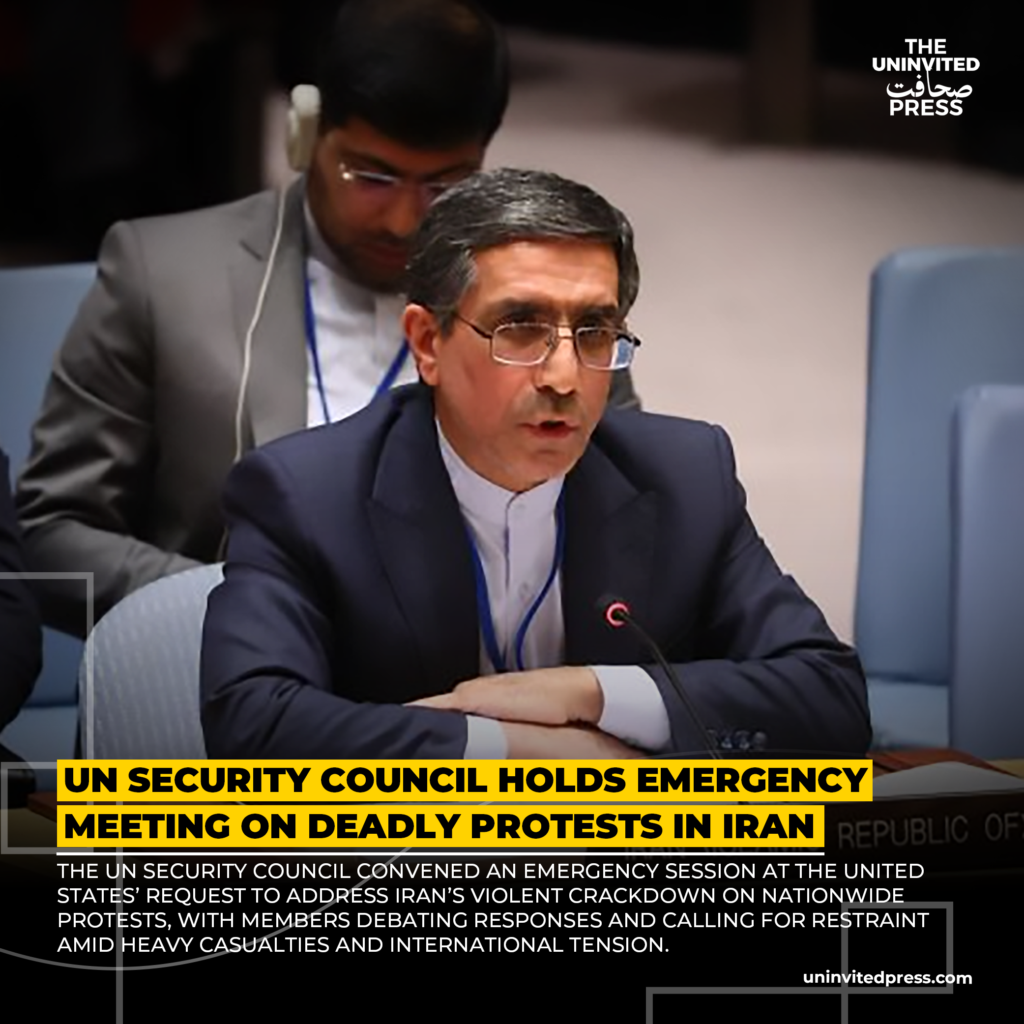
UN Security Council emergency meeting on January 15, 2026, addresses Iran’s crackdown on protests killing over 2,000 since December 2025, with US threats and calls for accountability.
UN Emergency Clash: Security Council Confronts Iran's Deadly Protest Crackdown:
The United Nations Security Council gathered in an emergency meeting on January 15, 2026, in New York City, at the urgent request of the United States, to confront Iran’s violent suppression of widespread protests that erupted in late December 2025. With human rights organizations estimating at least 2,000 deaths amid a sweeping crackdown, the session saw heated exchanges between U.S. and Iranian representatives, underscoring fears of escalation into a broader international crisis. This development exposes the deepening instability in Iran, where economic collapse has fueled demands for systemic change, potentially reshaping regional dynamics and challenging global efforts to curb human rights abuses.
From Bazaar Shutdown to Bloodshed: How Iran's Protests Exploded into Nationwide Uprising:
Protests ignited on December 28, 2025, in Tehran’s Grand Bazaar, where shopkeepers shuttered businesses amid skyrocketing costs and currency freefall. What began as localized economic grievances rapidly escalated into nationwide demonstrations, spreading to cities like Isfahan, Mashhad, Shiraz, and Ahvaz by early January 2026. Protesters chanted against corruption, poverty, and the clerical leadership, marking a shift from reform demands to outright calls for regime change.
The turning point came on January 3, 2026, when Supreme Leader Ali Khamenei labeled demonstrators “rioters” in a televised address, signaling a green light for intensified repression. Security forces, including the Islamic Revolutionary Guard Corps (IRGC) and Basij militia, responded with live ammunition, tear gas, and arbitrary detentions. By January 8, reports of mass killings emerged, with eyewitness accounts describing indiscriminate gunfire on crowds.
A near-total internet blackout imposed around January 8 hampered communication, but leaked videos and smuggled reports revealed overflowing morgues and hospitals. Rights groups documented shootings in residential areas, assaults on medical facilities to arrest the wounded, and the use of high-tech surveillance to target activists. As of January 16, arrests topped 10,000, with thousands injured.
The UN Security Council meeting on January 15 followed mounting global pressure. Convened at U.S. insistence, it featured briefings on the humanitarian toll, including child casualties and warnings against executions for protesters.
Roots of Rage: Decades of Economic Collapse Fuel Iran's Unprecedented Uprising:
Iran’s protests are rooted in decades of economic mismanagement, exacerbated by U.S. sanctions reimposed under former President Trump in 2018 and maintained thereafter. Inflation hit 52% in 2025, the rial lost 70% of its value since 2022, and unemployment soared to 12%, per World Bank data. Food prices doubled in months, pushing 40% of Iran’s 89 million people below the poverty line.
This wave echoes prior uprising: The 2019 fuel price protests, where 1,500 were killed, and the 2022 Mahsa Amini movement against mandatory hijab laws, claiming over 500 lives. Unlike those, the 2025-2026 unrest combines economic fury with political defiance, drawing in diverse groups from bazaar merchants to students and ethnic minorities in Kurdish and Baluch regions.
The crackdown’s scale-described by Amnesty International as “unprecedented”-has drawn comparisons to the 1979 Islamic Revolution’s chaos. A communications blackout, lasting over a week, mirrors tactics used in 2019 but on a larger scale, limiting global scrutiny. Regionally, Iran’s weakened proxies in Syria and Lebanon, following Israeli strikes in late 2025, have left the regime isolated, amplifying internal vulnerabilities.
The crisis’s significance lies in its potential to destabilize the Middle East. A prolonged uprising could strain Iran’s nuclear ambitions, invite foreign intervention, and inspire similar movements in authoritarian states. Globally, it tests the UN’s ability to enforce human rights amid veto powers held by permanent members like Russia and China, allies of Tehran.