

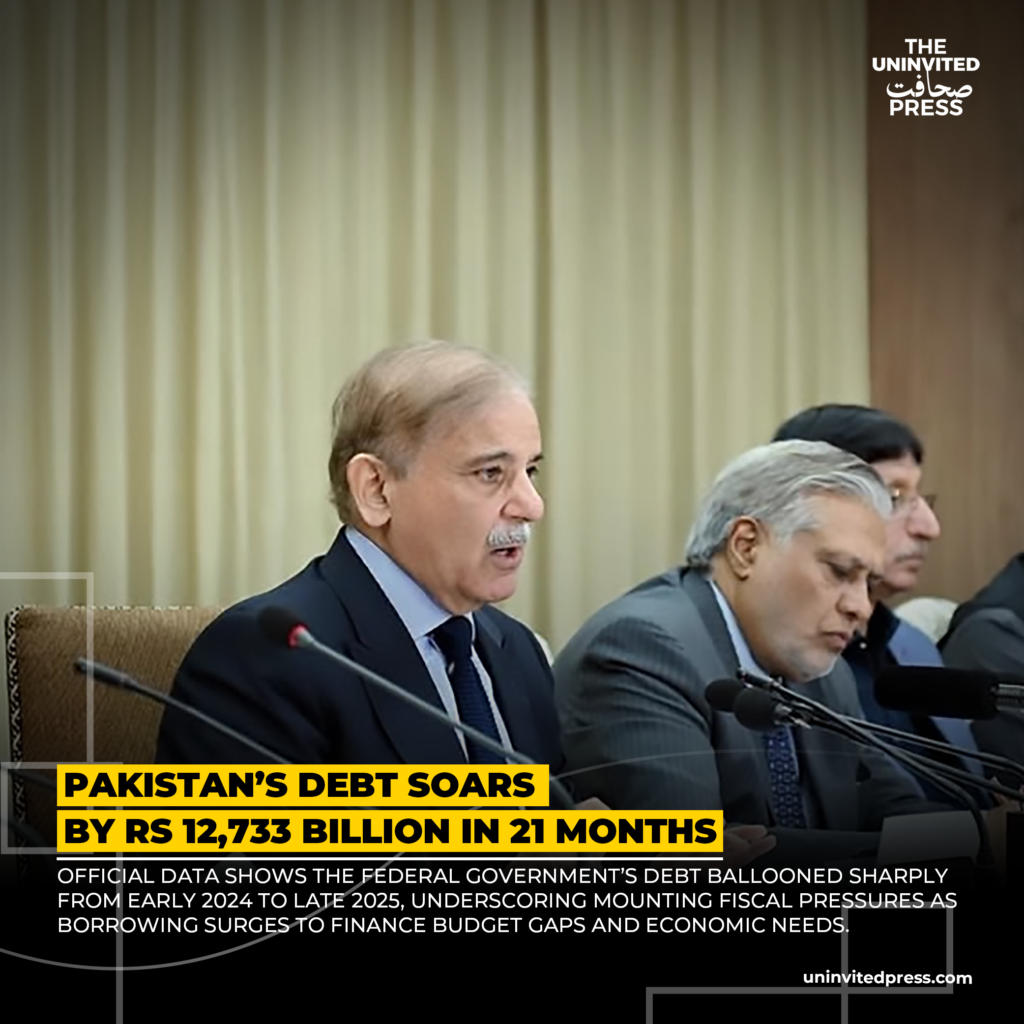
Pakistan’s federal debt surges Rs 12,733 billion in 21 months to Rs 77,543 billion by Nov 2025, amid IMF bailouts and economic strains-raising sustainability concerns.
Pakistan's Debt Bomb: Rs 12,733 Billion Added in Just 21 Months:
Pakistan’s federal government debt has skyrocketed by Rs 12,733 billion over just 21 months, climbing from Rs 64,810 billion in February 2024 to Rs 77,543 billion by November 2025, according to official State Bank of Pakistan data. This massive surge, driven largely by domestic borrowing to plug budget deficits and meet economic demands, highlights the nation’s precarious fiscal health amid high inflation, sluggish growth, and reliance on international bailouts. As debt repayments loom large, the increase raises alarms about sustainability, potentially burdening ordinary Pakistanis with higher taxes and reduced public services in a country already grappling with poverty and unemployment.
Sharif's 21-Month Debt Spiral: Rs 12.7 Trillion Jump Amid Fiscal Firefighting:
The debt escalation began shortly after Shehbaz Sharif assumed office for his second stint as prime minister in March 2024, following national elections and the end of a caretaker administration. At the close of the caretaker period in February 2024, federal debt totaled Rs 64,810 billion. By November 2025, it had ballooned to Rs 77,543 billion, marking a 19.6% increase over the period.
Domestic borrowing accounted for the lion’s share, rising by Rs 11,943 billion as the government tapped local banks and markets to fund operations. External debt, denominated in foreign currencies, grew more modestly by Rs 790 billion, influenced by disbursements from multilateral lenders like the International Monetary Fund (IMF) and the Asian Development Bank (ADB).
Monthly data from the SBP shows a steady climb: Debt hit Rs 76,970 billion in October 2025 before edging up to Rs 77,543 billion in November. This pattern reflects ongoing fiscal pressures, including subsidies, defense spending, and development projects amid a depreciating rupee and import needs.
The 21-month timeline aligns precisely with Sharif’s administration, which inherited an economy reeling from floods, political instability, and global commodity shocks. Official reports indicate the government borrowed heavily to avert default, securing a $3 billion IMF standby arrangement in 2023 that was extended into 2024-2025.
Pakistan's Endless Debt Cycle: Historical Roots and the Latest Explosive Growth:
Pakistan’s debt woes are not new, rooted in decades of structural imbalances. The nation’s external debt has hovered around $130-135 billion in recent years, with total public debt (including federal and provincial) reaching Rs 80.6 trillion by June 2025-equivalent to about 70% of GDP. This ratio has fluctuated, peaking at 91% in 2020 during the COVID-19 pandemic before easing slightly.
Historically, debt spikes have coincided with political transitions and economic crises. Under the previous Imran Khan government (2018-2022), external debt rose from $52.4 billion to $75.3 billion, a 44% jump, driven by current account deficits and currency devaluation. The Sharif administration’s recent surge builds on this, exacerbated by high interest rates-Pakistan’s benchmark rate hit 22% in 2023-2024-and energy sector arrears topping Rs 5 trillion.
Debt servicing now consumes over 50% of the federal budget, crowding out investments in health, education, and infrastructure. With 40% of Pakistan’s 240 million people living in poverty, this borrowing cycle perpetuates inequality, as higher taxes and inflation hit the vulnerable hardest. Globally, Pakistan ranks among frontier markets with rapid debt accumulation, alongside Kenya and Romania, per the Institute of International Finance. The rupee’s 30% depreciation since 2022 has inflated external debt costs, while remittances and exports provide some buffer but fall short.