

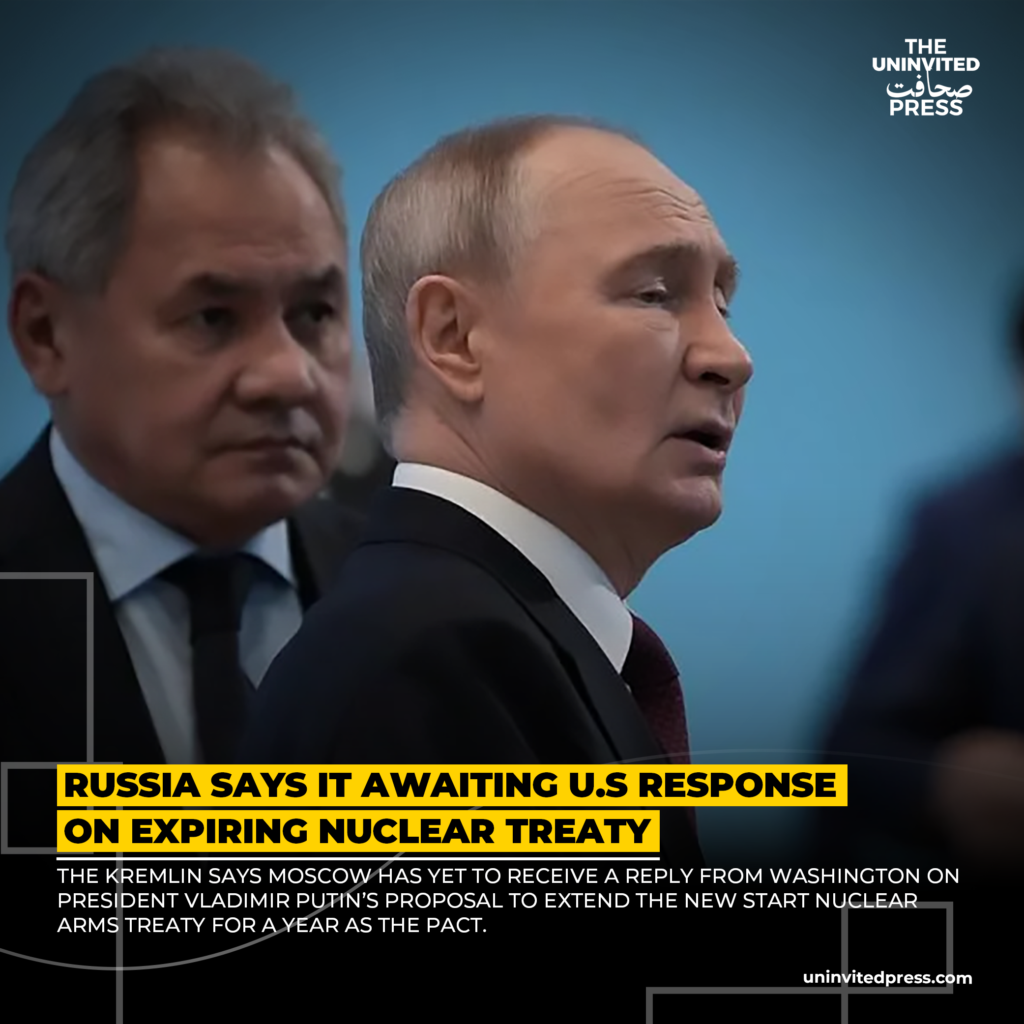
As New START nears its February 2026 expiration, Russia awaits U.S. response to Putin’s extension proposal, risking a nuclear arms race and global instability.
Russia Still Waiting: U.S. Yet to Respond on Saving the Last Nuclear Arms Deal:
Moscow is still waiting for a formal reply from the United States to President Vladimir Putin’s offer to informally extend the key provisions of the New START nuclear arms treaty for one year, as the pact-the final barrier against an unconstrained arms race between the world’s nuclear superpowers-approaches its expiration on February 5, 2026. With global tensions already strained by conflicts in Ukraine and elsewhere, the treaty’s lapse could usher in a dangerous era of uncertainty, eroding decades of hard-won stability and heightening the risk of miscalculation. This development underscores the fragility of international arms control at a time when nuclear threats loom larger than ever.
The Rise, Suspension, and Last-Ditch Bid to Save New START:
The New Strategic Arms Reduction Treaty, or New START, has been a cornerstone of U.S-Russia relations since it was signed in Prague in 2010 by then-Presidents Barack Obama and Dmitry Medvedev.
It entered into force in 2011, imposing verifiable limits on deployed intercontinental ballistic missiles (ICBMs), submarine-launched ballistic missiles (SLBMs), and heavy bombers equipped for nuclear armaments. Both nations met the treaty’s central limits by 2018, with regular data exchanges and on-site inspections ensuring compliance.
Tensions escalated in February 2023 when Putin announced Russia’s suspension of participation, citing Western support for Ukraine as a breach of the treaty’s spirit. Russia clarified it would continue abiding by the numerical caps but halted inspections and consultations. The U.S. State Department deemed this “irresponsible and unlawful,” finding Russia non-compliant since 2022 for refusing inspections and data sharing. In retaliation, Washington implemented countermeasures, including withholding U.S. treaty data and denying Russian inspections.
Fast-forward to September 2025: During a Security Council meeting, Putin proposed that both countries mutually observe New START’s central limits for one year post-expiration, provided the U.S. refrains from actions that “undermine or disrupt the existing balance of deterrence.” This informal extension would cap deployed forces at 700 launchers, 1,550 warheads, and 800 total launchers, buying time for potential future talks.
On January 15, 2026, Peskov told reporters in Moscow that no response had been received from Washington, emphasizing the topic’s importance. With the treaty’s end just weeks away, the silence from the Trump administration has amplified concerns about a post-New START world.
From Cold War Peaks to Today's Brink: The Legacy and Fragile Future of Nuclear Arms Control:
New START is the last vestige of a long line of Cold War-era arms control agreements that began with the 1972 Strategic Arms Limitation Talks (SALT) and evolved through START I (1991) and START II (1993). These pacts dramatically reduced nuclear stockpiles from Cold War peaks-over 30,000 warheads for the U.S. alone in the 1980s-to today’s constrained levels. The treaty’s significance lies in its role as a stabilizing force: It provides transparency through 42 bi-annual data exchanges and up to 18 annual inspections, reducing the risk of surprise buildups or accidental escalations.
The current impasse reflects broader geopolitical strains. Russia’s 2022 invasion of Ukraine shattered trust, leading to the 2023 suspension. Meanwhile, China’s nuclear expansion-projected to reach over 1,000 warheads by 2030-complicates bilateral U.S-Russia dynamics, as Beijing has resisted joining arms control talks. Without New START, experts warn of a potential three-way arms race, with emerging technologies like hypersonics adding instability. The treaty’s lapse would mark the first time since 1972 that no binding limits exist on U.S. and Russian strategic forces, potentially costing billions in new deployments and eroding global non-proliferation efforts ahead of the 2026 Nuclear Non-Proliferation Treaty review.