

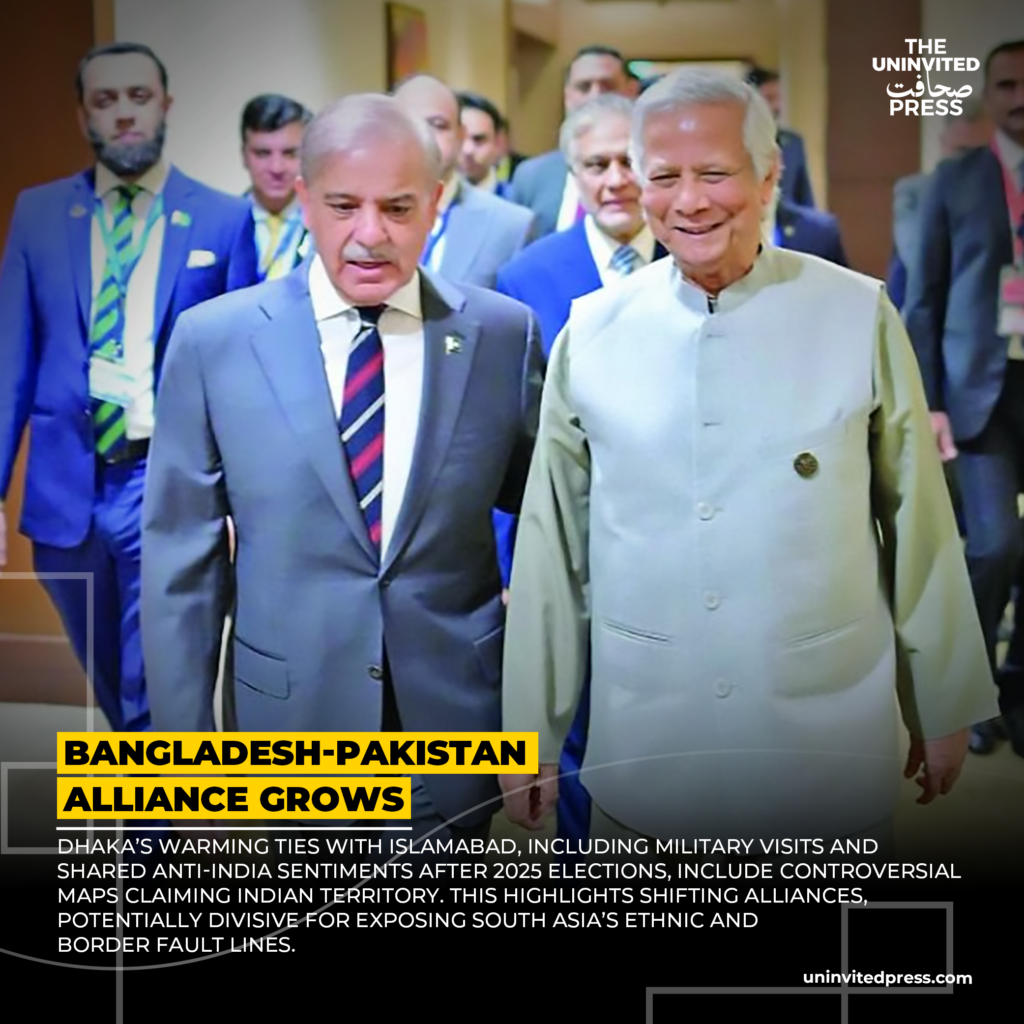
As Dhaka pivots from New Delhi under interim leader Muhammad Yunus, warming ties with Islamabad—including defense talks and high-level exchanges-heighten regional tensions and redraw geopolitical lines.
Bangladesh & Pakistan Unite: 2025 Shift Challenges India’s Regional Power:
In a marked departure from decades of strained relations, Bangladesh and Pakistan have accelerated diplomatic and military engagements throughout 2025, culminating in multiple high-level visits and discussions on defense cooperation. This resurgence, fueled by shared anti-India sentiments following Sheikh Hasina’s 2024 ouster, challenges India’s regional dominance and raises alarms over potential new alliances involving China. With Bangladesh’s elections looming in February 2026, this budding partnership could destabilize borders, escalate ethnic divisions, and disrupt economic ties, impacting millions across South Asia who rely on stable cross-border trade and security.
The 2025 Pivot: How Bangladesh and Pakistan Rebuilt Ties in Record Time:
The thaw began shortly after Sheikh Hasina’s government fell in August 2024 amid student-led protests. By early 2025, Pakistani officials initiated outreach. In January, Pakistan’s ISI Director General Maj Gen Shahid Amir Afsar visited Dhaka for intelligence talks, marking one of the first high-level engagements. This was followed by a meeting between Bangladesh’s Lt Gen S.M. Kamrul Hassan and Pakistan’s Gen Asim Munir. Throughout the year, four high-level Pakistani military and intelligence visits occurred, including Gen Sahir Shamshad Mirza’s trip.
Civilian diplomacy ramped up too. On September 25, 2025, Sharif and Yunus met at the UN General Assembly in New York, discussing trade, connectivity, and people-to-people ties. They reconvened in December at the D-8 Summit in Cairo, reinforcing commitments to stronger bilateral relations. November saw army-to-army talks in Rawalpindi, covering training and industrial collaboration. Bangladesh expressed interest in Pakistan’s JF-17 Thunder jets as part of its Forces Goal 2030 modernization plan.
Practical steps included resuming direct Dhaka-Karachi flights in December 2025 and easing visa restrictions. Bangladesh also joined Pakistan’s multinational naval exercise Aman-25. Amid these, anti-India rhetoric has surged. Bangladeshi media and officials have highlighted border killings and trade barriers, while some reports note controversial maps in Bangladesh claiming Indian territory.
Border Blood, Public Opinion, and Power Plays: The Roots and Risks of Bangladesh's New Alliances:
Bangladesh and Pakistan’s history is rooted in the 1971 Liberation War, where Bangladesh gained independence from Pakistan with India’s support, leading to decades of frosty ties. Under Hasina (2009-2024), Dhaka aligned closely with New Delhi, fostering a “Golden Era” of cooperation on security, trade, and infrastructure.
Hasina’s ouster amplified longstanding grievances: border violence (over 300 killed in 2024 unrest), economic dependencies, and perceived Indian interference. Surveys show 75% of Bangladeshis view China positively, 59% Pakistan, but only 11% India.
Yunus’s interim government seeks diversification, turning to Pakistan and China-Bangladesh’s top arms supplier (70% of imports 2010-2020). This trilateral nexus, including potential trans-Himalayan corridors linking Chittagong to Gwadar, undermines Indian projects like the India-Myanmar-Thailand Highway.
For Pakistan, facing economic woes and India tensions, this offers strategic depth. Anti-India sentiment unites them; Pakistan’s PML-N has threatened support for Bangladesh in any conflict.
It fragments South Asia’s geopolitics, risks ethnic violence (e.g., attacks on minorities in Bangladesh), and threatens India’s access to its northeast via the Siliguri Corridor. Human impact includes displaced families from border clashes and economic losses from disrupted trade.