

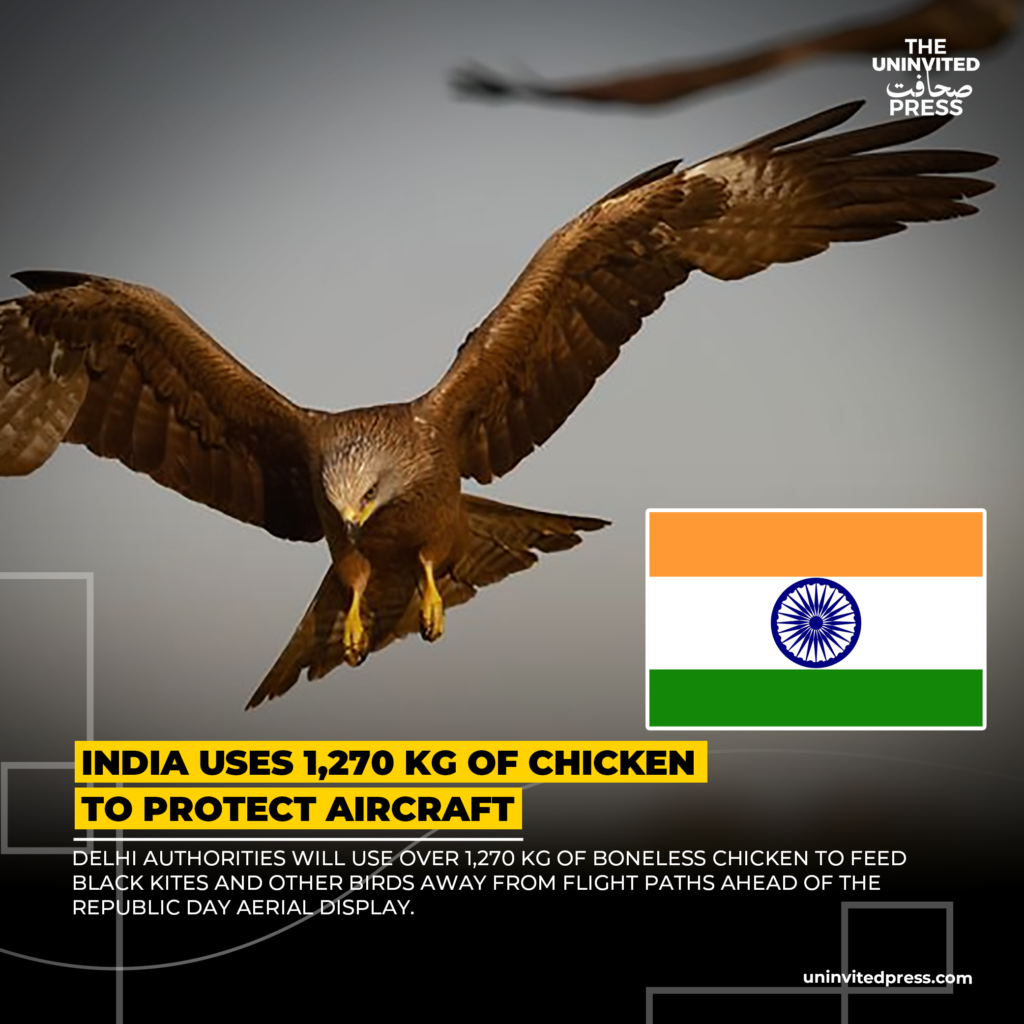
Forest officials switch to boneless chicken bait to lure black kites away from aircraft paths, ensuring a safe aerial spectacle on January 26, 2026.
1,275 Kg of Chicken to Safeguard Republic Day Skies:
In a unique blend of wildlife management and national security, Delhi’s Forest Department is set to scatter over 1,275 kilograms of boneless chicken across designated spots to divert black kites and other raptors from interfering with the Republic Day aerial display. This annual ritual, ramping up in the days leading to January 26, 2026, highlights the ongoing battle against bird strikes that could endanger pilots and planes during India’s grand patriotic showcase. With the switch from traditional buffalo meat to chicken this year, the strategy underscores innovative efforts to balance ecology and event safety in one of the world’s most bird-dense urban skies.
The Chicken-Fed Kite Diversion Operation:
Preparations for India’s 77th Republic Day celebrations are in full swing, but behind the pomp of parades and military displays lies a lesser-known operation; a targeted feeding program to manage Delhi’s avian population. Starting January 15, 2026, forest department teams will deploy from high-rise buildings around the city, tossing chunks of boneless chicken to attract black kites-large raptors notorious for soaring in urban thermals.
The initiative, confirmed by department officials, involves procuring and distributing approximately 1,275 kilograms of meat over 10 days. This equates to about 150 kilograms daily, strategically placed at 15-20 feeding sites far from the flight paths used by Indian Air Force jets during rehearsals and the main flypast on January 26. The meat is sourced from licensed vendors and handled under hygiene protocols to avoid attracting stray animals.
This year’s twist: a shift from buffalo meat, used in previous years, to chicken. Officials cited easier availability and reduced risk of disease transmission, though exact reasons weren’t detailed in statements. The operation builds on a proven method that has minimized bird-related incidents during past events, with teams monitoring bird movements via binoculars and coordinating with air traffic control.
No major disruptions have been reported in recent Republic Days due to birds, but the threat remains real-Delhi’s skies host thousands of black kites, drawn by open garbage dumps and thermals. In 2025, similar efforts used around 1,200 kg of meat, successfully diverting flocks without ecological harm.
The Hidden Battle for Safe Skies:
Republic Day, marking the adoption of India’s Constitution on January 26, 1950, is the nation’s premier display of military might and cultural heritage. The aerial component, featuring formations by fighter jets like Sukhoi Su-30s and Rafales, draws millions of eyes but carries inherent risks from bird strikes-a global aviation hazard that has caused crashes worldwide.
In Delhi, black kites thrive in urban environments, numbering in the tens of thousands. These birds, with wingspans up to 1.5 meters, pose a collision threat to low-flying aircraft. The feeding strategy emerged in the early 2010s as a humane alternative to culling or scaring tactics, inspired by falconry and baiting methods used at airports globally.
The approach not only safeguards the event but also supports bird conservation-kites play a vital role in controlling rodent populations. This year’s chicken substitution aligns with broader shifts; in 2024, concerns over avian flu prompted similar reviews. The operation costs around ₹2-3 lakh annually, funded by the forest department’s budget.