

Asia’s emerging economies dominate enrolments, injecting billions into education amid policy shifts and economic strains.
Asia’s Big Five Own 57% of Australia’s International Students-China & India Dominate the Map:
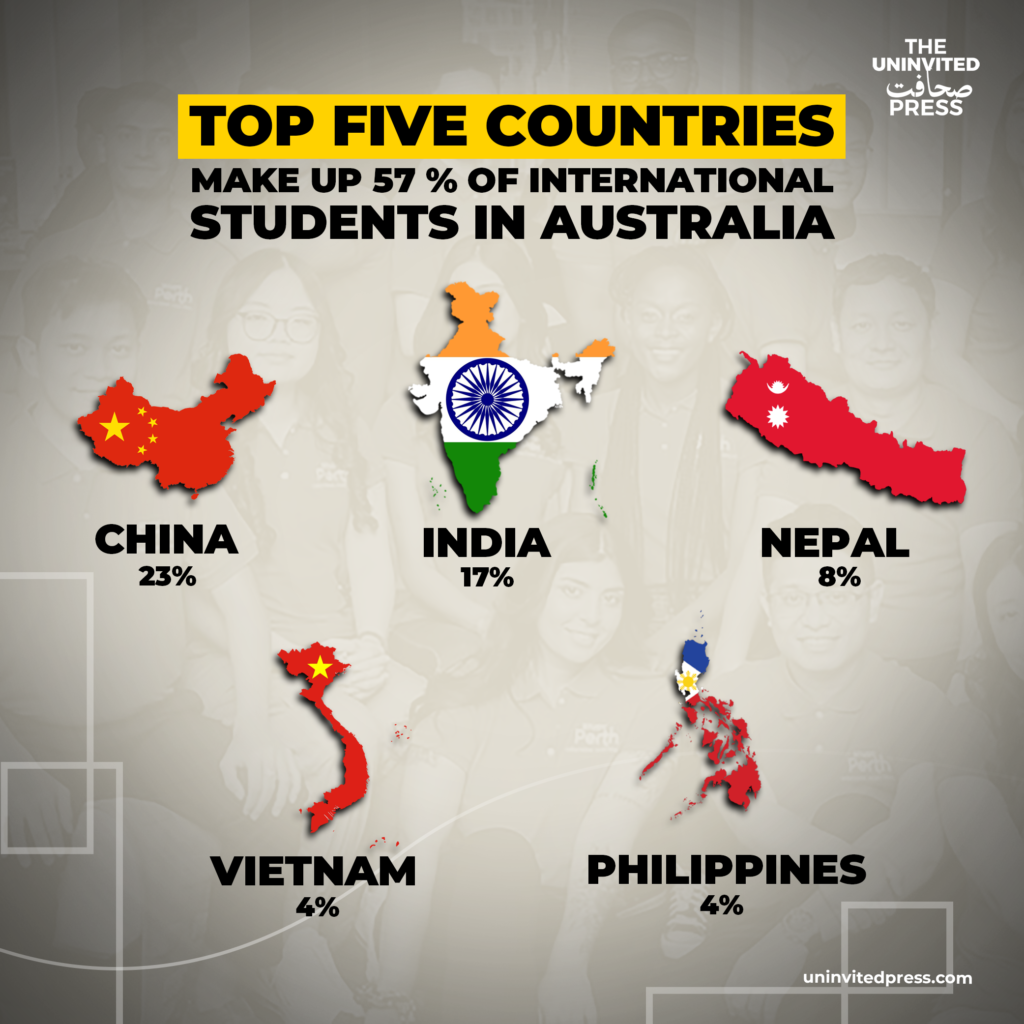
Five countries-China, India, Nepal, Vietnam, and the Philippines-account for 57% of Australia’s international students, with China alone representing 23% and India 17%, according to the latest federal data for year-to-date October 2025. This concentration highlights the sector’s reliance on Asian markets, fueling a $51.5 billion export industry that rivals mining giants. But as visa caps and housing pressures mount, this dominance raises urgent questions about diversification and sustainability in a post-pandemic landscape.
The Top Five Breakdown: 833,041 Students, 57% from Just Five Flags:
The Australian Department of Education’s monthly summary for year-to-date October 2025 reveals a clear pattern: 833,041 international students are studying across the nation, with a heavy skew toward five Asian countries. China tops the list at 23% (approximately 191,599 students), followed by India at 17% (141,617), Nepal at 8% (66,643), and both Vietnam and the Philippines at 4% each (33,322). Together, they comprise 57% of the cohort.
Breaking down further, the top 10 nationalities round out with Colombia (4%, 33,322), Indonesia (3%, 24,991), Brazil (3%, 24,991), Thailand (3%, 24,991), and Malaysia (2%, 16,661)-figures derived from total enrolments and percentages in official reports. This data, based on student visa holders and provider reports, shows a 0.3% dip in overall student numbers from 2024, while new starters fell 15% to 190,799 amid tighter visa processing.
The timeline traces back to a post-COVID surge: enrolments peaked at over 835,000 in 2024, rebounding from pandemic lows. By mid-2025, policies like Ministerial Direction 107-prioritizing low-risk providers-and higher financial requirements began curbing growth. October 2025 data marks the first full period under these measures, with declines most pronounced in vocational education and training (VET) sectors popular among Nepalese and Indian student.
One Continent, Five Power Players: How Australia Became Dependent on a Handful of Asian Markets?
Australia’s international education sector has ballooned since the 1980s, when policies shifted from aid-focused to market-driven models. By the 2010s, it became the nation’s third-largest export, valued at $40 billion pre-COVID. The pandemic halved numbers in 2020-2021, but reopenings in 2022 triggered a boom, with Asian students leading the recovery due to proximity, cultural ties, and Australia’s reputation for high-quality, English-taught programs.
China’s dominance stems from its massive middle class seeking global credentials; India’s from rapid economic growth and a youth bulge chasing STEM opportunities. Nepal, Vietnam, and the Philippines contribute through affordable pathways, often in VET and English courses, with migration prospects as a draw. This concentration-over half from five nations-mirrors historical patterns but amplified post-2022, when China eased zero-COVID and India overtook as the fastest-growing source.
Significance is profound; beyond $51.5 billion in 2024 revenue, students support 250,000 jobs and enrich campuses. Yet over-reliance risks shocks, as seen in 2019’s China tensions or 2023’s India-Canada spat. Current policies aim to mitigate housing strains from rapid inflows, but critics warn of economic fallout.