

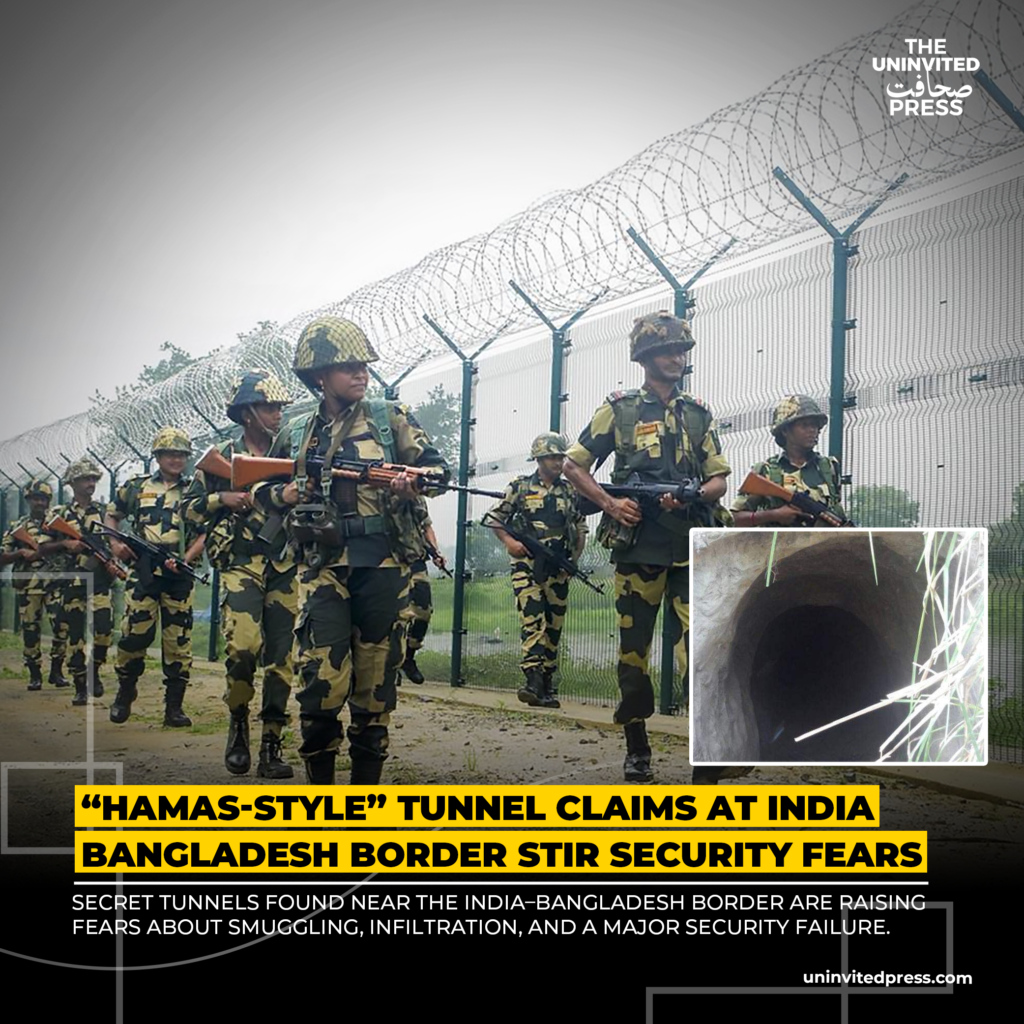
Discovery of underground passages in West Bengal revives alarms over smuggling, infiltration, and border vulnerabilities amid Bangladesh’s political shifts. Claims of “Hamas-style” tunnels along the India-Bangladesh border in West Bengal fuel fears of smuggling and infiltration, with social media and analysts highlighting security lapses.
Explosive social media claims of “Hamas-style” secret tunnels linking Indian territory in West Bengal to Bangladesh have ignited widespread alarm about potential smuggling, illegal infiltration, and major security failures along the porous 4,096-km border. These allegations, circulating widely since late December 2025, draw parallels to sophisticated underground networks used by militants elsewhere, raising stakes for national security at a time of heightened tensions following Bangladesh’s 2024 political upheaval. While older confirmed discoveries involve bunkers for narcotics and past cattle-smuggling tunnels, the latest unverified reports underscore persistent vulnerabilities despite fencing efforts.
Timeline of Discoveries and Claims:
The narrative exploded in late December 2025 when viral videos and posts described a tunnel allegedly running from a house bedroom in West Bengal’s South 24 Parganas or Kulatali village directly to Bangladesh, used daily for bringing in “infiltrators.” Social media amplified these as “Hamas-style,” implying sophisticated, militant-level engineering for covert crossings.
However, verified incidents trace back earlier. On January 26, 2025, BSF uncovered three large underground bunkers-each 15 feet deep, brick-walled with metallic covers and locks-in Majhdia, Nadia district, just 2 km from the border. These contained 62,200 bottles of Phensedyl (codeine-based cough syrup) worth ₹1.4 crore, with a fourth under construction. Officials linked them to narcotics smuggling networks exploiting the border.
Historical precedents include an 80-metre tunnel discovered in April 2017 near Chopra-Fatehpur outpost in North Dinajpur, suspected for cattle smuggling under the fence. Similar finds occurred in 2021 in Assam’s Karimganj (a 200-metre passage during an abduction probe). These were often basic, dug to evade detection after fencing reduced surface crossings.
The “Hamas-style” label appears in opinion pieces and social media from December 2025, comparing them to Gaza’s complex networks, but no official sources confirm militant engineering or intent in recent West Bengal cases.
A Porous Frontier Under Pressure:
India and Bangladesh share one of the world’s longest borders, much of it riverine and flood-prone, complicating full fencing-79% completed by late 2025. The border has long facilitated smuggling (cattle, narcotics like Phensedyl/methamphetamine) and illegal migration, with 1,104 infiltration attempts and over 2,550 Bangladeshi detentions in 2025, the highest in nearly a decade.
Tensions escalated after Bangladesh’s 2024 uprising and regime change, which some analysts link to rising radicalisation concerns. This has amplified fears of cross-border threats, especially in West Bengal’s border districts. Political debates rage over state-central coordination, with accusations that local policies hinder fencing. The BSF has intensified patrols and uses advanced tech like ground-penetrating radar elsewhere (primarily Indo-Pak), but eastern challenges persist due to terrain and bilateral dynamics.
These discoveries highlight the human impact: smuggling fuels crime and addiction, while infiltration strains resources and demographics in border states.