

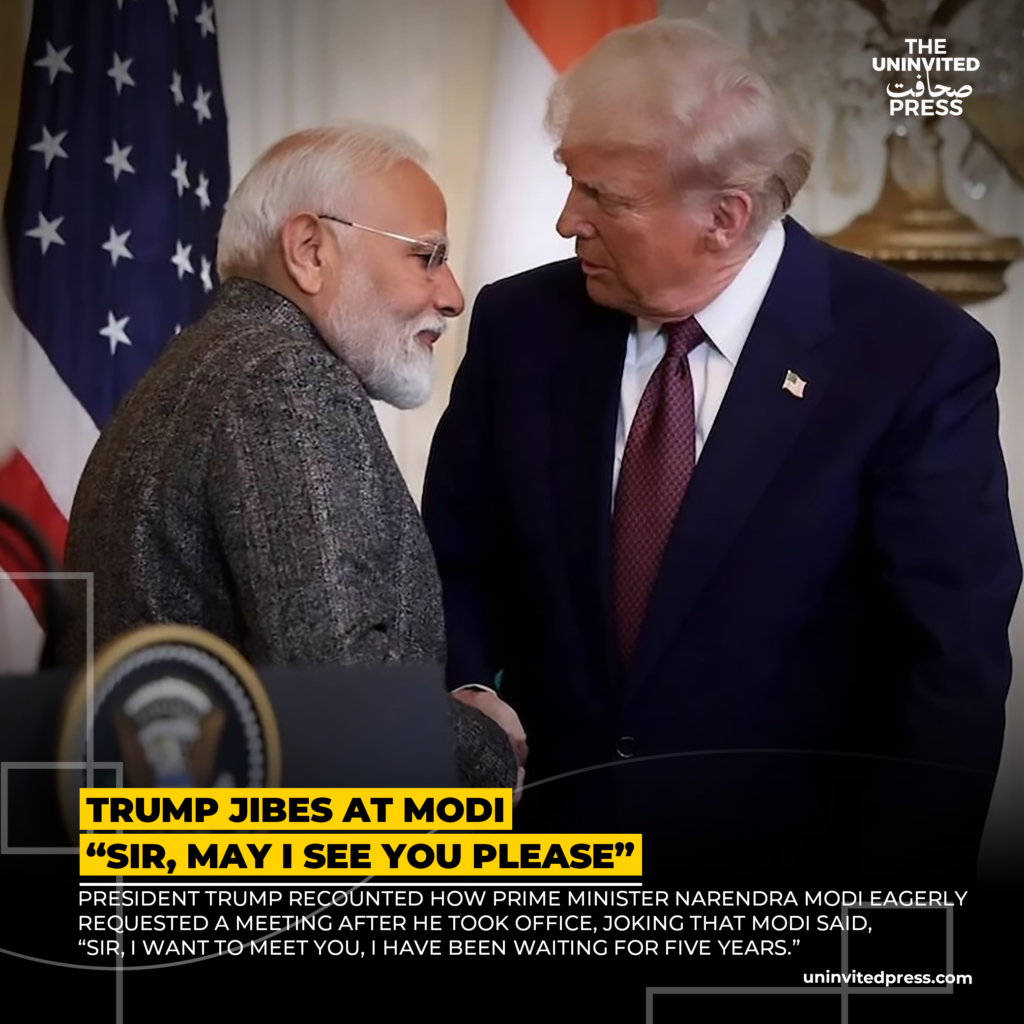
President Trump recounts Indian PM’s eager plea amid escalating U.S.-India trade tensions over Russian oil.
INCIDENT:
In a candid speech at a Republican retreat, U.S. President Donald Trump took a playful swipe at Indian Prime Minister Narendra Modi, mimicking his request for a meeting shortly after Trump’s inauguration. The remarks, delivered on January 7, 2026, highlight ongoing friction over tariffs tied to India’s Russian oil imports, even as Trump praised their relationship. This exchange underscores the high stakes in U.S.-India ties, where defense deals and trade imbalances could reshape bilateral dynamics amid global energy shifts.
FULL STORY:
President Donald Trump’s latest remarks on Indian Prime Minister Narendra Modi have stirred debate, blending humor with pointed commentary on trade and defense. Speaking at the House GOP Members’ Retreat on January 7, 2026, Trump described a post-inauguration interaction with Modi, imitating the Indian leader’s approach: “Prime Minister Modi came to see me. [He said] ‘Sir, may I see you, please?’ Yes.”
Trump framed the anecdote around India’s order for Apache attack helicopters from the U.S., claiming the country had waited five years for delivery. “India ordered 68 Apaches, and Prime Minister Modi came to see me. Sir. May I see you, please? Yes,” he said. He added that Modi expressed frustration over delays: “I mean, I had India coming to me, sir. I’ve been waiting five years; we’re changing it. We’re changing it.”
The timeline aligns with Modi’s visit to the White House on February 13, 2025, just weeks after Trump’s January 20, 2025, inauguration. Official readouts from that meeting confirm discussions on trade disparities and defense cooperation, with Trump noting agreements to negotiate imbalances. A prior phone call on January 27, 2025, set the stage, where the leaders reportedly discussed strengthening ties.
However, Trump’s specific claims about the helicopter order require scrutiny. Official records show India contracted for 28 AH-64E Apache helicopters from Boeing, not 68: 22 for the Indian Air Force in a 2015 deal worth $2.1 billion, with deliveries completed by March 2020, and an additional six for the Indian Army in 2020, inducted by 2023. Sources from India’s defense ministry and U.S. export records confirm no larger order exists. The five-year wait Trump mentioned may refer to bureaucratic delays in earlier phases, but deliveries occurred during his first term and under subsequent administrations.
Shifting to trade, Trump acknowledged strains: “I have a very good relationship with him. He’s not that happy with me because, you know, they’re paying a lot of tariffs now.” This refers to U.S. tariffs imposed on India for continuing Russian oil purchases amid the Ukraine conflict. In August 2025, the U.S. enacted a 25% ad valorem duty on select Indian imports like garments and chemicals, pushing total tariffs to 50% on affected goods. Trump has warned of further hikes, supporting a bipartisan bill-the Sanctioning Russia Act-that could impose up to 500% penalties on nations buying Russian energy.
Data from India’s commerce ministry and global trackers like Kpler show India has since reduced Russian oil imports by over 30% from peak levels in 2023-2024, dropping from 40% of total crude to around 25% by late 2025. U.S. officials credit tariffs for this shift, though Indian refiners cite market diversification as a factor.
CONTEXT & BACKGROUND:
U.S.-India relations have evolved rapidly since Trump’s return to office, building on a foundation laid during his first term. Modi and Trump share a history of high-profile engagements, including the 2019 “Howdy Modi” rally in Houston and the 2020 “Namaste Trump” event in Ahmedabad. These spectacles symbolized a strategic partnership aimed at countering China, with defense sales reaching $25 billion since 2008.
The current tensions trace back to Russia’s 2022 invasion of Ukraine. India, a traditional buyer of discounted Russian crude, ramped up imports to stabilize domestic energy prices amid global volatility. This drew U.S. ire, leading to the 2025 tariffs under the International Emergency Economic Powers Act (IEEPA). Trump’s administration views these measures as leverage to isolate Russia economically, while India balances energy security with Western alliances like the Quad (U.S., India, Japan, Australia).
The Apache deal exemplifies broader U.S.-India defense ties. The helicopters, equipped for anti-tank and reconnaissance roles, bolster India’s capabilities along borders with Pakistan and China. Delays in past orders stemmed from technology transfer negotiations and production backlogs at Boeing, not directly tied to Trump’s policies.
Higher tariffs could hit India’s $150 billion annual exports to the U.S., affecting sectors like textiles and pharmaceuticals. Conversely, reduced Russian oil reliance might deepen U.S.-India energy cooperation, including LNG deals. Analysts at think tanks like the Carnegie Endowment note this as a test of Modi’s “multi-alignment” foreign policy, navigating great-power rivalries without alienating key partners.