

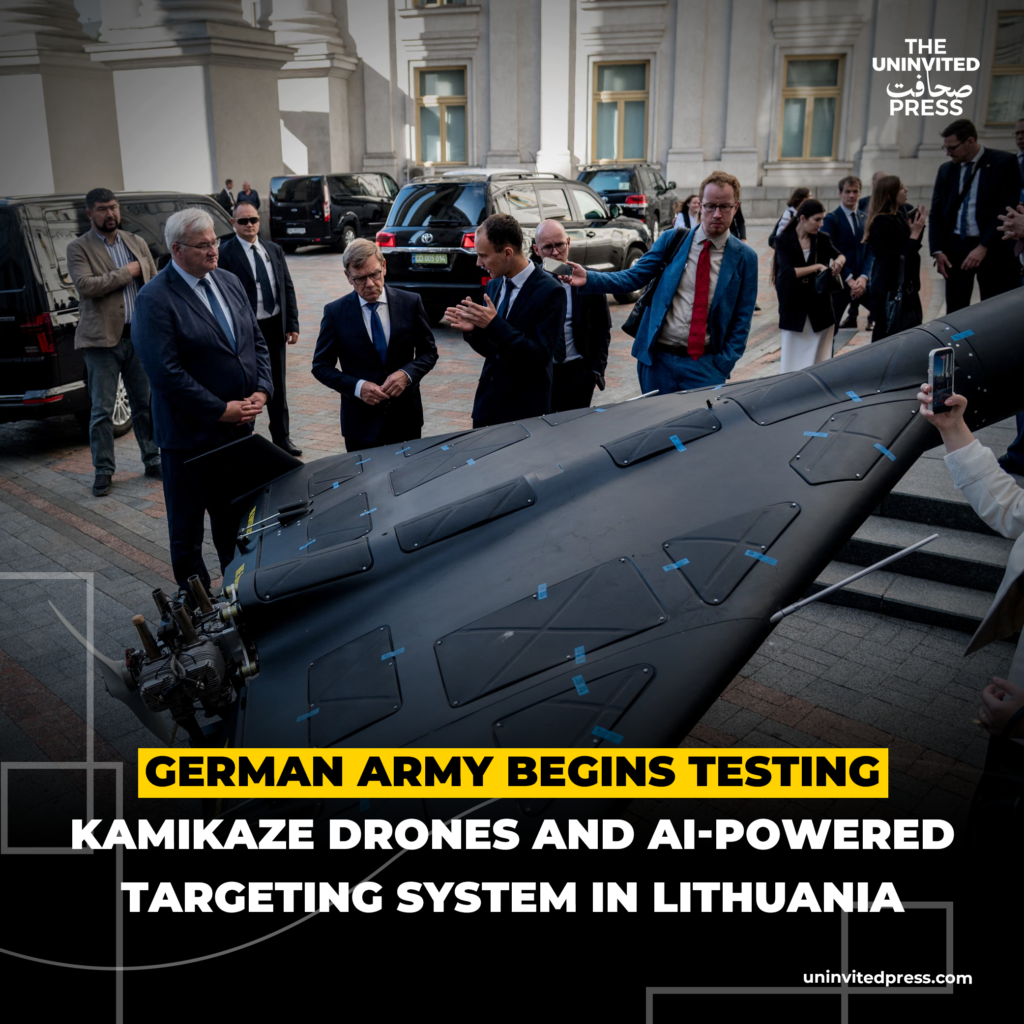
Trials near Belarus border mark major step in Berlin’s military modernisation and permanent NATO deployment.
Germany’s army has begun its first tactical tests of kamikaze drones, also known as loitering munitions, during military exercises in Lithuania, alongside trials of an artificial intelligence-powered targeting system. The drills took place at the Rudninkai training ground near the Belarusian border as part of the Freedom Shield exercise, the largest German military manoeuvre held in the Baltic country to date.
On Sunday, army chief Lieutenant General Christian Freuding observed loitering munitions produced by German defence firms Helsing and Stark, fitted with inert warheads, strike main battle tanks. The systems, including Helsing’s HX-2 and Stark’s Virtus, can loiter over an area before diving onto a target. Days earlier, German troops tested Helsing’s Clarity software, an AI tool designed to process large volumes of data from satellites, drones and other sensors faster than human operators, analyse the information and recommend potential actions.
Freuding, who previously oversaw German arms deliveries to Ukraine and is due to become chief of defence in February, described both the drones and the AI systems as “indispensable” for modern warfare. Germany only approved the purchase of loitering munitions in 2025 after years of political and ethical debate over acquiring weapons that explode on impact. Similar single-use drones have been extensively used by both Russia and Ukraine in the ongoing war.
NATO Tests Drones in Lithuania:
The tests form part of Freedom Shield, which has brought together around 3,800 personnel from eight NATO countries. They come as Berlin prepares to permanently station an armoured brigade of approximately 5,000 troops in Lithuania by the end of 2027-the first such long-term combat deployment by Germany since the Second World War. The Panzerbrigade 45 will be based at Rudninkai and Rukla and is expected to receive the new drone systems once fully operational.
The location of the trials, close to the border with Belarus, underscores NATO’s focus on reinforcing its eastern flank amid heightened tensions with Russia. NATO officials have warned of potential Russian military activity in the coming years, while Moscow has accused the alliance of expanding its presence and stoking confrontation. Germany’s rapid rearmament drive, accelerated by Russia’s full-scale invasion of Ukraine in 2022, has seen a sharp rise in defence spending and the development of unmanned and AI-enabled capabilities.
Germany Tests AI-Powered Weapons:
The introduction of AI into targeting decisions raises broader questions about the future of warfare. Clarity is designed to accelerate the “sensor-to-shooter” cycle by filtering vast amounts of battlefield data and suggesting courses of action, potentially reducing the time between detection and engagement. Critics of autonomous and semi-autonomous systems have long warned of risks related to accountability, error and the lowering of thresholds for the use of force, though German officials emphasise that human operators retain control.
Berlin’s move reflects a wider European shift towards greater military readiness and technological sophistication on NATO’s eastern borders. As Germany expands its permanent footprint in the Baltics and integrates loitering munitions into its forces, the tests in Lithuania signal both a practical preparation for high-intensity conflict and a deeper entanglement in the security dynamics of the region.