

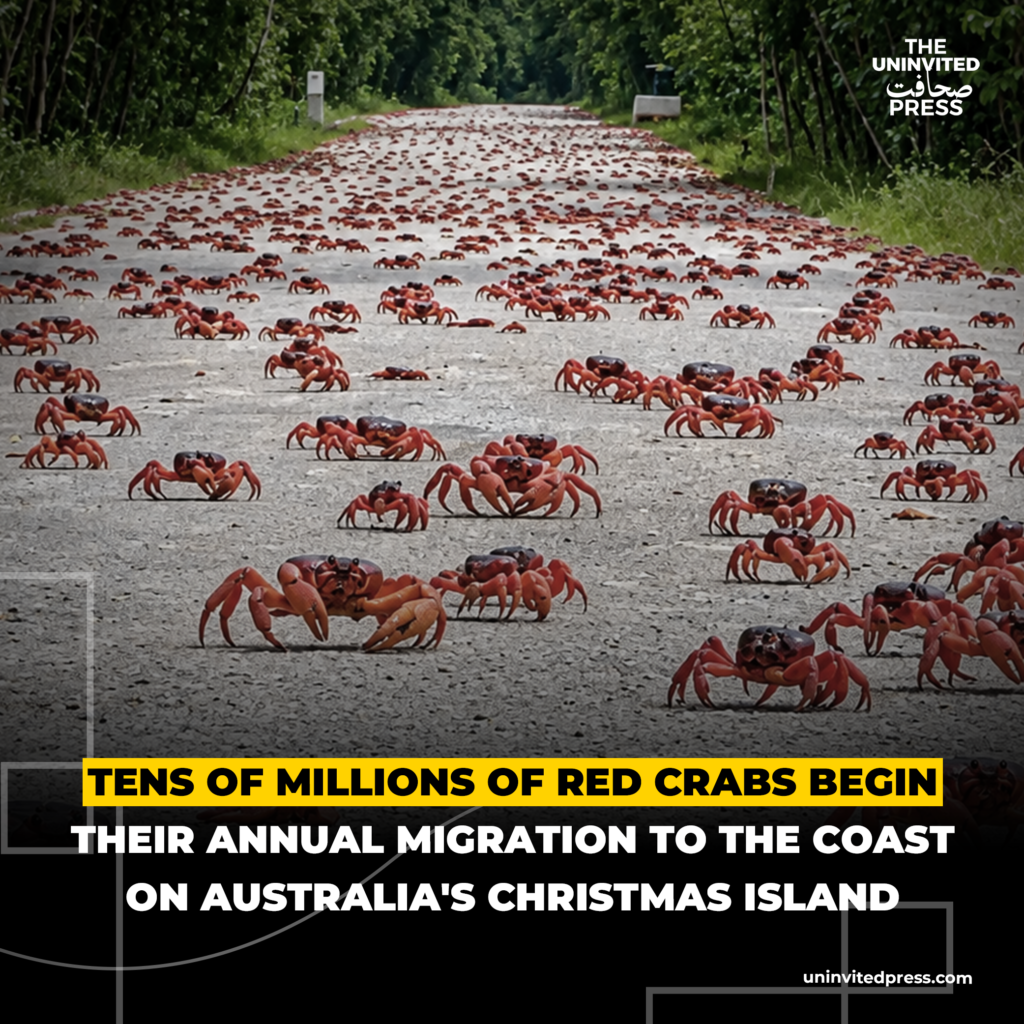
Wet-season rains trigger mass movement from rainforest to coast as crabs time breeding with the lunar cycle.
Tens of millions of bright red crabs have begun their annual pilgrimage across Australia’s Christmas Island, carpeting roads, forests and specially built crossings in one of the natural world’s most striking mass movements.
The migration, which started in mid-November 2026 following the first heavy rains of the wet season, sees the island’s endemic red crabs, Gecarcoidea natalis, leave their rainforest burrows and head toward the Indian Ocean shoreline to breed. Estimates put the total population at more than 100 million, with tens of millions typically participating in the journey each year.
Christmas Island’s Red Crab Migration Draws Global Attention:
Christmas Island, a remote Australian territory lying about 2,600 kilometres northwest of Perth, becomes a living river of red during the event. Male crabs lead the way, digging burrows near the coast. Females follow, mate, and later release their eggs into the sea. Each female can carry up to 100,000 eggs. The timing is remarkably precise: the crabs aim to spawn before dawn on a receding high tide during the last quarter of the moon.
Parks Australia, which manages Christmas Island National Park, has spent months preparing. Rangers clear underpasses, maintain kilometres of roadside barriers, and operate a five-metre-high “red crab bridge” that allows the animals to cross busy roads safely. Temporary road closures are common, and staff sometimes use rakes and other tools to guide crabs away from danger. Daily livestreams from the bridge have been made available so people around the world can watch the spectacle.
The phenomenon has long fascinated scientists and visitors. Naturalist Sir David Attenborough once described witnessing the migration as one of the greatest moments of his television career. For island residents, the crabs are both a defining feature of daily life and a keystone species that shapes the forest floor by consuming leaf litter and aerating the soil.
Red Crab Migration Continues on Christmas Island:
While the migration is a celebrated natural event, it is not without risks. Crabs face hazards from vehicles, heat and dehydration if conditions turn dry. Conservation efforts have helped the population recover in recent years after earlier declines linked to invasive species and other pressures. The return of large numbers of juvenile crabs in some seasons has further bolstered numbers.
Spawning windows later in the season remain possible depending on rainfall and lunar phases, with dates around early December and January also listed as potential periods. For now, the island’s roads and forests continue to pulse with the steady, determined movement of millions of crimson crustaceans making their way to the sea.
The annual red crab migration remains one of the most accessible and visually extraordinary wildlife events on Earth, offering a vivid reminder of the intricate links between rainfall, lunar cycles and the survival of an entire island ecosystem.